
If a Korean person asks whether you have eaten five minutes after saying hello, they may not be inviting you to dinner.
At first, the question can be oddly confusing.
You meet a Korean friend after work.
“밥 먹었어?”
Have you eaten?
You glance at the clock. Seven p.m. Maybe they are asking because they want dinner.
So you answer honestly.
“Yeah, I had a sandwich around four.”
And then the conversation moves on.
No restaurant recommendation.
No discussion of what you ate.
No dinner invitation.
So what, exactly, were they asking?
The answer has less to do with food than the English translation suggests. In Korean, 밥 먹었어? (bap meogeosseo?) can be a genuine question about a meal. Depending on who is speaking and the circumstances, it can also be a warm check-in—a way of asking whether someone is doing all right without saying How are you?
Food is simply where the conversation begins.
It Isn’t Always a Question About Food
The first thing to know is that 밥 먹었어? does not have one fixed meaning.
Sometimes it really means:
“Have you eaten?”
If someone is about to have lunch with you, they may simply want to know whether you are hungry.
But sometimes the food barely matters.
A parent calls an adult child.
“밥 먹었어?”
A friend messages after a long day.
“밥 먹었어?”
A relative sees you after several weeks.
“밥은 먹고 지내냐?”
The words have barely changed.
The feeling behind them can.
Are you doing okay?
Are you taking care of yourself?
Have you been eating properly?
How have you been?
That does not mean Koreans hear 밥 먹었어? and mentally translate it as How are you?
They do not.
The phrase has simply become one of the ordinary ways people show interest in someone else’s well-being.
Why “Bap” Means More Than Rice
There is a small detail hidden inside the phrase.
밥 (bap) literally refers to cooked rice, but in everyday Korean it can also mean a meal.
That distinction matters.
When a Korean says:
밥 먹었어?
they are not necessarily asking whether you ate a bowl of plain rice.
Bap can stand for the meal itself, a usage that reflects how closely food and shared meals are woven into everyday Korean life. Korea.net likewise describes bap as carrying meanings beyond cooked rice, including communal sharing, and notes its use in greetings.
Koreans say:
- 밥 먹었어? — Have you eaten?
- 밥 먹자. — Let’s eat.
- 밥 한 끼 하자. — Let’s have a meal sometime.
- 내가 밥 살게. — I’ll buy you a meal.
- 밥 잘 챙겨 먹어. — Make sure you eat properly.
Food appears in these everyday expressions not simply because everyone has to eat, but because sharing food is one of the most familiar ways of maintaining a relationship.
A Question Can Be a Greeting
That helps explain why someone might ask “Have you eaten?” when food is not really the subject.
English greetings often begin with statements or broad questions:
“Hi.”
“How are you?”
“How’s it going?”
Korean has those too.
But Korean also has a long-standing habit of using ordinary questions as greetings.
“Where are you going?”
“Have you eaten?”
“Are you going home?”
The questions do not always call for a detailed answer.
That distinction matters.
밥 먹었어? is not simply a mistranslated version of “How are you?”
It is its own Korean expression.
The words ask about food.
The situation tells you what the question is doing.
So Why Did Food Become the Language of Care?
One popular explanation reaches back to periods when food was less secure than it is today. In that context, asking whether someone had eaten could have been a genuinely practical question about their well-being.
If someone had eaten, they had food.
They were getting by.
They were okay.
As living conditions changed, the immediate urgency of the question faded. The expression remained.
That explanation is useful, but it should not be mistaken for a neat origin story. There is no single documented moment when Koreans collectively decided that Have you eaten? would become a greeting.
What we can say with more confidence is how the phrase works today: food provides a familiar, socially comfortable way to show concern.
That is why the question can still make sense even when the person asking already knows you have plenty to eat.
The question survived.
The circumstances changed.
The feeling remained useful.
The meal is sometimes the subject. The person is often the real subject.
The Same Question Can Sound Completely Different
Context matters enormously.
Consider three versions:
| Korean | Romanization | Typical context | Feeling |
|---|---|---|---|
| 밥 먹었어? | bap meogeosseo? | Close friends, family | Casual and familiar |
| 밥 먹었어요? | bap meogeosseoyo? | Polite everyday conversation | Warm and respectful |
| 식사하셨어요? | siksa hasyeosseoyo? | Older people, respected adults | More formal and respectful |
The important part is not memorizing three expressions.
It is understanding who is speaking to whom.
A close friend might casually say:
밥 먹었어?
An older relative might ask:
밥은 먹고 지내냐?
A more respectful version might be:
식사하셨어요?
The vocabulary and grammar shift with the relationship, as they do throughout Korean.
So if you are learning Korean, 밥 먹었어요? is certainly worth recognizing.
But do not rush out and start asking everyone you meet:
밥 먹었어요?
Korean greetings are shaped by familiarity, age, social relationship, and context.
From someone you know, the question can feel warm.
From a complete stranger, it can feel unexpectedly personal.
What Happens When Someone Says It to You?
This is where many Korean learners overthink things.
If someone asks:
밥 먹었어요?
you do not need to give them a restaurant review.
A simple:
네, 먹었어요.
Yes, I ate.
is perfectly normal.
Or:
아직 안 먹었어요.
I haven’t eaten yet.
Sometimes that second answer leads somewhere.
A coworker asks around lunchtime:
밥 먹었어요?
Maybe they are simply checking whether you have eaten.
Maybe they are about to ask:
같이 먹을래요?
Want to eat together?
The phrase can sit somewhere between conversation and invitation.
Context does the rest.
Why Do Koreans Ask “Have You Eaten?” When They Mean “I Care”?
The emotional meaning becomes easier to hear in a family conversation.
Imagine a Korean parent calling a child who has moved away.
The exchange might go something like this:
“밥 먹었어?”
“응.”
“뭐 먹었는데?”
“김치찌개.”
“제대로 먹어.”
Literally, they are talking about food.
Nobody is conducting a nutritional assessment.
The parent is checking in.
Have you eaten?
Are you taking care of yourself?
Are you living okay?
Food is simply an easy doorway into the conversation.
And it is not limited to parents. Friends, grandparents, relatives, and coworkers can all use food-related questions to open a conversation.
Korea Tourism Organization materials similarly describe “Have you eaten?” as a familiar Korean greeting and connect food with emotional and situational aspects of Korean culture.
But Koreans Don’t Spend All Day Asking About Food
It would be easy to read about 밥 먹었어? and come away thinking Koreans constantly ask one another whether they have eaten.
They do not.
Modern Korean conversation is much broader.
People say:
안녕하세요.
Hello.
They say:
잘 지냈어요?
Have you been well?
They say:
뭐 해?
What are you doing?
And, naturally, they talk about work, traffic, weather, money, television, weekend plans, and everything else people normally talk about.
밥 먹었어? is one small piece of a much larger communication culture.
Its importance lies less in how often every Korean says it than in what the expression reveals.
In Korean social life, food is an unusually natural way to express connection.
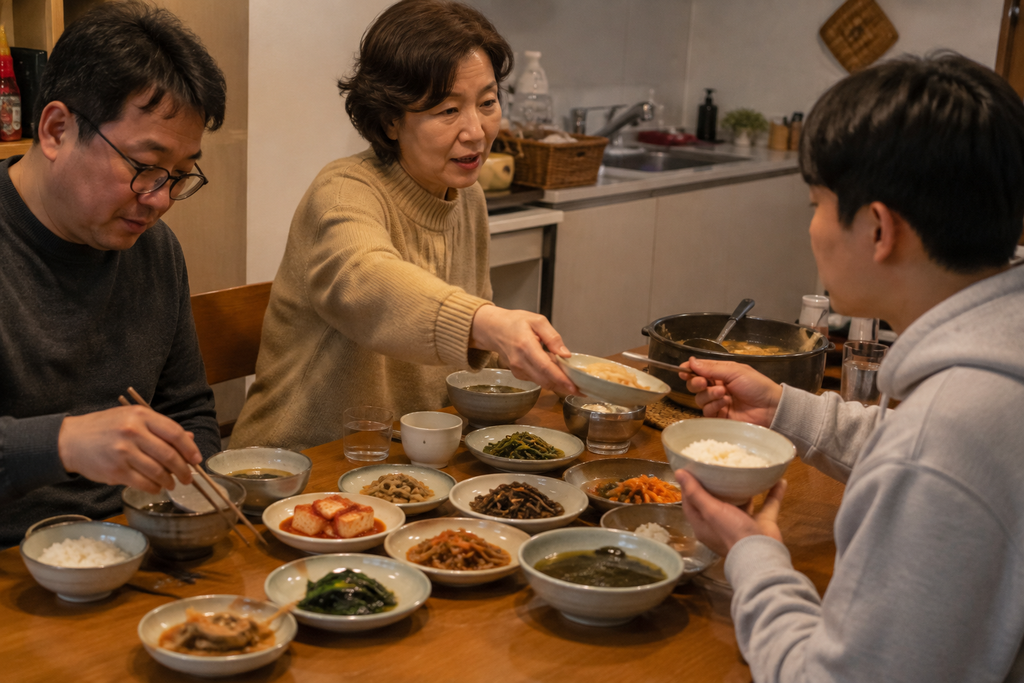
Why This Makes More Sense at a Korean Table
The meaning becomes easier to understand when you look at Korean meals themselves.
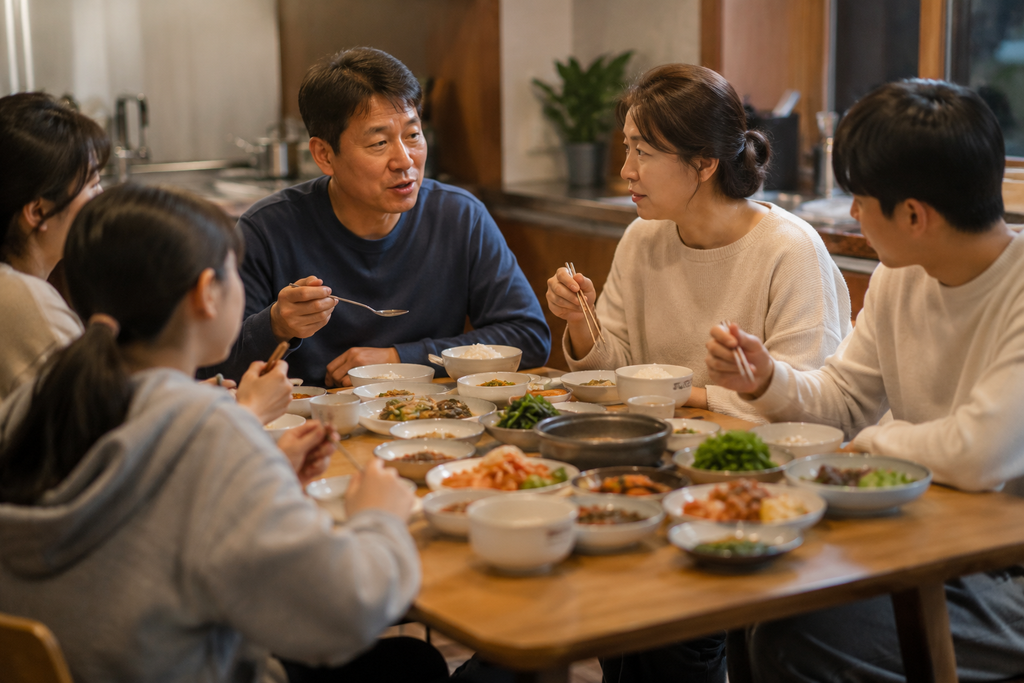
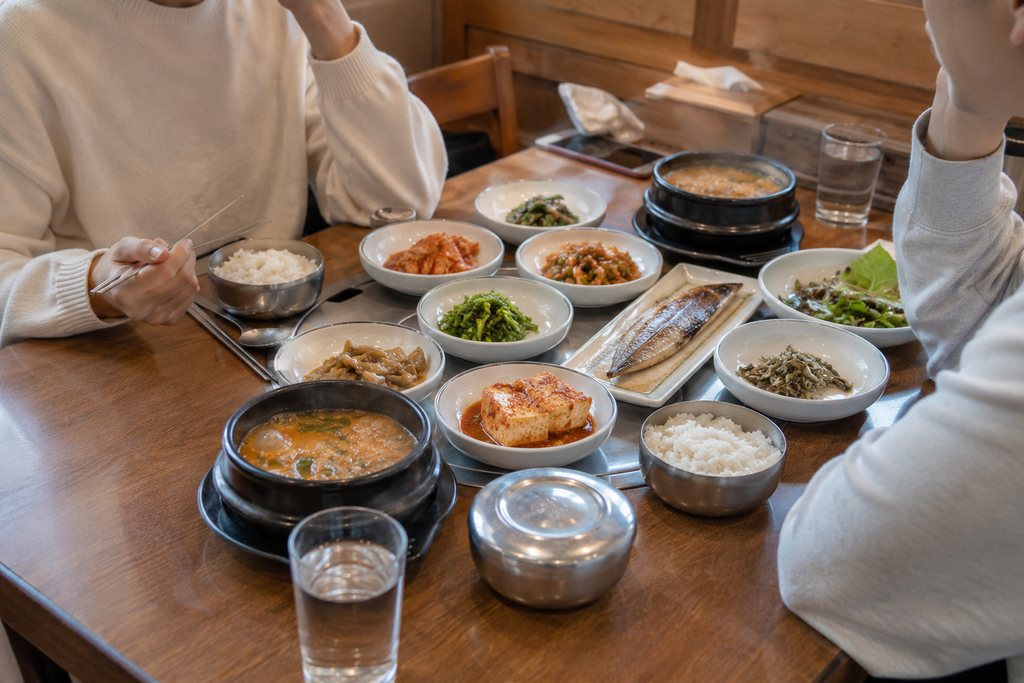
A Korean meal is rarely just one person eating one dish.
A typical meal might include rice, soup, several side dishes, and a group of people gathered around the same table.
Some dishes sit in the middle.
People reach across for them.
Someone notices your side dish is empty.
“더 먹어.”
Have some more.
Someone orders another dish.
Someone insists you take the last piece.
Nobody necessarily announces what any of this means.
They just do it.
That is precisely why these gestures can feel so intimate.
Care often appears as a practical action rather than an emotional statement.
Food Can Carry Feelings That English Puts Into Words
The phrase is difficult to translate for a reason.
English tends to separate several ideas:
How are you?
Are you okay?
Have you eaten?
Take care.
Let’s grab something to eat.
Korean can bring some of those social functions surprisingly close together.
That does not mean 밥 먹었어? literally means all five things.
It does not.
The phrase works within a cultural setting where food, well-being, and relationships overlap.
Translate the dictionary definition and you get the words.
Miss the context, and you miss part of the relationship.
The Interesting Part Isn’t the Rice
That is why explaining 밥 먹었어? as proof that Koreans are unusually obsessed with food feels too easy.
Food matters in Korean culture.
But the more interesting question is why food became such a comfortable language for maintaining relationships.
A person can say:
“Did you eat?”
and mean:
“I noticed you.”
“I was thinking about you.”
“Are you taking care of yourself?”
Sometimes, of course, they really mean:
“Are you hungry?”
The sentence has room for all of these possibilities because relationships carry meaning that the words alone cannot.
That is what makes the phrase worth understanding.
What Should You Say If a Korean Asks You?
Nothing complicated.
If you have eaten:
네, 먹었어요.
Yes, I ate.
If you have not:
아직 안 먹었어요.
I haven’t eaten yet.
If the person follows up with:
뭐 먹었어요?
What did you eat?
Now they may actually be interested in your lunch.
And if they ask:
같이 먹을래요?
Want to eat together?
The question has officially become a dinner plan.
That is one of the pleasures of Korean conversation. You do not always know whether a question about food is a greeting, an expression of concern, or the beginning of an invitation until the conversation keeps moving.
One Small Question, One Very Korean Idea
밥 먹었어? is easy to translate.
It is much harder to translate culturally.
The literal meaning is about a meal.
The everyday meaning can be about a person.
Words do not always carry their entire social meaning by themselves. Sometimes the relationship between two people carries part of the sentence.
So the next time someone in Korea asks:
“밥 먹었어요?”
do not immediately launch into an explanation of what you had for lunch.
Listen to the question in context.
Maybe they are asking whether you are hungry.
Maybe they genuinely want to know what you ate.
Or maybe, in the most ordinary Korean way possible, they are simply checking that you are doing okay.
Sometimes, asking about your meal is a way of asking about you.
A Small Cultural Note
Don’t overuse “밥 먹었어요?” just because you learned it from a Korean drama.
The phrase is natural, but Korean communication depends heavily on relationship and context.
If you are close to someone, it can sound warm.
If you are speaking to someone older, the form matters.
If you are meeting a stranger for the first time, 안녕하세요 remains the safer and more natural greeting.
The interesting thing about 밥 먹었어? is not that it replaces “hello.”
It is that Korean has a natural way of turning concern into an everyday question.
KOREA, BUT WHY?
A Korean person asking whether you have eaten may sound like a question about lunch.
Sometimes it is.
But sometimes the meal is simply the easiest way to ask something slightly bigger:
Are you okay?
That is why 밥 먹었어? is more than a phrase worth translating.
It is a small example of how Korean culture turns ordinary things—food, meals, sharing a table—into ways of maintaining relationships.
And once you understand that, the question starts sounding a little different.
Not:
Why do Koreans care so much about whether I ate?
But:
“Oh. They’re checking on me.”