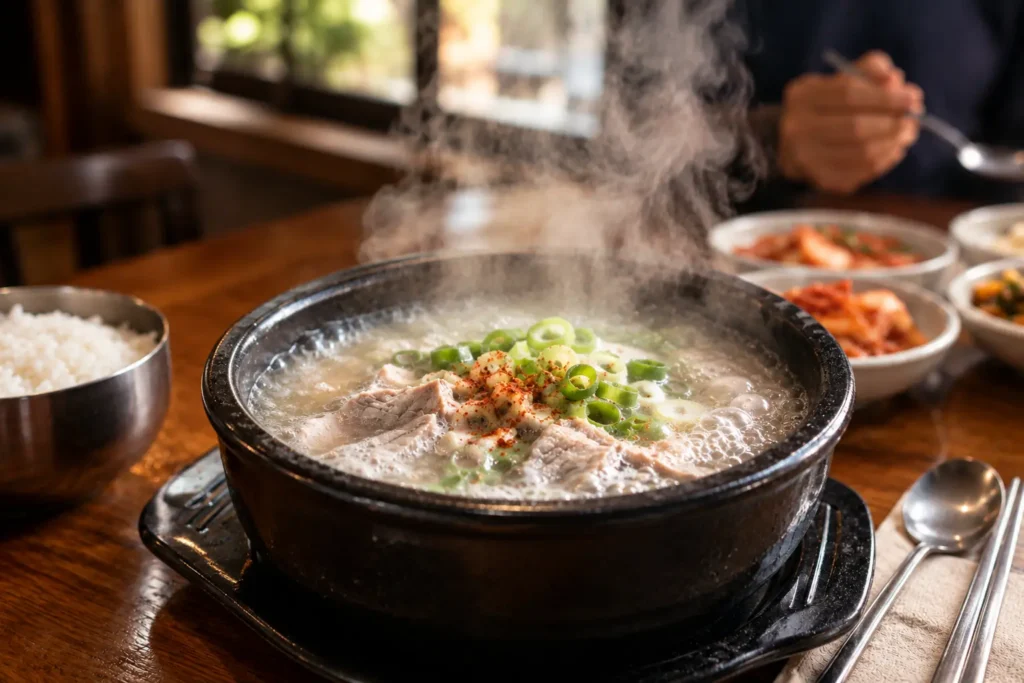
Your soup arrives still bubbling
Steam curls over the rim of the bowl. The broth trembles with every bubble. Across the table, someone picks up a spoon and starts eating as if nothing unusual has happened.
Outside, it may be 35°C.
You look down at a bowl that seems intent on making the afternoon even hotter.
Why would anyone want soup this hot in the middle of summer?
It is not because Koreans enjoy making themselves sweat. There is no national rule telling restaurants how hot soup must be. What looks like one peculiar habit from the outside is the result of several things working together: how Korean dishes are cooked and served, the vessels they arrive in, seasonal food traditions, and a Korean word that does not fit neatly into English.
Once you notice those details, the steaming bowl starts to make more sense.
Why Is Korean Soup Served So Ridiculously Hot?
Korean food is far too varied for a single explanation.
A bubbling sundubu-jjigae in a stone pot, a bowl of seolleongtang, and a plate of cold naengmyeon belong to the same food culture but arrive at the table for very different reasons.
What they share is a preference for serving hot dishes while they are still properly hot.
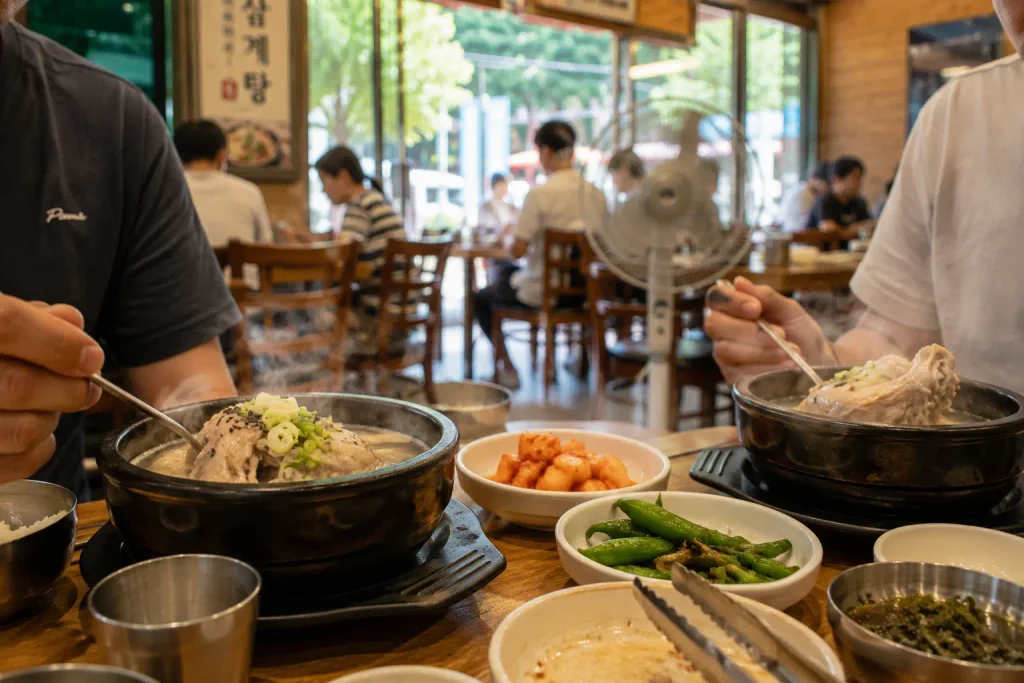
The serving vessel matters more than you might expect. Stone pots, earthenware bowls, and other heat-retaining dishes hold onto heat long after the food leaves the kitchen. With some dishes, the bubbling you see at the table is not for show. The vessel is still cooking, or nearly cooking, what is in front of you.
So when a bowl arrives looking almost volcanic, nobody is testing your tolerance.
The restaurant is doing exactly what it intended to do.
Serve the food hot.
Then Why Eat It in Summer?
This is where the story gets more interesting.
Korean summer has its own food traditions, particularly around sambok (삼복)—chobok, jungbok, and malbok, the three periods traditionally associated with the hottest part of the year.
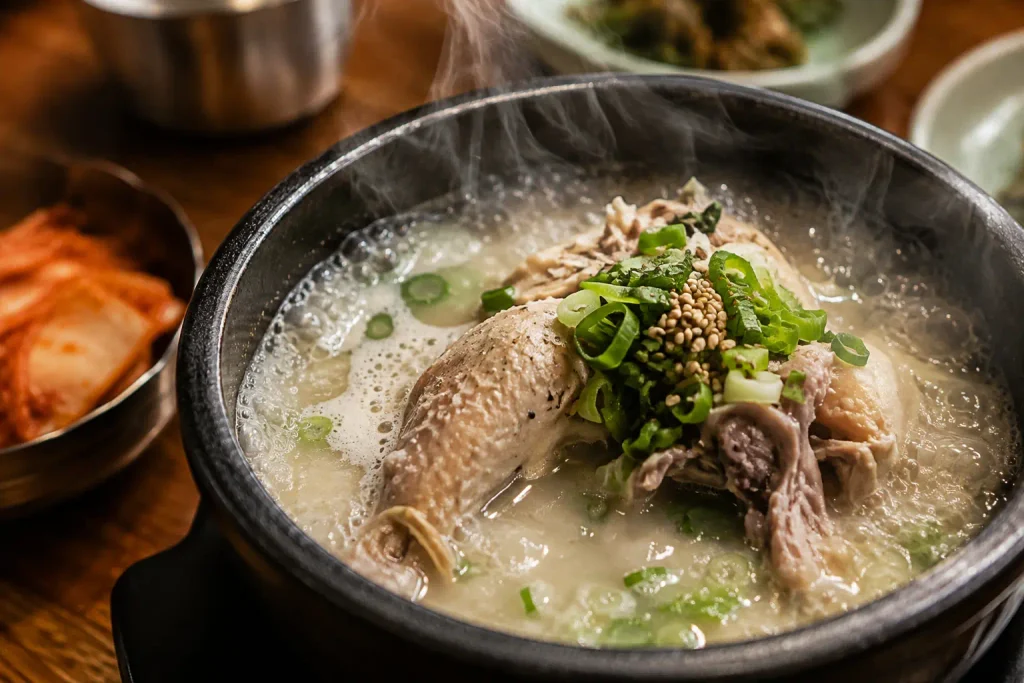
One of the dishes most closely associated with these days is samgyetang: a whole young chicken stuffed with glutinous rice and cooked with ginseng, garlic, jujube, and other ingredients.
It arrives steaming.
And people deliberately seek it out when the weather is at its hottest.
The tradition is closely associated with 이열치열 (i-yeol-chi-yeol), roughly “fighting heat with heat.” The idea is wonderfully counterintuitive: rather than trying to escape the heat altogether, you eat something hot and let yourself sweat.
Korean tourism sources still describe this as part of summer food culture, while also noting that modern Koreans have plenty of cold dishes to choose from.
That distinction matters.
Korea is not a country where everyone spends July and August eating boiling soup.
Naengmyeon, kongguksu, chilled broths, and shaved ice are just as familiar at a summer table.
The choice can look something like this:
| When the weather gets hot | What you might find |
|---|---|
| Looking for something substantial | Samgyetang, hot soups, and stews |
| Following a seasonal tradition | Samgyetang around sambok |
| Wanting immediate relief | Naengmyeon, kongguksu, and other chilled dishes |
| Finishing the meal | Bingsu or another cold dessert |
The point is not that hot food is better than cold food.
In Korea, temperature itself has become part of the way people experience summer food.
The Tradition Behind the Steaming Bowl
Summer was not always merely uncomfortable.
For an agricultural society, it could mean long hours of physically demanding work outdoors. The three boknal periods became associated with eating nourishing foods, and dishes such as samgyetang eventually found a place on the calendar.
The circumstances have changed.
You can now sit in an air-conditioned Seoul restaurant, order dinner from your phone, and walk home with an iced coffee in your hand.
People still line up for samgyetang during sambok.
Food traditions often outlive the conditions that gave rise to them. The practical reason can fade while the ritual remains, familiar enough that nobody needs to explain why a particular dish belongs to a particular time of year.
The season arrives.
So does the soup.
And Then There Is “시원하다”
There is another reason Korean soup can leave an English speaker puzzled.
Imagine someone taking a mouthful of very hot broth, wiping their forehead, and saying:
“아, 시원하다.”
Literally, 시원하다 is often associated with being cool or refreshed.
So why say it after eating something that is practically burning?
Because “cool” is not quite what the word means in this context.
Korean speakers use 시원하다 for a sense of relief, freshness, or satisfaction. A cool breeze can be 시원하다. So can a clean-tasting broth. So can the feeling that comes when something uncomfortable finally passes.
A hot bowl of soup can produce that same response.
The speaker is not saying:
“This soup is cold.”
They are closer to saying:
“That hit the spot.”
The distinction becomes especially noticeable with Korean soups and broths, where 시원하다 can describe the character and sensation of the broth rather than its literal temperature.
Materials from the National Institute of Korean Language likewise show that 시원하다 extends beyond simple physical coolness and can express relief and satisfaction.
One word does a surprising amount of work.
The Heat Is Part of the Experience
Then there is the simplest explanation of all.
The bowl is hot.
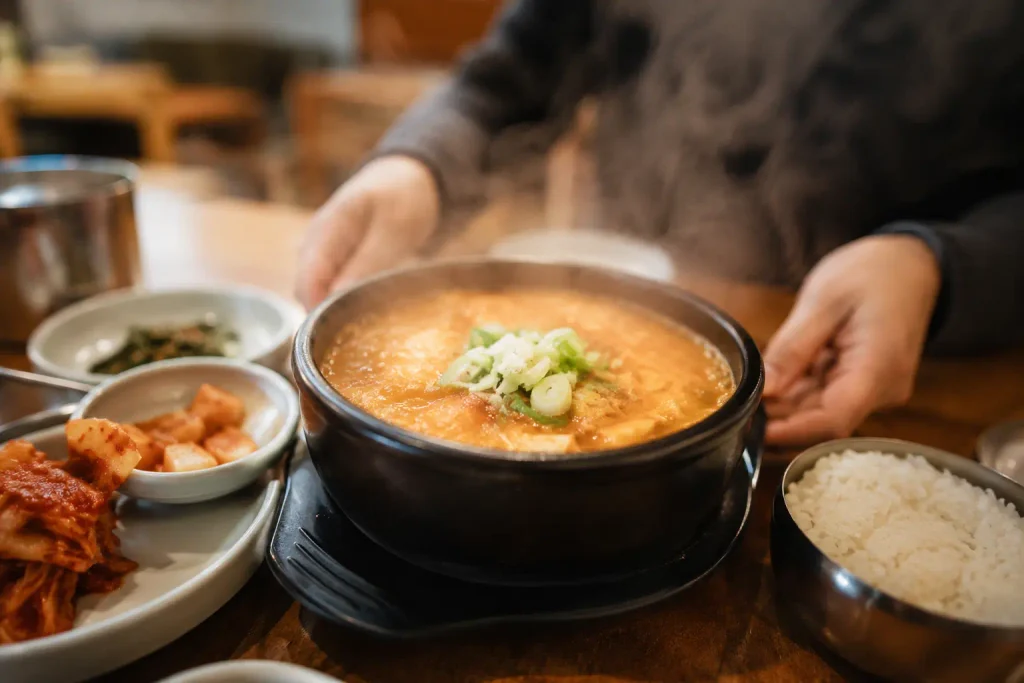
A thick stone vessel stays hot. Soup served in an ordinary ceramic bowl may become comfortable after a few minutes; the same soup in a heat-retaining stone pot can continue steaming long after it reaches the table.
Sundubu-jjigae makes the point especially well. The bubbling broth is part of what you see when the dish arrives, and the heat keeps working after the bowl has been placed in front of you.
The meal changes as you eat.
The first spoonful may be almost painfully hot.
Five minutes later, it has settled.
A little later, the flavors have opened up and the broth has finally reached the temperature you wanted in the first place.
You do not have to rush.
The bowl gives you time.
Does Hot Food Actually Change How We Eat?
There is some scientific evidence that food temperature can affect how a meal is experienced and consumed, although it would be a mistake to turn that evidence into an explanation for Korean food culture.
A 2003 study published in the Korean Journal of Nutrition compared meals containing hot beef-and-vegetable soup at about 75°C with a corresponding cold-meal condition. Thirty women participated. The researchers found differences in energy and nutrient intake between the two conditions, with the cold-meal condition producing higher reported energy intake in that experiment.
That does not mean Koreans developed hot soup because of this effect.
The study came decades after the traditions surrounding Korean summer food had already taken shape, and it was not designed to explain Korean dining culture.
What it does suggest is much simpler:
Temperature can change the experience of a meal.
Heat affects how quickly you eat, how food feels in your mouth, and how the dish changes as it cools.
A steaming bowl is not simply the same food at a different temperature.
It behaves differently on the table.
Hot Soup Is Only Half of the Korean Summer Story
It would be easy to turn all of this into a neat stereotype:
Koreans eat hot soup because they believe hot food is good in hot weather.
That would leave out half the table.
Korean summer cuisine is full of cold food.
Naengmyeon is the obvious example. Kongguksu—noodles in a chilled soybean broth—is another. Then come cold seafood dishes, shaved ice, chilled broths, and the endless procession of iced drinks.
Summer food in Korea is not a battle between hot and cold.
It is a menu of different responses to the same season.
Some dishes are warming. Some are cooling. Some belong to a seasonal tradition. Some are simply what someone happens to crave that afternoon.
| Hot summer food | Cold summer food |
|---|---|
| Samgyetang | Naengmyeon |
| Gukbap | Kongguksu |
| Jjigae | Chilled broths |
| Grilled eel | Mulhoe |
| Nourishing soups | Bingsu |
The contrast is not a contradiction.
It is the point.
So Why Does Korean Soup Arrive That Hot?
By now, the answer should feel less mysterious.
Hot dishes are generally served hot, and Korean cooking makes extensive use of vessels that hold heat exceptionally well.
Summer traditions add another layer, particularly through sambok and the idea of i-yeol-chi-yeol.
Then language adds another. 시원하다 does not always describe physical temperature. A hot, clean-tasting broth can be 시원하다 because of what it does to the person drinking it.
And beneath all of that is habit.
If you grow up watching soup arrive at the table still steaming, waiting for it to cool becomes part of the rhythm of eating. The first spoonful. The pause. The second attempt. You learn when it is ready.
What looks unusual to a visitor can feel completely ordinary to everyone else.
What Should You Do When Your Soup Arrives Bubbling?
Nothing complicated.
Wait a moment.
Take a small spoonful.
Still too hot?
Wait.
There is no prize for burning your tongue.
You may notice that Koreans sometimes begin eating surprisingly quickly. That does not necessarily mean the soup was served at a different temperature. They may simply be accustomed to eating it that way.
And if someone takes a mouthful of piping-hot broth and quietly says, “시원하다,” you now know what they mean.
They are not telling you the soup has somehow become cold.
They are telling you it feels good.
The Bowl Makes More Sense Once You Stop Looking at the Temperature
A steaming Korean soup is easy to read as a contradiction.
It is 35°C outside.
The soup is bubbling.
Surely one of those things has gone wrong.
But Korean food culture does not divide summer quite so neatly. Some dishes offer immediate relief from the heat. Others appeal because they are warm, filling, nourishing, or tied to a ritual that returns every year.
And beneath all the cultural explanations sits something wonderfully ordinary.
A good soup should arrive hot.
Not because a regulation says so.
Not because every Korean has the same theory about heat.
And not because Koreans secretly enjoy suffering through lunch.
The dish is meant to be eaten hot.
The summer traditions simply gave that habit a particularly Korean twist.
So when a bowl arrives at your table bubbling hard enough to look dangerous, you do not need to treat it as some mysterious cultural rule.
Let it cool.
Take a spoonful.
And if, after a few bites, you find yourself thinking that the hot broth is somehow refreshing, you may have just encountered one of the harder Korean food experiences to translate.
뜨거운데, 시원하다.
Hot.
And somehow, refreshing.