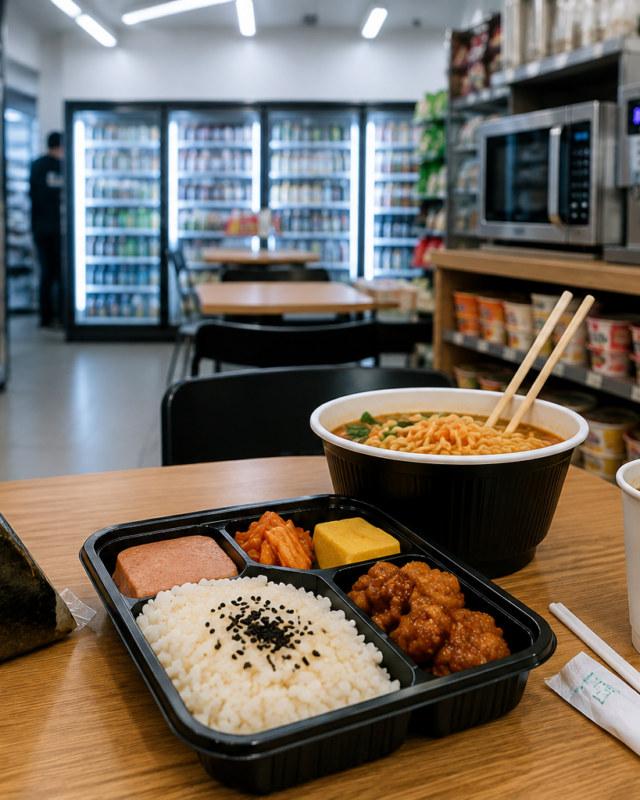
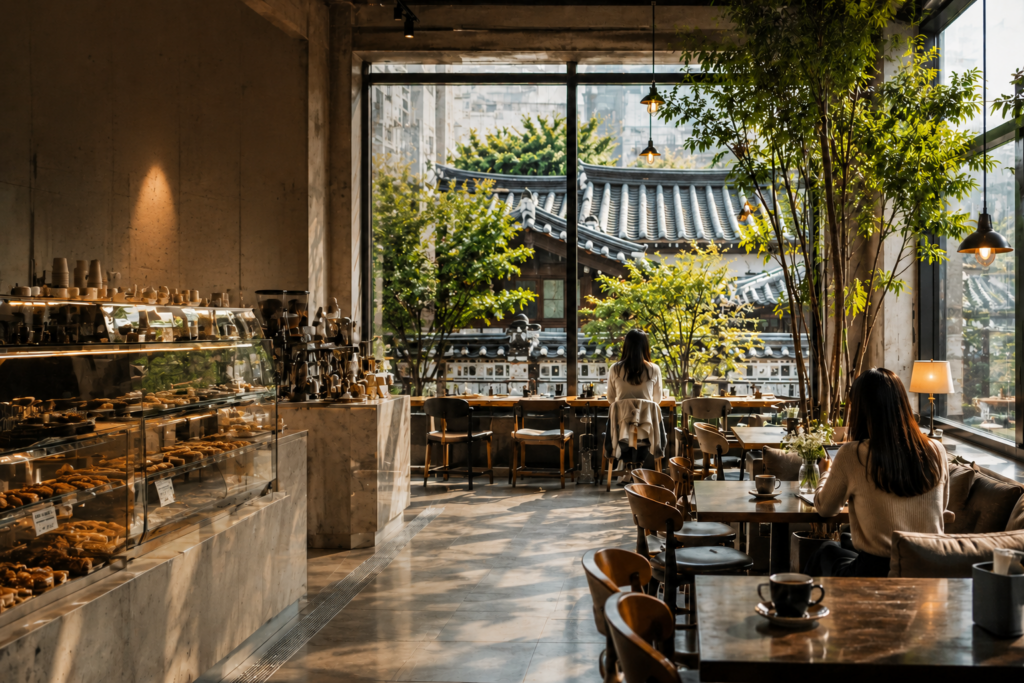
You come to Seoul with a list.
Gyeongbokgung in the morning. A market for lunch. Maybe a neighborhood you saved on your phone because someone told you it was worth wandering through.
Then, somewhere along the way, you see a café.
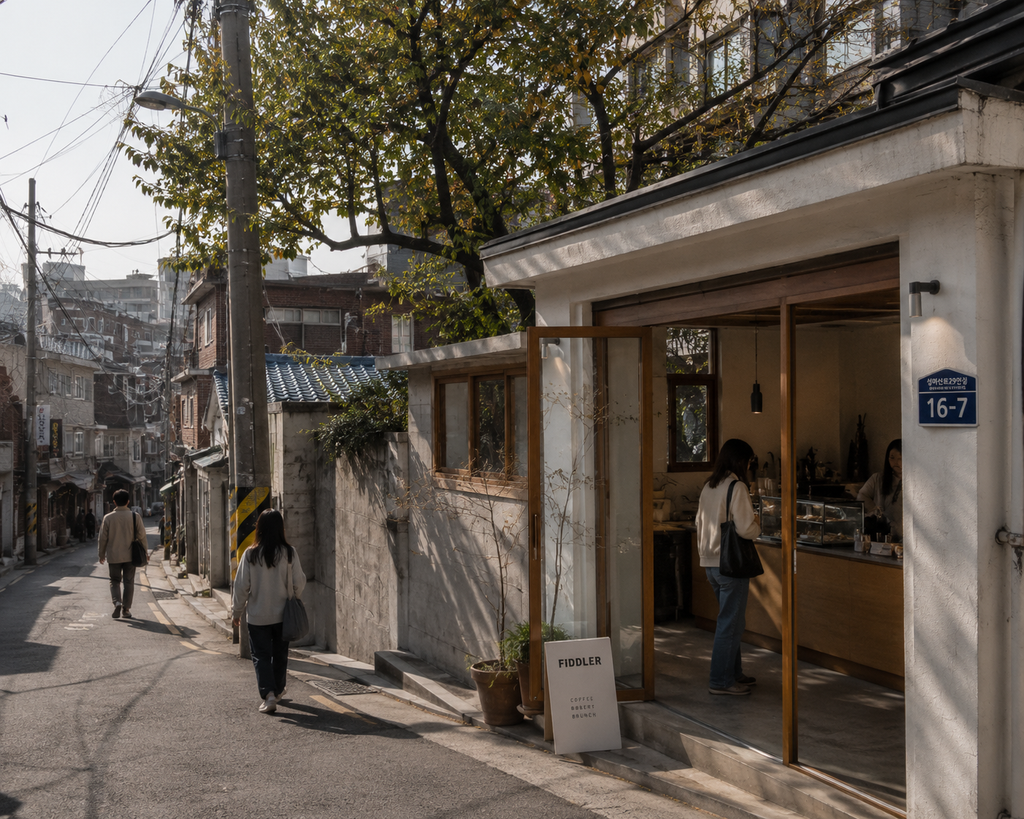
Maybe it occupies an old brick building in Seongsu. Maybe it sits behind a narrow door in Ikseon-dong. Maybe it has been fitted into a renovated hanok in Jongno. You step inside for coffee, perhaps without giving it much thought.
Then you notice the room.
The windows. The courtyard. The old beams. The people around you. A pastry you have never seen before.
Your coffee arrives.
And suddenly, you have nowhere else you need to be.
For visitors to Korea, the experience is easy to recognize. A café can certainly be somewhere to rest between sights. But increasingly, it can also be one of the places you came to see.
When the Café Becomes Part of the Plan
There is a difference between looking for a café and looking for the café.
The first is practical. You have been walking for two hours and want something cold to drink.
The second feels more like sightseeing.
You have seen photographs. Someone recommended the place. Maybe you heard that the neighborhood itself is known for its cafés. You make a small detour, then realize the detour has become part of the afternoon.
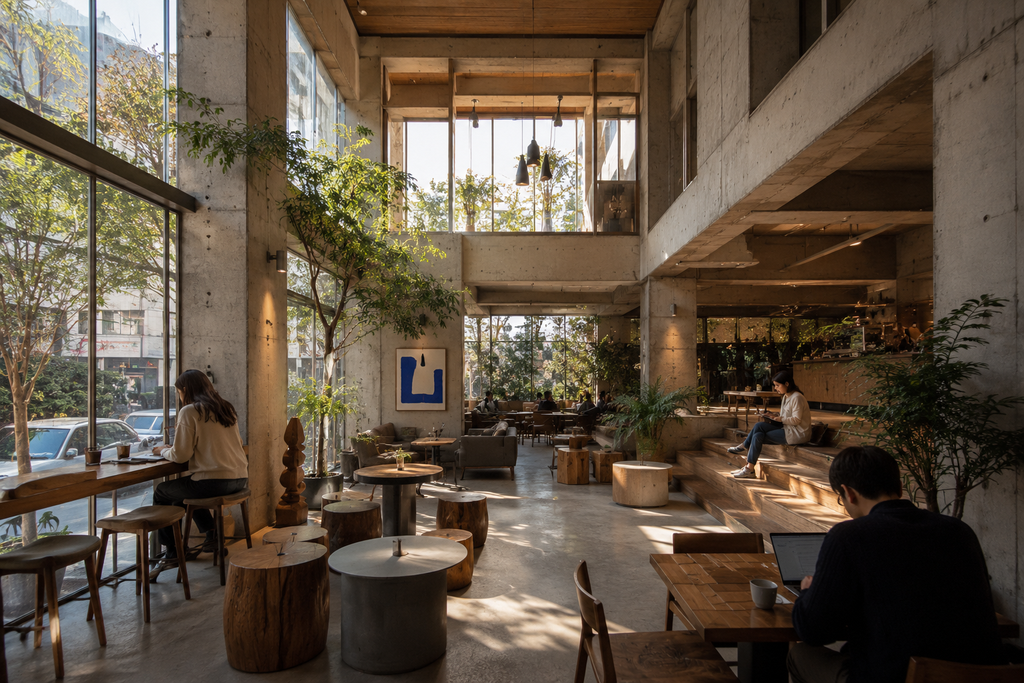
Seongsu is a good example. Once heavily associated with manufacturing, the neighborhood has filled with cafés, restaurants, galleries, and shops inside and around its former industrial spaces. The café is no longer simply somewhere to stop after exploring Seongsu.
For many visitors, it is part of the reason to go.
Ikseon-dong offers a different version of the same idea. Its narrow lanes wind between renovated hanok houses, many now occupied by cafés and restaurants. You walk through the lanes looking at the buildings, the signs, the courtyards, the people—and somewhere along the way, deciding where to drink coffee becomes part of deciding where to spend the afternoon.
The destination and the coffee stop begin to blur.
The Building Is Often Part of What You Came For
A café does not have to look extraordinary to be good.
Seoul has thousands of ordinary neighborhood cafés where people meet friends, study, work, or sit alone with a drink.
But some cafés make the room itself part of the experience.
An old factory keeps its exposed brick and high ceiling. A narrow building opens toward the street. A traditional house is arranged around a courtyard. A new space is designed around a particular view.
You notice these things before you have even opened the menu.
For a traveler, that changes the question.
You are no longer deciding only whether the coffee is worth ordering. You are deciding whether the building, the room, and the surrounding neighborhood are worth an hour of your day.
Sometimes, the answer is yes.
Seongsu Shows How This Happened
Seongsu may be the clearest example of a café becoming part of a neighborhood’s identity.
The area was once known for manufacturing. Its industrial past remains visible in the buildings and streets, even as many former workspaces have been put to entirely different uses. Cafés, restaurants, galleries, and shops followed, bringing a new kind of foot traffic with them.
You can now spend an afternoon there without a single landmark dictating where you should go next.
A café might be your first stop.
Then another street catches your attention.
Then a shop.
Then another café.
Seoul is particularly well suited to this kind of wandering because so much can fit into a relatively small area. A coffee break does not necessarily pull you away from the neighborhood.
It can take you further into it.
Then There Are the Cafés Inside Hanok
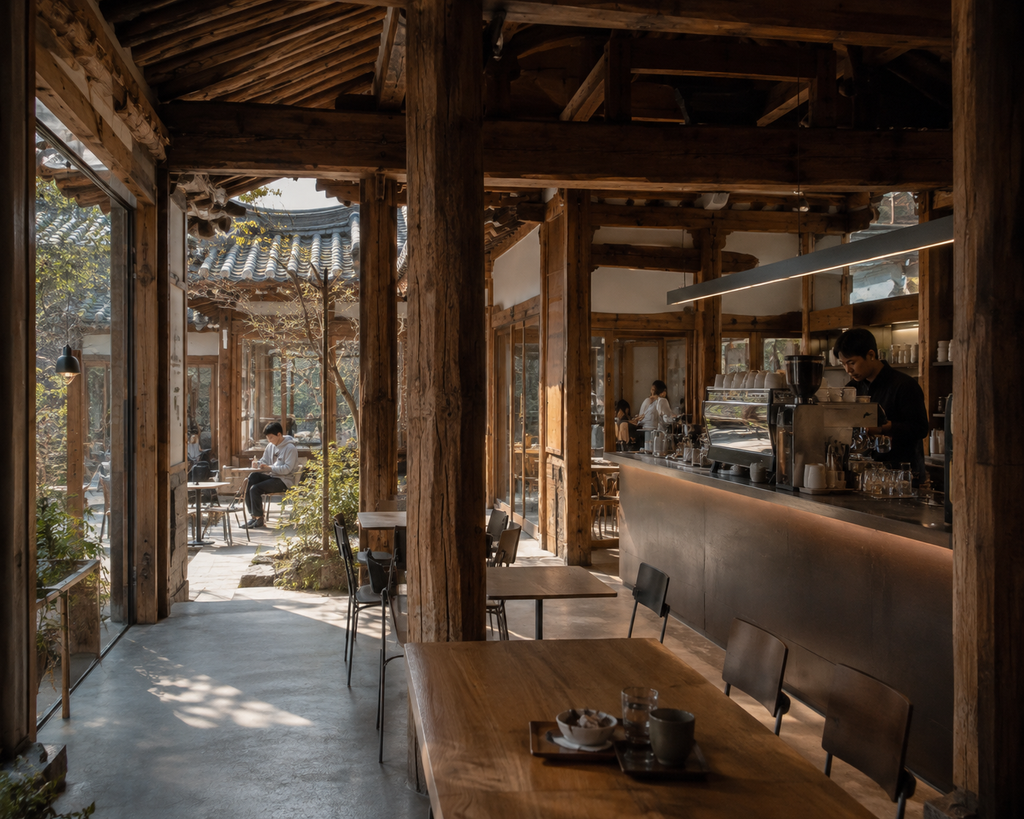
The experience changes again when the café occupies a traditional Korean house.
A hanok was not designed as a café. Its proportions, wooden structures, courtyards, and relationship with the surrounding space came from a very different way of living.
Yet inside one, you might find an iced Americano, a slice of cake, and a laptop open on the table.
The contrast is part of the appeal.
Korea Tourism Organization has highlighted hanok cafés as part of Seoul’s contemporary use of traditional architecture, particularly in areas such as Ikseon-dong and Jongno.
You do not need to know the history of hanok architecture to appreciate the experience.
You can simply sit in the courtyard.
Look up at the roofline.
Listen to the conversation from the next table.
Notice how different the room feels from the café you visited twenty minutes earlier.
Sometimes that is enough.
Why Are Cafés So Easy to Fold Into a Day of Sightseeing?
Part of the answer is practical.
A museum has opening hours. A palace has an entrance. A tour has a starting time.
A café usually asks very little of you.
Walk in alone.
Stay for twenty minutes.
Stay for three hours.
Talk. Read. Work. Open your laptop. Stare out the window.
Or do absolutely nothing.
That flexibility matters in a city where a day on foot can become tiring faster than expected. It also explains something visitors often notice: people do not necessarily finish their coffee and immediately leave.
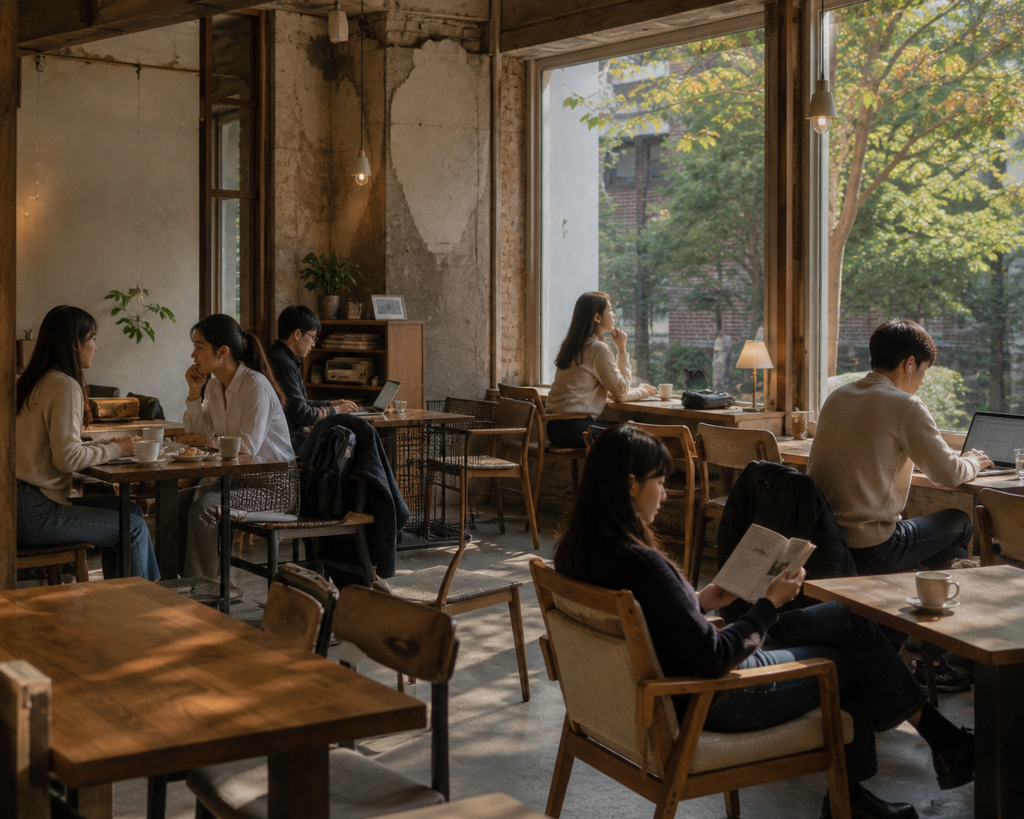
Students occupy tables for hours. Friends keep talking after their drinks are gone. Someone works quietly in a corner. A traveler sits alone without needing an excuse beyond wanting somewhere comfortable to be.
Recent reporting on Korean café culture has documented the role cafés play as spaces for studying and working, with some businesses adapting their layouts for customers who stay for extended periods.
For a traveler, that makes the café useful in ways that have very little to do with caffeine.
A Café Can Tell You Something About the Neighborhood
Look outside.
A café in Seongsu may sit among traces of the area’s industrial past and the businesses that have replaced them. A café in Ikseon-dong might open onto a maze of hanok and narrow lanes. In Seochon, a café can be one stop among markets, galleries, restaurants, and residential streets.
Korea Tourism Organization’s walking routes reflect this mixture. Its Seochon route, for example, combines markets, restaurants, galleries, cafés, historic streets, and residential areas rather than treating each as a separate tourist attraction.
That makes a café surprisingly useful as a way of seeing a neighborhood.
You sit down.
The neighborhood keeps moving outside.
The Café Does Not Always Have to Be Famous
The most photographed café is not necessarily the one you will remember.
A destination café can be fun, especially when the building or setting really is unusual. But some of the more revealing moments happen in places that were never built to attract international visitors.
A group of students shares a table.
Someone works quietly in the corner.
An older couple stops for coffee after lunch.
Friends order dessert and spend the afternoon talking.
Nothing dramatic happens.
That is precisely what makes it worth noticing.
Travel encourages us to look for what is different. A neighborhood café can show you something else: what people do when they are simply going about an ordinary afternoon.
What Should You Notice When You Visit a Korean Café?
If you are interested in more than taking photographs, look around before you leave.
| What to notice | Why it is interesting |
|---|---|
| The building | An old factory, hanok, house, warehouse, or new structure can tell you something about the neighborhood. |
| The location | Markets, homes, shops, galleries, and historic buildings around the café reveal how the area is used. |
| The customers | People may be meeting, studying, working, reading, or simply taking a break. |
| The seating | The layout can suggest whether the café expects quick visits, long stays, or both. |
| The menu | Coffee may share space with desserts, seasonal drinks, or ingredients associated with Korean food culture. |
| The pace | Watch how long people stay and how the café fits into the rhythm of the street. |
You do not need to turn the visit into research.
Just look around.
The Café Is Sometimes the Place You Remember
A day in Seoul can become a long sequence of places.
Palace.
Market.
Museum.
Shopping street.
Restaurant.
Another subway ride.
Another neighborhood.
A café interrupts that rhythm.
You sit down. The city continues outside the window. Someone studies at the next table. A delivery scooter passes on the street. People around you carry on with an afternoon that has nothing to do with your itinerary.
For a few minutes, you are not sightseeing.
You are simply somewhere in Seoul.
That may be the part travelers remember.
The café lets you encounter a neighborhood without having to understand everything about Korea first. Its architecture, its customers, its food, and the way people use the room tell you something simply by being there.
And sometimes the most memorable part of the afternoon is the part you never planned.
So, Why Do Korean Cafés Feel Like Destinations?
Not because every café is extraordinary.
And not because Koreans somehow turned coffee into a tourist attraction.
The explanation is more ordinary.
In many parts of Korea, cafés have become places where different pieces of city life overlap. People work there, study there, meet friends there, take breaks there, and sometimes go simply because they like the space. In neighborhoods popular with visitors, those same cafés can become part of the way people experience the area.
For a traveler, that creates a different kind of stop.
You might choose a café because of the building.
You might stay because of the room.
You might leave and keep walking.
Or you might look at the time an hour later and realize you have completely forgotten about the itinerary.
The coffee is still important.
It just isn’t the whole reason you came.
A Small Café Can Be a Small Window Into Seoul
If you visit Korea, you do not need to chase every famous café.
Pick a neighborhood you want to explore.
Walk.
If a place catches your eye, go inside.
Look at the building. Listen to the room. Notice who is there and what they are doing. Try something unfamiliar if you feel like it.
Then sit for a while.
You may find that the café was never really a break from the trip.
It was part of the trip all along.