
At Gwangjang Market in central Seoul
the smell of grilled meat drifts through the crowded lanes. Steam rises from dumpling baskets. Stews bubble. Plates of banchan fill the tables.
Then, a few steps away, someone sets down a plate of yukhoe.
Thin strips of raw beef. A little pear. Sesame seasoning. Sometimes an egg yolk sitting in the middle.
No sizzling pan.
Nothing is being cooked in front of you.
A few streets away, the scene changes again. At a seafood restaurant, a customer chooses a fish from a tank. Not long afterward, it returns to the table sliced into hoe, ready to eat.
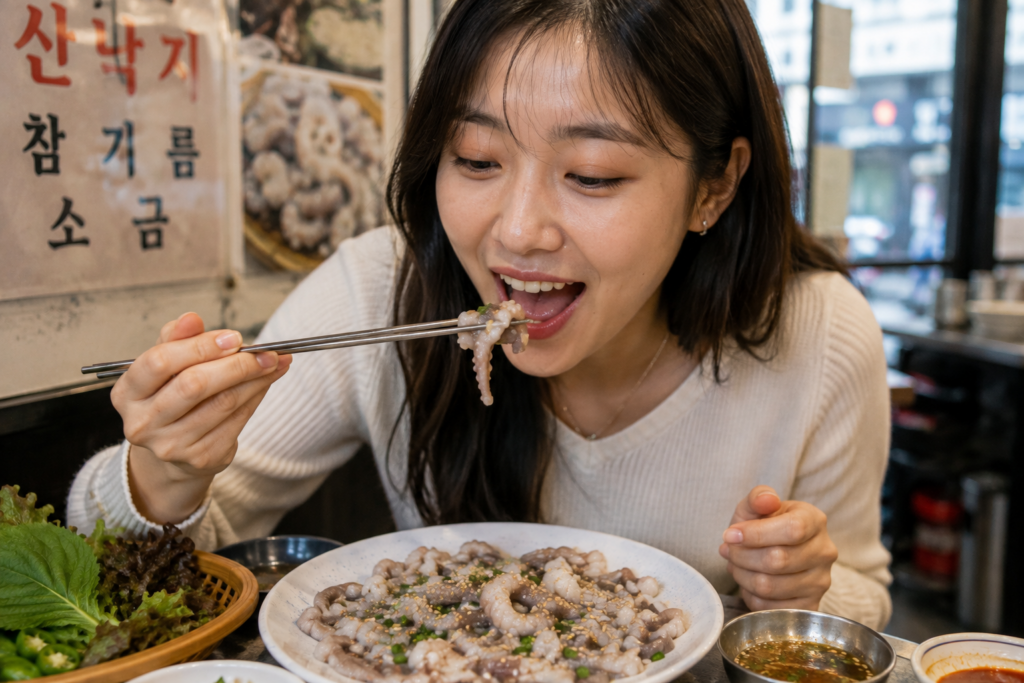
And then there is sannakji.
The octopus has been cut into pieces, but the tentacles may still move on the plate.
For someone encountering Korean food for the first time, these dishes can seem to belong to the same peculiar category: food that somehow skipped the cooking stage.
But raw food occupies only a small corner of Korean cuisine. An ordinary Korean meal is far more likely to revolve around rice, soup, stew, grilled meat, vegetables, fermented foods, and ingredients transformed through heat.
So the interesting question is not why Koreans eat everything raw.
They do not.
It is why certain foods are considered worth eating this way.
Raw Food Is Only One Part of the Table
Sit down to an ordinary Korean meal and raw food is unlikely to be the first thing you notice.
There may be rice in a small metal bowl, soup still giving off steam, grilled meat, seasoned vegetables, and several small dishes spread across the table. Kimchi may be the item a visitor recognizes first, but it belongs to a much larger tradition of fermentation, seasoning, simmering, grilling, and boiling.
Raw dishes occupy a much smaller corner of that picture.
They are simply much harder to miss when they appear.
A plate of yukhoe looks unmistakably different from everything around it. Hoe arrives without the browned edges of cooked fish. Sannakji can still move.
That visual difference is part of what fascinates visitors. Korean food guides often single out chopped live octopus and beef tartare as dishes that can be especially surprising to international diners. In a 2018 Korea Tourism Organization survey of 944 foreign social-media users, live octopus ranked first among the “authentic Korean dishes” respondents wanted to try.
The fascination makes sense.
These dishes make the condition of the ingredient unusually obvious.
And that leads to the more interesting part of the story.
When Freshness Becomes Something You Can See
At a Korean seafood market, freshness is not always an abstract promise printed on a menu.
You can watch the fish swimming.
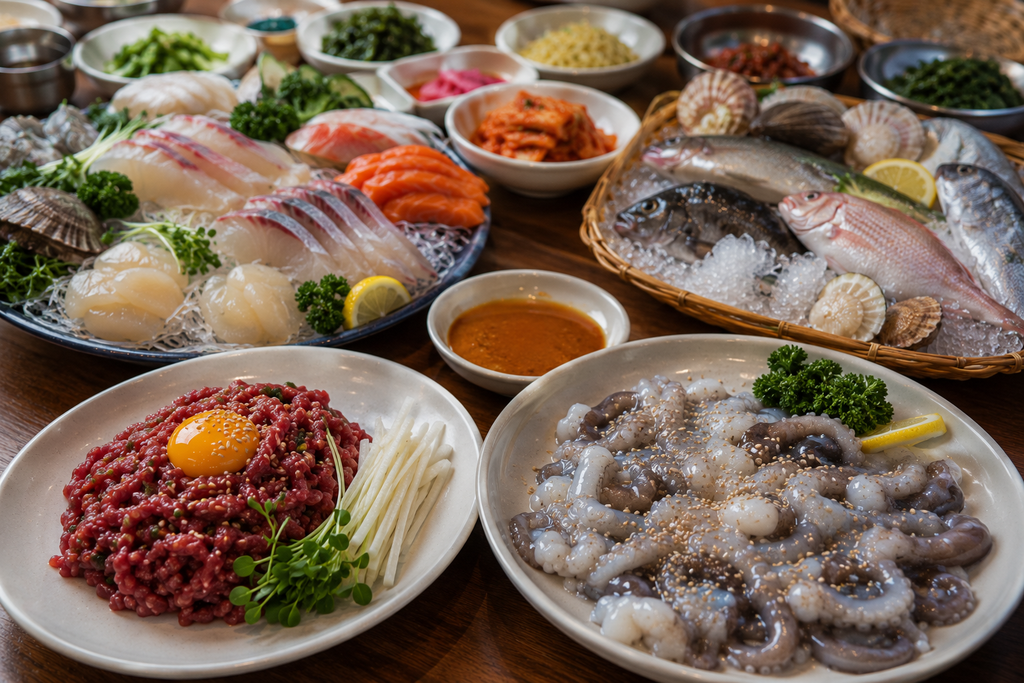
Noryangjin Fisheries Market in Seoul offers perhaps the clearest example. Fish tanks fill the market, and the distance between choosing seafood and having it prepared can be remarkably short.
That creates an unusual relationship between diner and ingredient.
You are not simply choosing sea bream rather than flounder.
You are choosing the condition of the fish, too.
A fish moving through a tank presents a different proposition from one that has already been sitting on ice. In Korean hoe culture, those differences have become part of how seafood is understood and valued.
The fish is there.
You can see it.
Then it becomes dinner.
The Fish Does Not Have Much Time to Hide
There is another consequence to serving fish this way.
Very little stands between the ingredient and the diner.
Cooking can soften, crisp, brown, smoke, or otherwise transform food. Raw fish has fewer places to hide. Texture matters. Temperature matters. The condition of the flesh matters.
That helps explain the detailed vocabulary that has developed around seafood quality in Korean hoe culture.
The Noryangjin research found that hoet-gam is not simply a category for fish that will be eaten raw. It can function as a broader reference for the quality of fresh seafood. The idea can even influence how other fish are evaluated, regardless of whether they eventually appear as hoe.
Freshness becomes part of the language of the market.
It affects what customers look for.
It affects what they consider desirable.
And with hoe, it becomes part of the meal itself.
Yukhoe Takes a Different Route
Yukhoe has nothing to do with a fish tank.
Its story begins with beef.
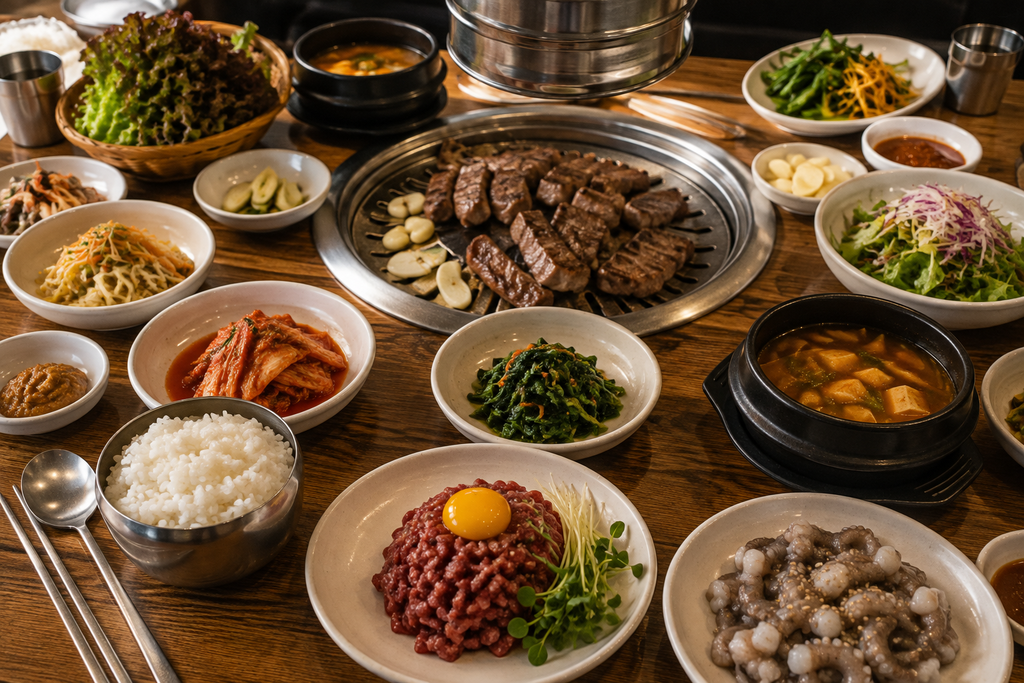
Around Gwangjang Market and Jongno 5-ga, restaurants specializing in yukhoe are particularly well known. The dish is generally made from thinly sliced raw beef seasoned with ingredients such as soy sauce, garlic, sesame salt, and sugar. Pear is commonly served alongside it, and egg yolk is often added.
The combination is remarkably restrained.
The pear brings sweetness and crunch. The seasoning adds salt, aroma, and richness. The beef stays soft and prominent.
Nothing tries to make the meat resemble something cooked.
That matters because yukhoe depends heavily on the texture of the beef itself. The raw meat is not merely a blank surface waiting to be covered in sauce. Its tenderness is part of what diners are there to experience.
That is also why the dish can surprise someone expecting Korean food to be dominated by powerful seasoning.
The flavor is there.
But so is the meat.

The Market Makes the Dish Feel Less Strange
There is something about eating yukhoe in a market that changes the way the dish looks.
On a screen, raw beef topped with a bright yellow egg yolk can seem almost theatrical.
At Gwangjang Market, it sits among dumplings, noodles, mung-bean pancakes, and other foods being prepared within a few meters of each other.
It becomes dinner rather than an internet curiosity.
The market also has restaurants that combine yukhoe with chopped live octopus, bringing together two of Korea’s most visually striking raw preparations. Korea Tourism Organization lists several such restaurants around Gwangjang Market, where the combination is served with pear, sprouts, and egg yolk.
From a distance, the pairing can look extreme.
At the table, the logic is easier to understand.
The beef is soft.
The octopus is chewy.
The pear is crisp.
The egg yolk rounds everything out.
Texture becomes as important as flavor.
Then There Is Sannakji
Sannakji is where the conversation usually gets animated.
The octopus is cut into pieces and served immediately. Because the muscles can continue contracting after the animal has been cut, the pieces may wriggle on the plate. Korean Tourism Organization describes the familiar preparation: the pieces move as though still alive and are commonly dipped in sesame oil mixed with salt and sesame seeds.
For a visitor, the movement is hard to ignore.
It is also easy to turn the dish into a kind of dare.
That is not a particularly useful way to understand it.
The appeal of sannakji is closely tied to texture. The pieces are slippery and chewy, and the physical sensation of eating them is unusually noticeable.
There is also a practical warning that tends to disappear in short videos: the suction cups can stick to the mouth or throat, so the pieces need to be chewed thoroughly. The spectacle may make sannakji look like a challenge, but it is still food.
And it needs to be eaten carefully.
A dish can be unfamiliar without being a stunt.
Why Does Korea Have So Many Ways to Eat Something Fresh?
This is where the simple explanations begin to fall apart.
“Korea has a culture of freshness.”
The statement sounds convincing.
It also explains very little.
A fish market, a bowl of yukhoe, and a plate of sannakji involve different ingredients and different traditions.
The seafood market places unusual emphasis on the condition of the fish.
Yukhoe is built around the tenderness of raw beef and the contrast of its accompaniments.
Sannakji turns texture into almost the entire experience.
What connects them is less a national preference for raw food than an acceptance of raw preparation as a legitimate way to let certain ingredients retain a particular character.
That becomes especially noticeable with foods whose texture changes dramatically under heat.
Fish becomes firmer and develops another flavor when grilled.
Beef takes on an entirely different character when seared.
Octopus changes dramatically with cooking.
Serving them raw preserves a particular version of each ingredient.
For diners who prefer that version, cooking would not necessarily improve it.
It would simply make a different dish.
The Texture Is Often the Part You Remember
Ask someone who has never tried sannakji what they expect it to taste like, and they may talk about eating something alive.
Ask someone who has actually eaten it, and the texture is more likely to come up.
The same thing happens with yukhoe.
The first description is usually “raw beef.”
The second is about how soft it is, how the pear changes the bite, or how the egg yolk coats the meat.
Hoe works much the same way.
The question is not simply whether the fish has been cooked.
The bite itself becomes part of the reason for ordering it.
That detail can disappear when Korean raw dishes are introduced mainly as shocking foods.
The novelty gets attention.
The texture keeps people eating.
Raw Does Not Mean the Same Thing Everywhere
There is no single Korean version of “raw food.”
Hoe has its own traditions around fish and seafood.
Yukhoe belongs to another part of the cuisine.
Sannakji is different again.
There are raw seafood dishes, seasoned raw fish preparations, and regional or seasonal foods that do not fit neatly into the three examples most often shown to foreign visitors.
Even within hoe, the culture is more complicated than the simple idea of “fresh fish.” The Noryangjin study shows how fishermen, traders, and customers have developed detailed ways of distinguishing seafood according to freshness, fishing method, distribution, and condition.
Calling this a national obsession with raw food misses the more interesting detail.
Korean cuisine has many ways of transforming ingredients.
Sometimes heat does the work.
Elsewhere, fermentation changes the ingredient over time.
A careful hand with seasoning can be enough in other dishes.
And sometimes the least transformation is the one people want.
So What Are Koreans Actually Looking For?
Perhaps the easiest place to see the answer is back at the table.
The fish has been sliced.
The beef is chilled and seasoned.
The octopus still moves slightly when the chopsticks lift it.
None of these dishes is trying to impress you simply by being uncooked.
Their appeal lies somewhere more ordinary: the ingredient has a particular texture, a particular condition, and a particular way of tasting when it has been left largely alone.
That is why Korean raw dishes can feel so striking to a first-time visitor.
They make something that is usually invisible—the condition of an ingredient before cooking—unusually easy to notice.
And once that becomes part of the meal, “raw” stops being the most interesting word on the menu.
Freshness is.