

For a group that debuted in 2024, RESCENE has had a remarkably strange summer.
Their song “LOVE ATTACK,” released nearly two years ago, climbed to No. 1 on Melon’s TOP100 in July. Their new single, “Pretty Girl,” followed with two music-show wins. Member Woni topped the July individual girl-group brand reputation rankings, and by late August, RESCENE had reached No. 1 in the overall singer brand reputation rankings as well.
Suddenly, RESCENE was hard to miss.
But the interesting part is not simply that the group became popular.
It is how people found them.
No single comeback set everything off. Attention gathered in small, unlikely places: a personal YouTube channel, a trip to Geoje, a joke that escaped its original video, a handful of short-form clips, and an old song that found listeners nearly two years after its release.
Then a new single arrived at almost exactly the right moment.
By the end of August, “LOVE ATTACK” was still sitting at No. 1 on Melon’s TOP100. “Pretty Girl” was at No. 5, and “Deja Vu” at No. 7.
For a group that had been relatively easy to overlook not long ago, that is a remarkable amount of RESCENE on one chart.
So what happened?
It Started With a YouTube Channel
The first clue is not a music show.
In 2026, member Woni opened a personal channel separate from RESCENE’s group account. The videos felt less polished than a conventional idol production: trips, everyday conversations, small jokes, and the chemistry between members when nobody was performing for a three-minute music video.
One episode followed Minami, the group’s Japanese member, on a visit to Woni’s hometown of Geoje.
At one point, Minami shouted:
“Geoje yaho.”
The phrase combined the city’s name with the Japanese expression “yaho,” a playful greeting.
It was a tiny moment.
Online, it did not stay tiny.
The phrase began circulating through short-form content. People who arrived for the joke started encountering the five members behind it. Korea JoongAng Daily reported that the meme helped push “LOVE ATTACK” back up the charts, while SBS also connected the song’s resurgence to the viral moment on Woni’s YouTube channel.
The important distinction is this:
RESCENE did not suddenly become interesting because someone found a better marketing slogan.
People became curious about the members first.
The music came after.
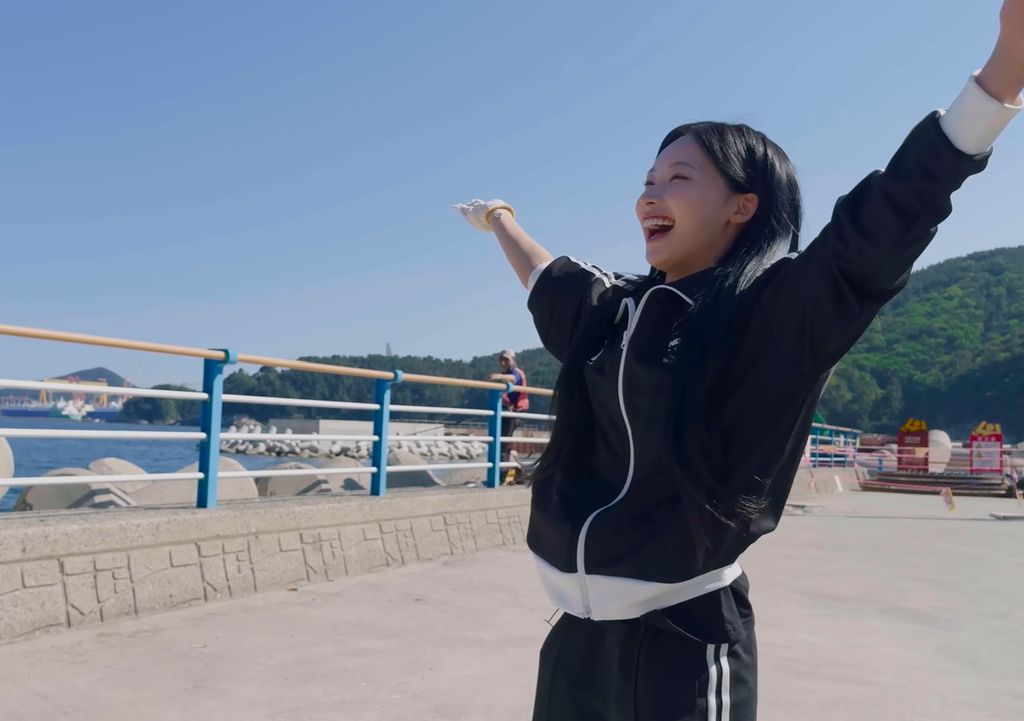
Still from [RESCENE’s official YouTube video]
The Members Became the Way In
K-pop has always sold personality alongside music. But the way audiences reach that personality has changed.
A polished music video gives viewers a carefully constructed version of an idol. A personal YouTube channel leaves room for something messier and more recognizable: accents, jokes, awkward pauses, local references, and the little interactions that would never survive a three-minute single.
For RESCENE, that turned out to matter.
Woni’s connection to Geoje gave the group a setting far removed from the familiar K-pop imagery of Seoul, luxury fashion, and choreographed stages. Minami’s reaction to the city was memorable partly because it did not feel manufactured.
By July, Woni had reached No. 1 in the Korean Business Research Institute’s individual girl-group brand reputation rankings. The analysis covered 735 members and measured consumer participation, media coverage, communication, and community awareness. Among the prominent keywords associated with Woni were “Geoje,” “YouTube,” and “Pretty Girl.”
The shift was subtle but important.
People were no longer encountering RESCENE only as a group.
They were beginning to recognize the people inside it.
Then an Old Song Came Back
The strangest part of the story is what happened to “LOVE ATTACK.”
The song was released in August 2024 as the title track of RESCENE’s first mini album, SCENEDROME. It did not become an immediate chart phenomenon.
Nearly two years later, it started climbing.
By the end of June 2026, “LOVE ATTACK” had reached No. 5 on Melon’s TOP100.
On the night of July 8, it reached No. 1.
Koreans have a word for this kind of comeback: yeokjuhaeng. It describes an older song making an unexpected return to the charts long after its original promotion has ended.
This one was particularly striking.
Melon reported that streams of “LOVE ATTACK” rose by as much as 2,019 percent compared with the period before Woni’s YouTube video. Searches for RESCENE increased by more than 6,500 percent.
An old song had found a new entrance.
And the entrance was not another music video.
It was a meme.

Korea’s Short-Form Culture Did the Rest
This is where RESCENE’s story becomes part of a larger change in how Korean pop culture travels.
A viewer does not have to decide to become a RESCENE fan.
They might see a ten-second clip on YouTube Shorts. Then another on TikTok. They might hear “Geoje yaho” without knowing where it came from.
Then they search.
Who said that?
What group are they in?
What else have they done?
The trail leads from Minami to Woni, from Woni to RESCENE, and eventually to “LOVE ATTACK.”
Each step is tiny.
Together, they create momentum.
Korea JoongAng Daily described the rise as a grassroots online phenomenon, noting that the group accumulated attention through a large volume of online content rather than one conventional promotional push.
That helps explain why the rise looks so sudden from the outside.
The audience sees the moment the song reaches No. 1.
The attention that made No. 1 possible had been building somewhere else.
Then “Pretty Girl” Arrived
RESCENE had one more advantage: they had new music ready while the old song was still climbing.
On July 8, RESCENE released “Pretty Girl,” a remake of KARA’s 2008 song.
The timing could hardly have been better.
“LOVE ATTACK” was already climbing. People were discovering the members through Woni’s channel. Then a familiar song arrived with a new performance from a group that suddenly had far more attention than it had when the original track was released.
“Pretty Girl” did not replace “LOVE ATTACK.”
For a while, the two songs simply traveled together.
“Pretty Girl” reached No. 4 on Melon’s TOP100 in July. On July 14, RESCENE won its first-ever music-show trophy with the song on The Show. Eleven days later, the group won again on MBC’s Show! Music Core, marking its first win on a terrestrial broadcast network.
Then “LOVE ATTACK” got its own moment.
On July 26, almost two years after its release, it took No. 1 on SBS Inkigayo.
An old song and a new song were now carrying the same group at the same time.

Suddenly, It Wasn’t Just About Music
Once the attention became large enough, it began showing up outside the music industry.
In June, RESCENE was appointed an honorary promotional ambassador for Suwon, with the city planning to involve the group in campaigns connected to its 2026–2027 Visit Suwon Year.
The appointment came while the group’s online momentum was already building.
Brands followed.
Domino’s Korea announced RESCENE as its new exclusive model in July, saying the group’s bright and energetic image fit the brand’s direction.
This is when “everywhere” starts to become literal.
You can encounter RESCENE in music feeds, short-form videos, entertainment news, advertising, and city promotion.
The person who first discovered the group through a joke about Geoje can now run into the same members somewhere completely unrelated to K-pop.
A trend becomes harder to escape once different parts of popular culture begin repeating it.
The Numbers Caught Up With the Feeling
It would be easy to call the whole thing a viral accident.
The numbers tell a more complicated story.
In late June, RESCENE ranked No. 1 among rookie idol groups in the Korean Business Research Institute’s monthly brand reputation rankings, with its index up 167.76 percent from the previous month.
In July, Woni ranked No. 1 among individual girl-group members, while RESCENE placed second among girl groups in the same month’s rankings.
Then came August.
RESCENE ranked No. 1 in the Korean Business Research Institute’s overall singer brand reputation rankings, ahead of BTS and Lim Young-woong in that month’s analysis.
Meanwhile, Melon’s current TOP100 still has “LOVE ATTACK” at No. 1, with “Pretty Girl” and “Deja Vu” also sitting inside the top ten.
At that point, “suddenly everywhere” stops being just a feeling.
Something measurable had changed.
So, Why Is RESCENE Suddenly Everywhere?
Because there was never just one reason.
A personal YouTube channel gave people a way into the members without requiring any prior interest in their music. A joke about Geoje became a recognizable phrase. Short-form platforms carried it beyond the original video. That attention sent listeners back to an older song, which climbed the Korean charts almost two years after its release.
Then RESCENE had something new to offer.
“Pretty Girl” arrived while “LOVE ATTACK” was still rising. The group won music shows. Woni became the most visible member in brand-reputation rankings. Cities and companies began putting RESCENE into their own campaigns.
None of those events explains the rise by itself.
Together, they do.
What makes the story unusual is not simply that a lesser-known K-pop group had a viral moment.
It is that the viral moment created several different roads back to the same place: the members, the music, and eventually RESCENE itself.
That is why the group can seem to be everywhere at once.
The song was old.
The joke was small.
The YouTube channel was personal.
Then those three things connected.
People started passing RESCENE to one another.
And in Korean pop culture, that can be enough to change everything.