
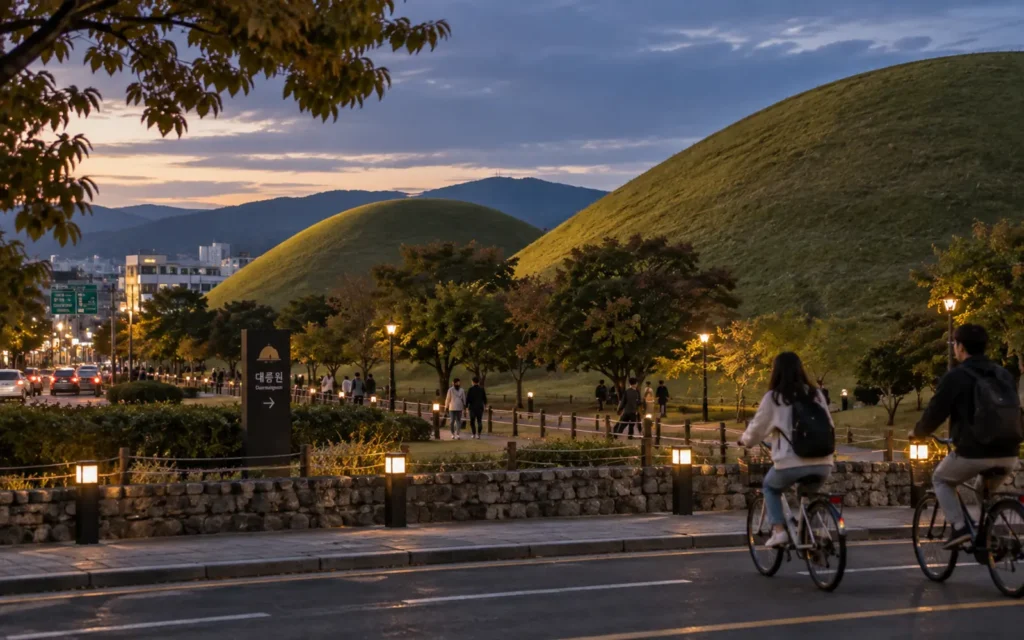
At dusk, cyclists slip past grass-covered burial mounds rising behind a row of low buildings.
A couple carrying iced coffee stops beside one of them, studying its curve before moving on. Across the road, traffic lights change, buses pull away and restaurant signs flicker on.
The mounds do not sit behind museum gates. They occupy the middle of Gyeongju.
For nearly a thousand years, this city anchored Silla, a kingdom that endured from 57 BCE to 935 CE and shaped much of the political, religious and artistic vocabulary that later Korean societies inherited. Gyeongju served as its capital for 992 years. Palaces, royal tombs, Buddhist temples, fortresses and stone monuments still trace that history across the modern city, dense enough that UNESCO treats five separate archaeological zones as parts of a single historic landscape.
992 YEARS AS A CAPITAL
Gyeongju, then known as Seorabeol, served as the capital of Silla for 992 years.
Before Seoul, There Was Seorabeol
Long before Seoul became the centre of Korean political life, Silla’s rulers governed from a city known as Seorabeol.
The kingdom began in the southeast of the peninsula and endured through centuries of shifting alliances and warfare with Baekje and Goguryeo. By the seventh century, Silla had defeated its two principal rivals with Tang Chinese assistance, then fought Tang forces as control of the peninsula was redrawn. Gyeongju emerged from that upheaval as the political centre of a larger and wealthier state.
Power left marks on the ground. Royal compounds occupied the Wolseong area. Elite families buried their dead beneath enormous earthen mounds. Temples spread through the capital and onto nearby mountains. Roads, ponds and defensive works organised a city whose political reach extended far beyond its own valley.
UNESCO’s Gyeongju Historic Areas preserve five broad concentrations of that world: the Namsan, Wolseong, Tumuli, Hwangnyongsa and Fortress belts. Together they retain evidence not only of monuments, but of the layout and social structure of the Silla capital itself.
Gold Under the Grass
The royal tombs appear deceptively simple from outside.
Large green mounds rise from the centre of Gyeongju like pieces of landscape that someone forgot to flatten. Inside, archaeologists found evidence of a court that commanded extraordinary craftsmanship and wealth: gold crowns, belts, earrings, glass, weapons and decorated horse equipment.
The excavation of Cheonmachong in 1973 produced one of Silla’s most recognisable gold crowns, along with the painted saddle flap that gave the tomb its modern name. The crown, dated to the sixth century, carries branching gold ornaments, suspended gold pieces and curved jade decorations. Archaeologists still debate the precise identity of the person buried there.
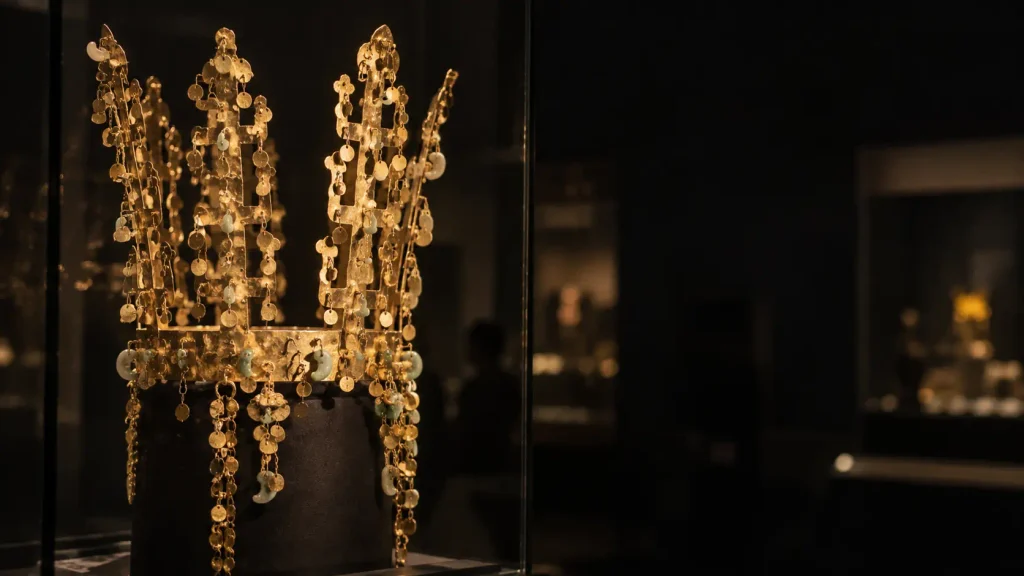
The grave goods complicate any picture of early Korea as culturally isolated. Roman glass and other imported objects point toward networks that crossed Northeast Asia and the Eurasian steppes, while Silla’s goldsmiths developed a visual language distinctly their own.A city in southeastern Korea accumulated foreign materials and ideas, then reshaped them into an unmistakably Silla visual language.
Above ground, children now walk between the tombs with snacks in their hands.
When Buddhism Took Monumental Form
Silla officially adopted Buddhism in the sixth century, and Gyeongju gradually turned religious belief into architecture.
Temples rose across the capital and the mountains surrounding it. On Namsan alone, UNESCO records the remains of 122 temples, 53 stone statues, 64 pagodas and 16 stone lanterns among the sites known when the historic areas were inscribed. The mountain reads less like a single sanctuary than a religious landscape assembled over generations.
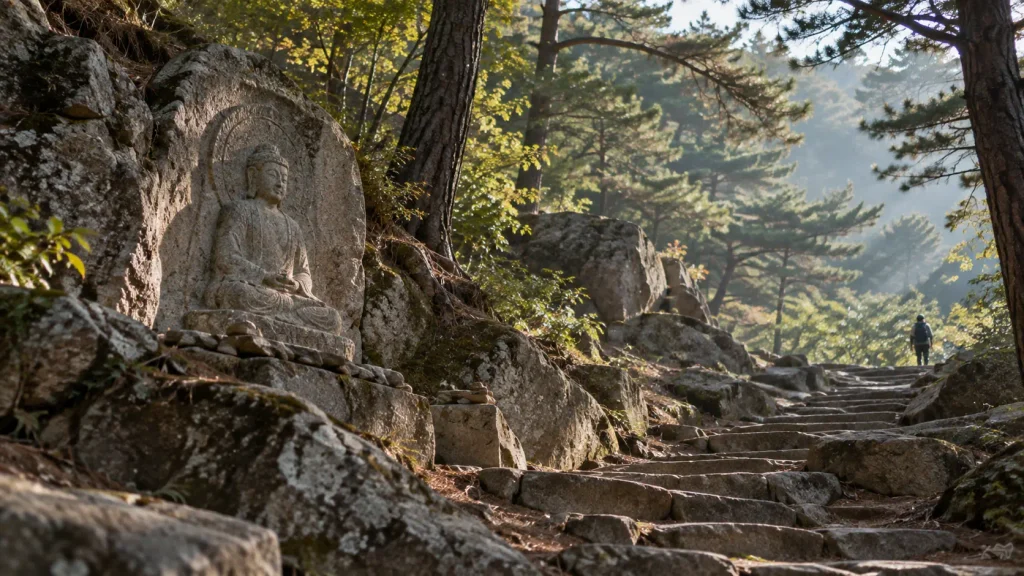
The artistic ambition reached its clearest expression outside the city centre at Bulguksa and Seokguram. Built and developed during Silla’s eighth-century cultural flowering, the temple’s stone terraces and pagodas and Seokguram’s granite Buddhist sculpture became defining works of Korean Buddhist art. UNESCO inscribed the two together as a World Heritage property in 1995.
Religion here also worked as statecraft. Temples projected royal authority, connected the court to Buddhist intellectual worlds abroad and gave the capital a ceremonial landscape equal to its political ambitions. Stone endured after the dynasty that commissioned it vanished.
The Sky Was Part of Government
A short walk from the royal palace ruins brings another kind of Silla monument into view.
Cheomseongdae rises only a little over nine metres, its curved stone body narrowing before opening into a square frame at the top. It was probably constructed during the reign of Queen Seondeok, who ruled from 632 to 647. Its name translates as a platform for observing the stars, and Korea’s heritage authorities describe it as the oldest surviving astronomical observatory in Asia while noting that scholars have proposed other ritual or symbolic interpretations of the structure.
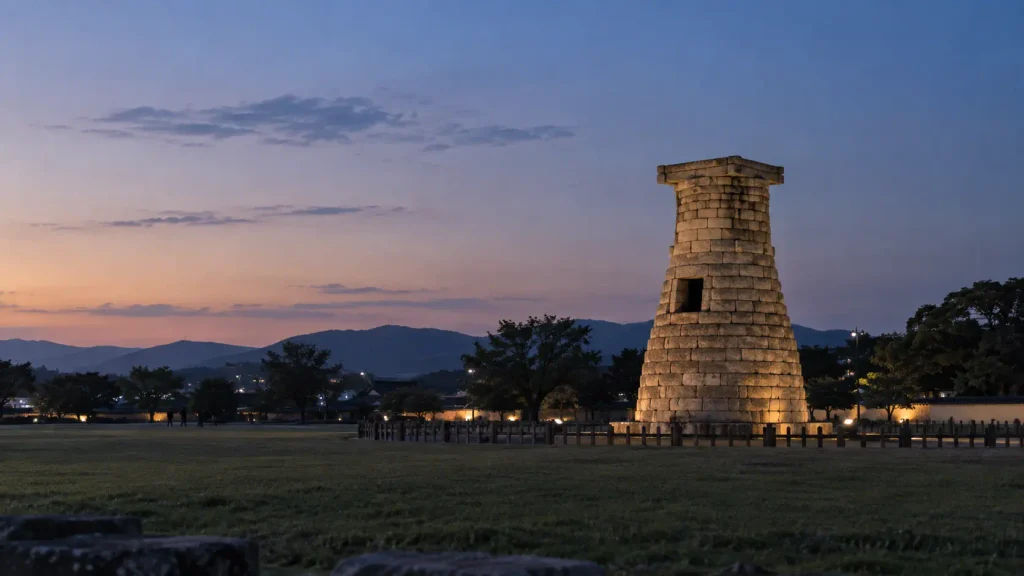
Astronomy carried practical and political weight. Celestial observation helped agricultural societies track seasons; rulers also read events in the sky as signals tied to the fortunes of the state. Science, farming, ritual and authority met in the same field.
Today the tower stands beside walking paths and flower fields. Visitors circle it with phones raised while nearby cars move through the former royal capital.
The distance between seventh-century astronomy and a weekend evening can be a few metres.
A Palace Survives as Water and Stone
Gyeongju often preserves history in fragments rather than complete buildings.
At Donggung Palace and Wolji Pond, the royal architecture largely disappeared, leaving water, reconstructed structures and archaeological traces to suggest the scale of the original compound. The site served Silla crown princes and hosted banquets for officials and foreign envoys; the pond was created during the reign of King Munmu.
Elsewhere, Hwangnyongsa survives principally through foundations and archaeological evidence. Wolseong is read through earthworks, excavation trenches and reconstructed understanding. Entire buildings can be absent while their former position still controls how the landscape is interpreted.
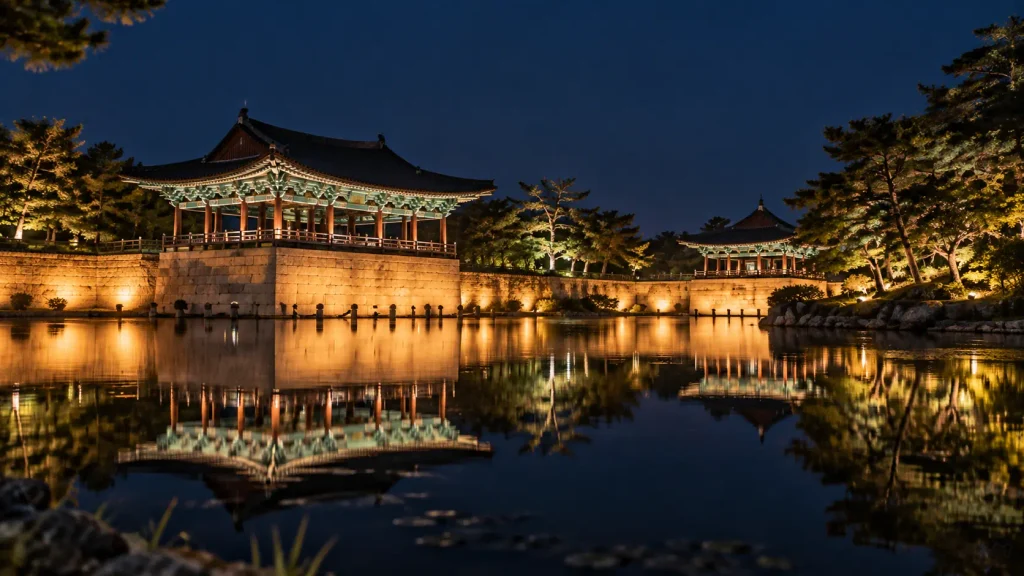
That incompleteness gives Gyeongju a different texture from a preserved historic town. The city does not offer one intact ancient street. It asks visitors to assemble a vanished capital from burial mounds, stone foundations, surviving monuments and the spaces between them.
Archaeology fills the missing walls.
The Past Still Complicates the Present
Gyeongju’s history does not remain politely inside designated attractions.
Much of the ancient capital lies beneath a functioning modern city. UNESCO notes that archaeological heritage is so extensive that cultural-heritage impact assessment is required before construction in protected areas, while development around major sites remains tightly controlled. Building height, design, traffic and the visual setting of the historic zones all enter the preservation equation.
That creates an urban problem few cities face at the same scale. Roads must serve residents without cutting the historic landscape apart. Businesses need buildings. Homes need renovation. Archaeologists may discover that the ground underneath an ordinary development plan belongs to a much older city.
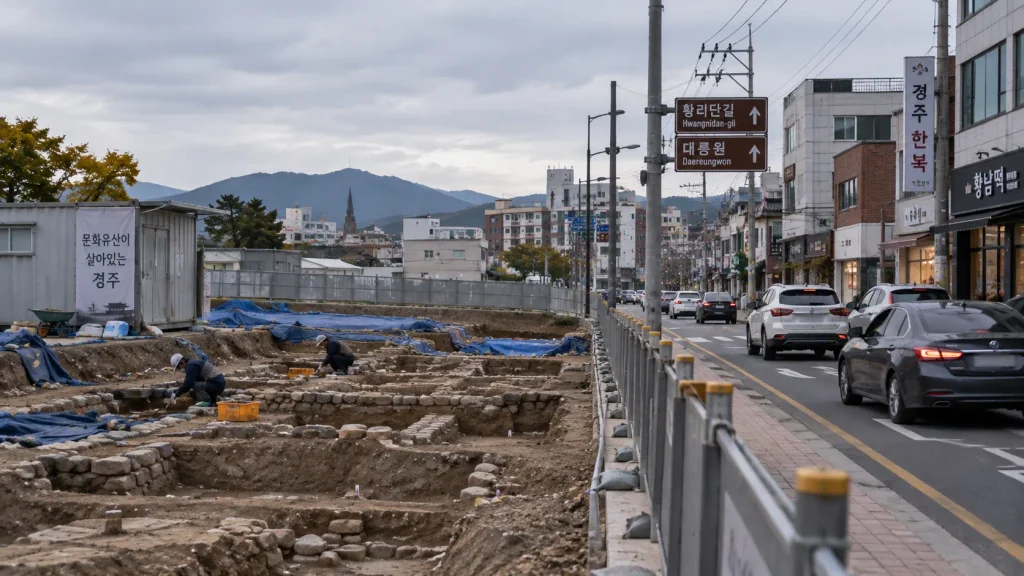
Gyeongju therefore grows with a kind of historical friction. Its importance restricts it as much as it promotes it.
The ancient capital still has a vote in what gets built above it.
History Without a Museum Door
The phrase “museum without a roof” appears often in descriptions of Gyeongju, including the city’s own account of itself. The comparison works because Silla heritage rarely arrives as a single collection enclosed by walls. It spreads across fields, mountains, neighbourhoods and roads.
The density is difficult to reproduce elsewhere in Korea. A royal tomb can sit beside a café district. Cheomseongdae stands within walking distance of palace remains. Buddhist sculpture appears on Namsan while gold crowns from nearby burial mounds rest inside the national museum. Sites separated by centuries still belong to the same urban journey.
Gyeongju also complicates the habit of reading Korean history backward from modern Seoul. Political power moved repeatedly after Silla fell in 935, eventually settling elsewhere. The physical evidence of an earlier centre stayed concentrated here.
A capital can lose its government and keep its historical gravity.
After the Tour Buses Leave
Night settles quickly around the burial mounds.
The paths stay lit, and the grass turns nearly black against the sky. People drift toward restaurants and cafés while a few walkers remain beside the curved silhouettes, their conversations low enough to disappear into the open ground.
No palace rises above them now. The rulers have no names written across the skyline.
A bicycle bell sounds near the edge of the park. Someone steps aside, then keeps walking past a royal tomb that has occupied the same patch of earth for roughly fifteen centuries.
