A woman pauses halfway up a staircase, one hand resting on the railing and the other steadying her phone.
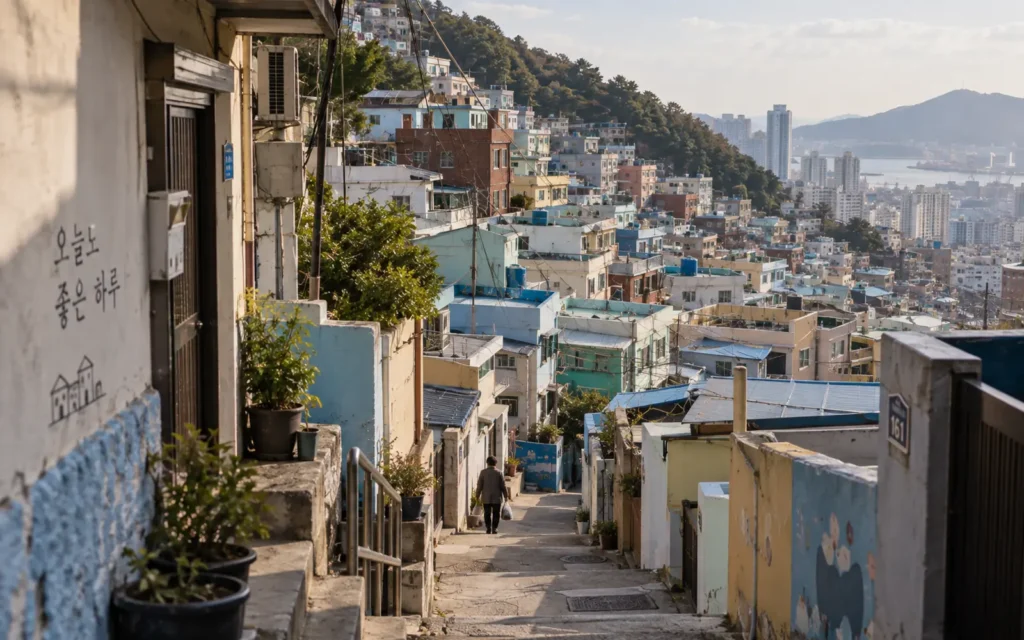
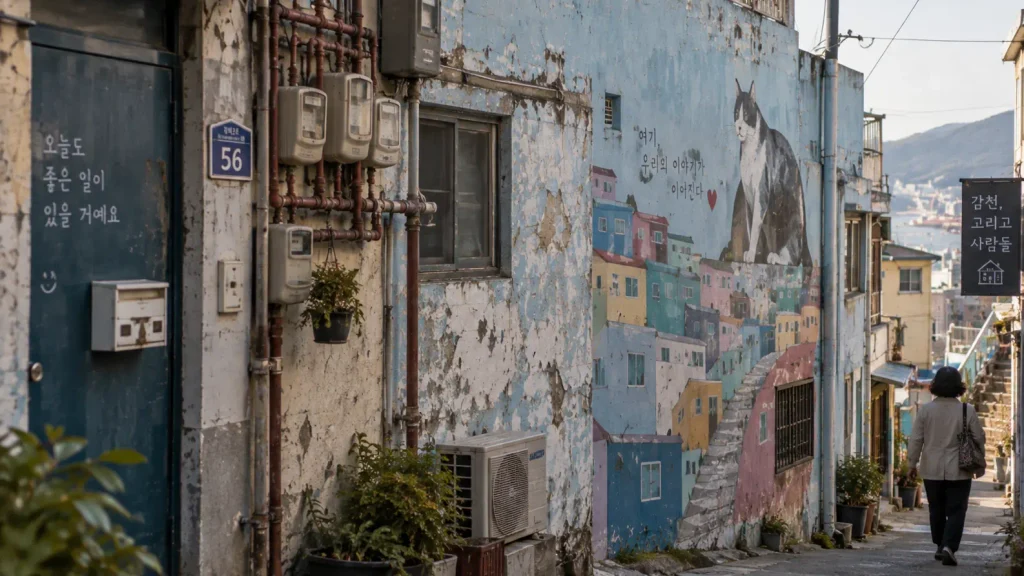
Below her, rooftops stack tightly across the hillside in faded blues, oranges and greens. Laundry hangs between houses. A metal gate opens. A scooter slips through an alley barely wide enough for it.
From above, Gamcheon can look almost unreal.
From inside, it feels much more ordinary: homes, shops, stairs, walls and doors. The tension between those two views sits at the centre of the village’s identity.
Gamcheon did not begin as an art destination. Its hillside community took shape in the 1950s as Korean War refugees and members of the Taegeukdo religious community settled on steep land on the edge of Busan. By the 1990s, its population had reached an estimated peak of 25,000. Decades later, a community-led art project began transforming neglected houses and alleys into places visitors wanted to photograph.
A City Built on a Slope
Gamcheon makes more sense from the side than from the postcard.
The village climbs the mountainside in layers, following the contours of the land rather than a conventional street grid. Stairs replace gentle roads. Alleys bend around buildings, narrow suddenly and open onto small terraces overlooking western Busan.
The arrangement began with necessity. During the Korean War, displaced people needed somewhere to live in a city absorbing a huge refugee population. The settlement grew across difficult terrain, with houses adapting to the slope rather than reshaping it.
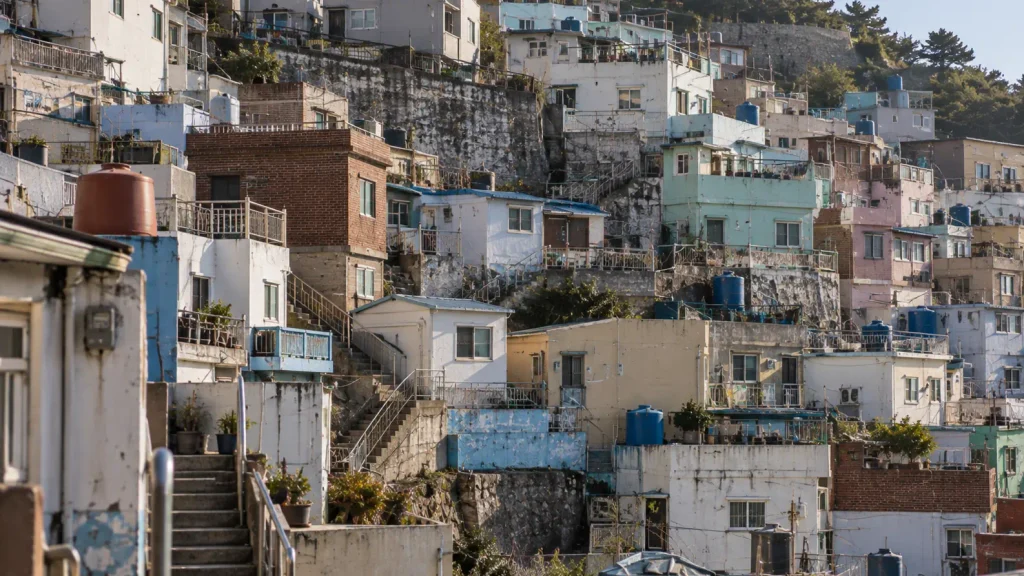
Busan’s heritage records date the present village formation to 1955, when the Taegeukdo community moved collectively into Gamcheon-dong. The landscape that later attracted photographers began as a response to limited land, limited money and a city under pressure.
Its beauty came afterward.
When the View Became the Story
For years, Gamcheon functioned primarily as a residential neighbourhood. Its steep terrain and ageing housing stock offered little reason for outsiders to visit.
Then came a different proposition.
In 2009, Gamcheon was selected for the Village Art Project, bringing residents, artists and students into the process of reshaping parts of the neighbourhood. Murals appeared. Sculptures occupied corners. Neglected spaces found new uses.
1955 → 2009
Gamcheon’s modern story spans more than half a century: the Taegeukdo community moved into the area in 1955, while the Village Art Project selected Gamcheon in 2009.
The projects worked around the existing settlement rather than clearing it. A second project followed in 2010, while a residents’ organisation formed that same year. Environmental improvements and cultural programmes gradually added another layer to the village.
The camera followed.
Art Arrived Without Moving the Houses
The transformation worked partly because it avoided the clean slate.
Instead of demolishing the village and constructing a new cultural district, artists and residents worked with the stairs, alleys, houses and sightlines that were already there. Colour spread across walls. Small studios and workshops occupied adapted spaces.
Visitors encounter murals and sculptures alongside objects that belong to ordinary life. Busan’s tourism authority presents the village as a meeting point of history, culture and art, while its National Geopark highlights the relationship between the tiered houses, mountain terrain and maze-like alleys.
That mixture gives Gamcheon its visual force.
The colourful rooftops provide the wide shot. A narrow staircase, laundry basket or half-open door supplies the close-up.
The village never stopped being a neighbourhood. It acquired another life on top of the first.
Then the Tourists Came
Once Gamcheon entered travel guides and social media feeds, the scale of the place changed.
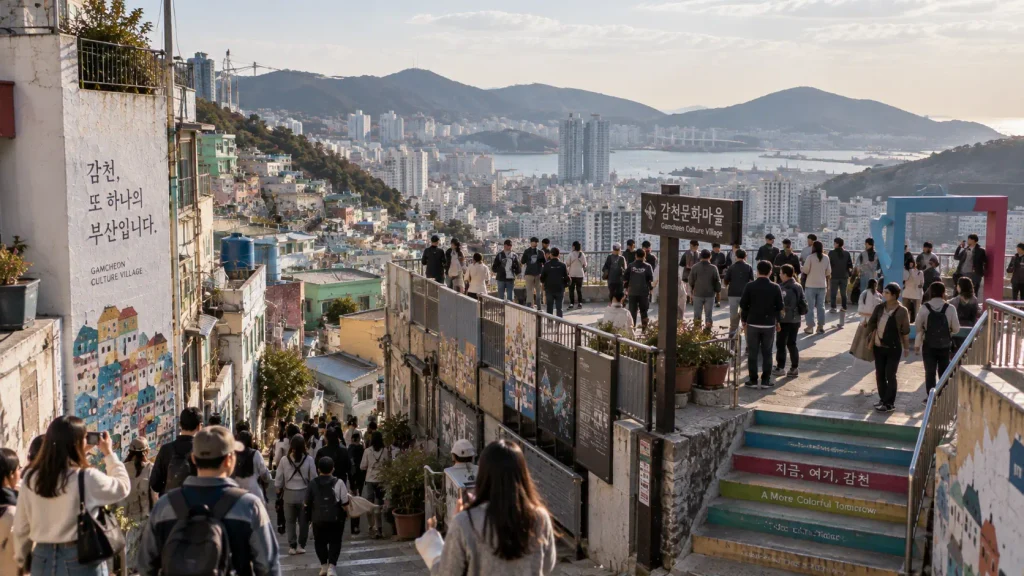
Visitors arrived looking for viewpoints, murals and the stacked rooftops. Busan began promoting the village as a major cultural attraction, while experience programmes, craft workshops and walking routes developed around it. Current tourism material describes Gamcheon as a major landmark of western Busan and says more than three million people visit each year.
Those numbers sit awkwardly beside its residential character.
People still live behind the painted walls. Residents carry groceries up the same stairs tourists climb for photographs. A bedroom window can sit directly above a souvenir shop.
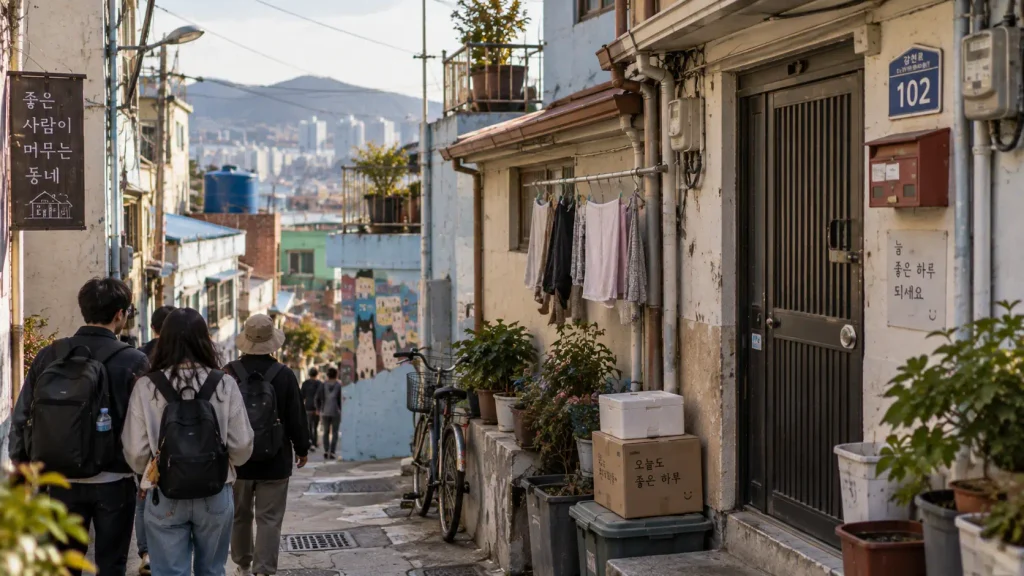
The proximity creates friction as well as opportunity. Visitors stop to photograph a doorway. Someone still needs to open it.
The Village That Became Busan
Busan has plenty of places that represent the city: its port, beaches, fish markets, film culture and dense central districts.
Gamcheon contributes something different.
Its landscape compresses part of Busan’s postwar history into one hillside. Refugees built homes on difficult terrain. A marginal settlement became a dense community. Artists and residents later recast parts of that environment as a cultural space.
Busan selected Gamcheon as a Busan Future Heritage in 2021, recognising its historical and living-cultural value and its later transformation through community-centred cultural regeneration.
Without the history underneath them, the blue roofs and painted walls would simply make a good photograph.
What Gets Preserved When a Place Changes?
Urban regeneration often follows a familiar formula: clear the old buildings, widen the roads and build something new.
Gamcheon took a slower route.
Its narrowness remained. So did much of its irregular architecture and everyday texture. The approach produced a place that feels unlike a purpose-built tourist district, while leaving residents living inside the attraction.
The colour draws the eye.
The neighbourhood asks you to look longer.
Busan’s current tourism guidance explicitly reminds visitors that Gamcheon remains a residential community and asks them to respect the people who live there. Local programmes likewise frame the neighbourhood through its refugee history, architecture and community-based regeneration.
The village keeps asking visitors to look twice.
First at the colour.
Then at the life underneath it.
The Photograph Has to Wait
Late in the afternoon, the upper terraces begin to empty. A few visitors remain at the viewpoints, checking their photographs before starting back down the stairs.
Below them, the village settles into its quieter rhythm.
A resident carries groceries through an alley. A door closes. Laundry moves in the breeze between two houses painted different shades of blue.
From the hillside, Gamcheon still looks like a picture.
Up close, someone is still living inside it.