
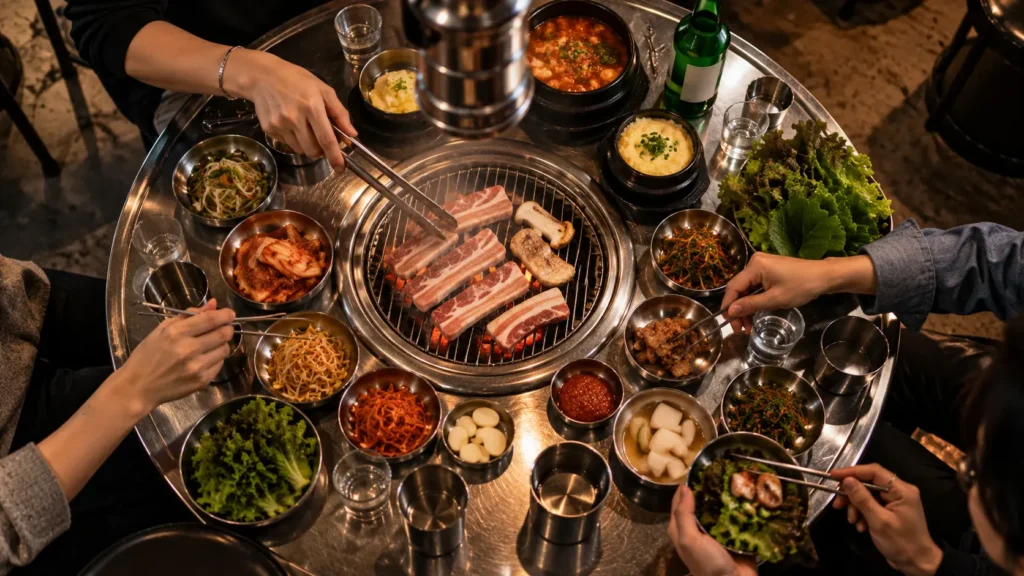
The tongs move before anyone reaches for the chopsticks.
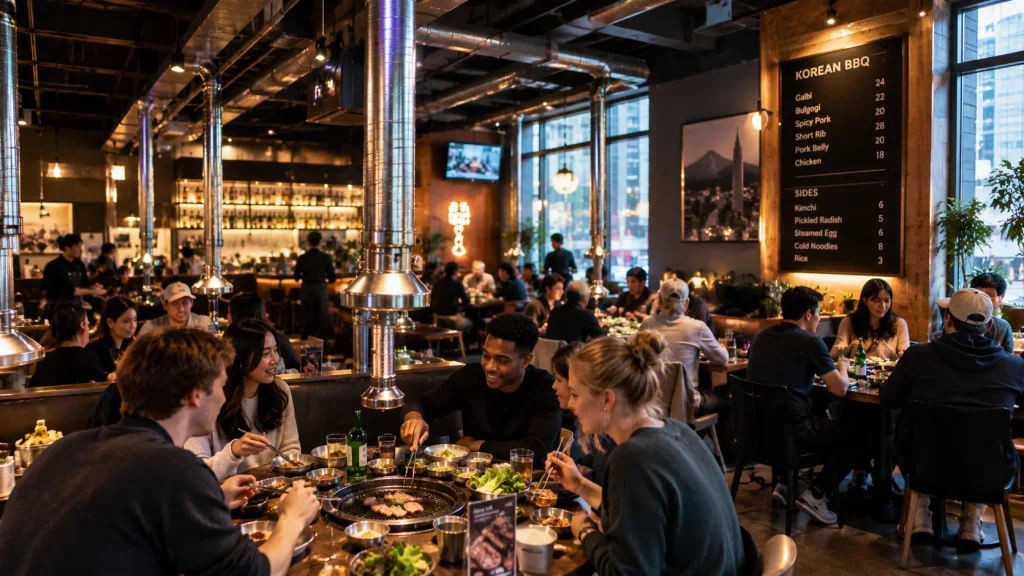
A server lays thin slices of pork across the metal grill sunk into the middle of the table. Fat hits the heat and snaps. Someone leans forward with a pair of scissors, cutting the meat into smaller pieces while another hand turns them with tongs. Soju passes from one person to the next. Lettuce leaves gather beside kimchi and ssamjang. Pieces disappear almost as soon as they come off the fire.
Nobody seems to have come simply to eat meat.
The grill has rearranged the table. People lean toward one another, monitor the cooking, argue over whether another thirty seconds will help, refill a glass and reach across for garlic or sauce. Korean barbecue places the cooking itself between the diners, where a restaurant kitchen would normally keep it out of sight.
That small design decision helps explain the staying power of Korean BBQ. The meat matters, certainly, but so do the actions surrounding it — who orders, who cooks, who serves, who pours, who pays and who quietly takes responsibility for the next batch. Over time, the grill became a setting for family dinners, friendships, dates, celebrations and the ordinary business of eating together.
The Grill Moved Into the Middle of the Table
Korean BBQ changes the architecture of a restaurant.
The kitchen effectively ends at the table. Diners receive raw or partially prepared ingredients and a cooking surface, then decide how quickly the meal should move.
Meat goes down first. Vegetables, sauces and side dishes gather around it. Staff may replace the grill, adjust the heat or help manage the meat, but much of the meal remains in the hands of the people eating it.
For a visitor accustomed to restaurants where the chef controls nearly every stage, the arrangement can feel unusually participatory.
The tradition did not emerge from a single invention. Korean gogigui, the broader practice of grilling meat, developed alongside changing diets, urbanisation and rising incomes during South Korea’s rapid economic development in the second half of the twentieth century.
Meat itself carried weight. Beef and pork had once occupied a less routine place in everyday meals. As prosperity spread, they moved more comfortably into ordinary social dining. Restaurants built around the grill could then sell something beyond the food itself: a reason for people to stay at the same table.
The grill supplied the evening with a clock.
Someone Always Ends Up Holding the Tongs
Spend enough time at a Korean BBQ table and a small hierarchy appears.
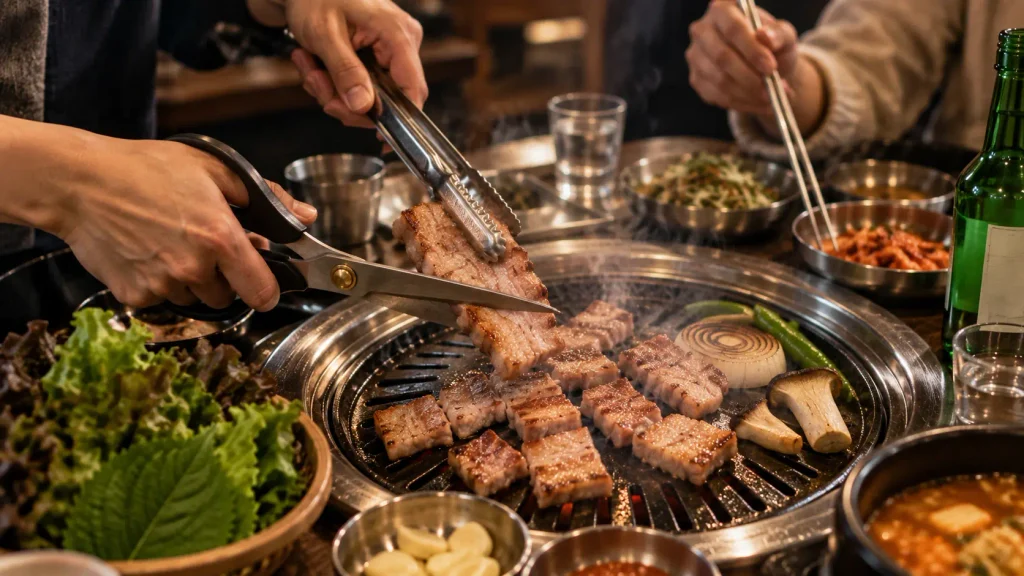
One person takes control of the grill. They turn the meat, judge the heat and decide when a piece has reached the moment when everyone else should take it. Another diner cuts the meat with scissors, separating pieces so they cook evenly.
The role rarely remains fixed.
A friend takes over. Someone complains that a piece has been left too long. Another diner reaches across the table to rescue one before it burns.
These tiny negotiations are part of the meal.
Korean dining places considerable emphasis on sharing, and barbecue intensifies that habit because the food physically belongs to the space between people. A plate of meat arrives at the table before it belongs to any individual. Kimchi, lettuce, garlic, mushrooms and dipping sauces follow the same logic.
Even cooking becomes collective.
The person holding the tongs has, for a few minutes, taken responsibility for everyone else’s dinner. Nobody needs to announce the arrangement. Someone simply picks up the tongs and starts.
Meat Became a Different Kind of Occasion
Korean BBQ also carries a longer history of how meat came to occupy a more visible place in Korean dining.
Grilled beef dishes such as bulgogi and galbi developed distinctive positions in Korean cuisine, while charcoal grilling and marinated meat became associated with gatherings and special meals. The modern restaurant format grew alongside Seoul’s transformation into a dense, urban dining culture where eating out became part of ordinary social life.
As meat moved from something relatively occasional towards something more accessible, the social meaning around it shifted.
The same table can accommodate a birthday, a reunion, a work dinner or an ordinary Friday night. University friends and office colleagues can occupy almost identical seats around almost identical grills.
The format does not demand ceremony.
It has a habit of creating one anyway.
The Side Dishes Refuse to Stay on the Side
Before the meat is fully cooked, the table may already be crowded.
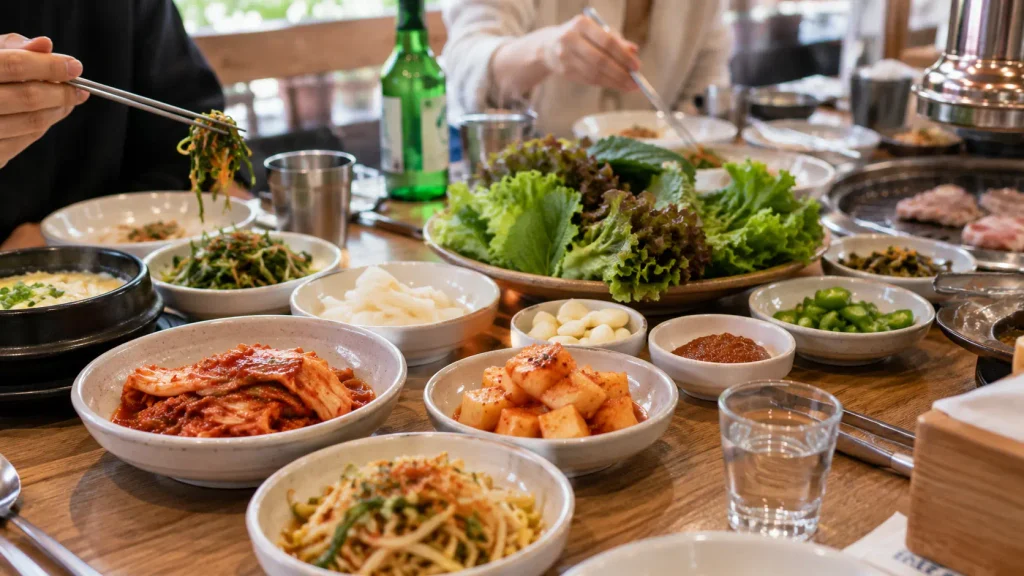
Kimchi arrives with seasoned vegetables, pickled radish, garlic, green onions, sauces and lettuce leaves. Depending on the restaurant, small plates spread almost from one side of the table to the other.
The meat sits in the centre.
It does not control what happens next.
One piece of pork disappears into lettuce with garlic, ssamjang and kimchi. Another gets dipped in salt. Someone adds rice. Someone else reaches for pickled radish.
The combinations keep changing.
That makes Korean BBQ feel less like a fixed sequence of courses and more like an open assembly. Each bite can be constructed differently, then rebuilt a few seconds later.
For someone encountering the format for the first time, the number of small dishes can seem extravagant. Within Korean dining culture, the abundance reflects a broader idea of the shared table, where side dishes accompany the meal without simply decorating it.
The grill stays at the centre.
Everything else keeps moving around it.
The Restaurant Became Part of the Night
Korean BBQ also fits a particular rhythm of urban life.
In Seoul, dinner can begin after work and continue through several places without anyone considering the transitions unusual. A group meets for barbecue, walks somewhere for drinks and perhaps ends the night with a late snack.
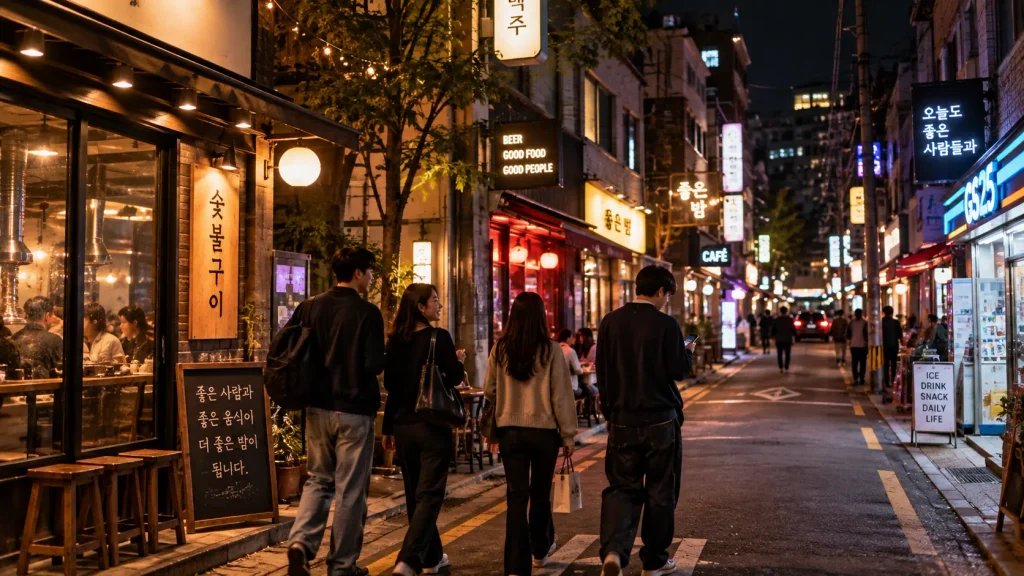
The grill fits neatly into that sequence.
A barbecue restaurant gives a group enough structure to gather, enough food to share and enough time for conversation to stretch. The grill itself needs attention, which provides its own reason to remain at the table.
Work dinners added another layer.
The Korean hoesik, or company dinner, historically brought colleagues together outside the office, often over meat and alcohol. Those gatherings have changed as younger workers reshape expectations around corporate socialising, and long drinking sessions are no longer as universal as they once were.
The restaurant has adjusted, The grill remains.
The Sound of Korean BBQ Travels Well
There is a sensory reason the format has travelled so effectively beyond Korea.
The meat arrives raw or partially prepared. The grill heats. Fat crackles. Smoke rises. Someone turns a piece. The smell drifts towards the next table.
The customer watches the food transform.
That visibility gives Korean BBQ a theatrical quality without requiring a performance. Nothing appears fully finished. Dinner happens in front of you.
Restaurants overseas recognised the appeal quickly.
Korean BBQ establishments spread across major cities, from Los Angeles and New York to London, Sydney and Singapore. Some reproduce the tabletop grill almost exactly. Others adjust the setup to local regulations, restaurant layouts and dining habits.
Details change.
Charcoal may give way to gas or electric grills. Beef cuts shift with local supply. Portions can shrink or expand. Side dishes can become more restrained.
The central ritual survives: gather around the heat, cook together, eat immediately.
Seoul Put a Social Life Around the Grill
Korean BBQ restaurants rarely function as isolated food destinations.
They sit in commercial districts, neighbourhood streets and areas already associated with nightlife. A restaurant may be positioned between a bar, convenience store and café, making the meal one part of a longer evening rather than the entire destination.
That helps explain the appeal of districts where dining and nightlife overlap.
A group can meet for barbecue, walk for coffee and finish somewhere else. Seoul supplies the movement between them. The meal becomes one chapter in a night that continues after the plates are cleared.
For foreign visitors travelling independently, Korean BBQ can start as a simple restaurant recommendation and become an introduction to the way social time works in Seoul: around tables, in groups, across neighbourhoods, without a hard boundary between dinner and whatever comes next.
The restaurant door does not necessarily mark the end of the experience.
It opens onto the rest of the evening.
Korean BBQ Does Not Ask You to Eat Quietly
Some cuisines place the finished dish firmly at the centre.
Korean BBQ puts the interaction around the dish on display.
People talk while they cook. Portions get watched. Sauces move from one side of the table to another. Food crosses between plates. Every few seconds, the meal gives someone a practical reason to interact.
The pattern becomes especially visible when acquaintances are still getting comfortable with one another.
“Is this cooked?”
A hand reaches across.
A piece gets cut in half.
The grill needs turning.
Conversation finds its next subject.
The mechanics of dinner keep producing contact. Nobody has to sit silently over a finished plate while searching for something else to say. The food keeps creating small tasks.
Younger Koreans have also adapted the format to changing social habits. Groups can drink less, stay for less time or treat barbecue as an occasion without following older expectations around company dining.
The grill never insists on one particular kind of evening.
The Global Version Has Started Changing
Korean BBQ has travelled far enough that there is no single overseas version.
56 COUNTRIES
Korean food-service companies operated 4,644 overseas outlets across 56 countries by the end of 2025.
In Los Angeles, the format became deeply embedded in the city’s food culture through generations of Korean immigrants and Korean American communities. Elsewhere, diners encountered it later through the wider international rise of Korean food and popular culture.
The newer global audience arrives with different levels of familiarity.
Some customers know the difference between samgyeopsal and galbi before sitting down. Others arrive with a much simpler idea: Korean BBQ means meat cooked at the table. Restaurants adjust, offering familiar cuts alongside dishes designed for first-time diners.
The language travels with the food.
Samgyeopsal.
Bulgogi.
Galbi.
Ssam.
Banchan.
Soju.
These words now appear on menus far beyond Korea without requiring a full cultural briefing.
By the end of 2025, Korean food-service companies operated 4,644 overseas outlets across 56 countries, with the United States accounting for 1,106 of them.
The food has become familiar enough that the customer can enter without a guide.
The second visit still depends on what happens after the first bite.
K-Pop Opened Doors, the Grill Kept Them Open
Korean popular culture gave Korean food an enormous international audience.
A drama can make ramyeon look irresistible. A celebrity can suddenly make a restaurant visible. A K-pop fan arriving in Seoul may already have a list of Korean dishes to try.
Korean BBQ benefits from that attention without depending entirely on it.
The meal works even when nobody at the table recognises the singer on the poster or has watched a Korean drama. Meat browns on the grill. Smoke rises. Someone reaches for lettuce.
The cultural reference can disappear.
The dinner remains.
That durability matters as Korean food continues expanding internationally. The strongest dishes do not require diners to become experts in Korean culture before sitting down.
Korean BBQ offers one of the fastest entries.
Sit down. Pick up the tongs. Wait for the meat to brown.
The explanation can come later.
The Grill Also Tells a Story About Korean Hospitality
There is a familiar Korean dining habit of keeping food within reach of other people.
A host refills a guest’s glass. Someone serves meat to someone else. A side dish moves across the table without ceremony. Hospitality appears through small acts that are easy to overlook until you are the person receiving them.
Korean BBQ gathers those gestures around a single object.
The grill.
Someone watches your meat while you talk. Someone notices the lettuce is nearly gone. A friend slides the sauce closer. The person who has spent ten minutes cooking finally puts down the tongs and starts eating.
Nobody needs to label any of it hospitality.
It simply happens.
That may explain why Korean BBQ can feel communal even when the people at the table do not share a language. The social rules are built into the mechanics of dinner. You learn the rhythm by taking part.
Why Does Korean BBQ Feel So Korean?
The grill itself is not uniquely Korean.
Many cultures cook meat over fire. Korean BBQ takes that familiar act and builds a particular social system around it: shared cooking, banchan, sauces, drinking, conversation and a restaurant format designed to keep the meal moving.
The arrangement resists isolation.
You do not have to order the same thing as everyone else. You do not have to construct every bite in the same way. What everyone shares is the table and the heat in its centre.
That fits a broader Korean preference for meals that create proximity between diners.
Rice can be eaten alone. A stew can be shared. A table full of banchan can serve several people at once. Korean BBQ pushes that communal logic directly into the cooking process.
The food becomes something the group does together.
The Tongs Come Back Around
Later in the evening, the grill looks different.
The first pieces of meat are gone. Lettuce leaves have thinned out. A little kimchi rests at the edge of a dish while empty plates have been pushed towards the side. The heat has faded.
Then another order arrives.
The server sets down a fresh plate of meat. Someone clears space on the grill. Another person picks up the tongs, without anyone formally asking.
The conversation continues.
Pork touches the heat and begins to hiss.
A hand reaches for the scissors.
Around the table, everyone leans in again.