The spoon usually arrives before the first bite.
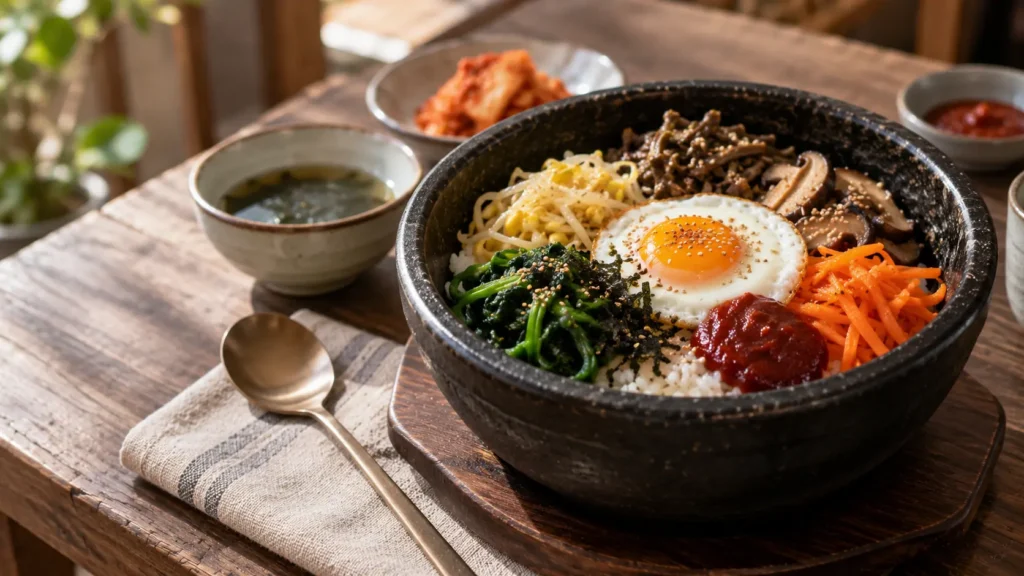
A bowl sits in front of the diner with almost suspicious neatness. White rice fills the bottom. Spinach, bean sprouts, mushrooms, carrots and fernbrake occupy separate sections around the edge. A fried egg rests on top, its yolk catching the light. A small mound of red gochujang waits to one side.
For a few seconds, the bowl looks too carefully arranged to disturb. Then the spoon goes in, lifting rice through the vegetables as the egg breaks and gochujang spreads into the grains. Sesame oil follows. A few turns of the spoon and the separate ingredients begin to lose their boundaries.
Bibimbap literally refers to mixed rice, and the dish carries that small contradiction all the way to the table. It arrives divided into parts, then asks the diner to dismantle the arrangement. Different flavours, textures and colours merge without becoming anonymous. That habit fits comfortably within Korean dining culture, where rice provides a foundation and vegetables, side dishes and seasonings gather around it. Bibimbap puts that instinct into one bowl.
The Bowl Arrives in Pieces
The first thing to notice about bibimbap is how little it resembles itself before the mixing starts. A typical bowl presents its ingredients individually: vegetables in separate portions, meat in one section, an egg at the centre and gochujang nearby, leaving the diner to decide how much heat belongs in the meal.
The arrangement creates visual order before the spoon removes it. One person may add a generous spoonful of gochujang and mix vigorously; another may use less sauce, keeping the vegetables more distinct. Someone else may add sesame oil, break the egg immediately and work slowly from the bottom.
The kitchen prepares the components. The diner finishes the dish.
Then Someone Reaches for the Spoon
There is a moment when bibimbap stops looking like a collection of ingredients. The egg yolk breaks, the sauce moves into the rice, vegetables turn over and the spoon pulls everything back towards the centre.
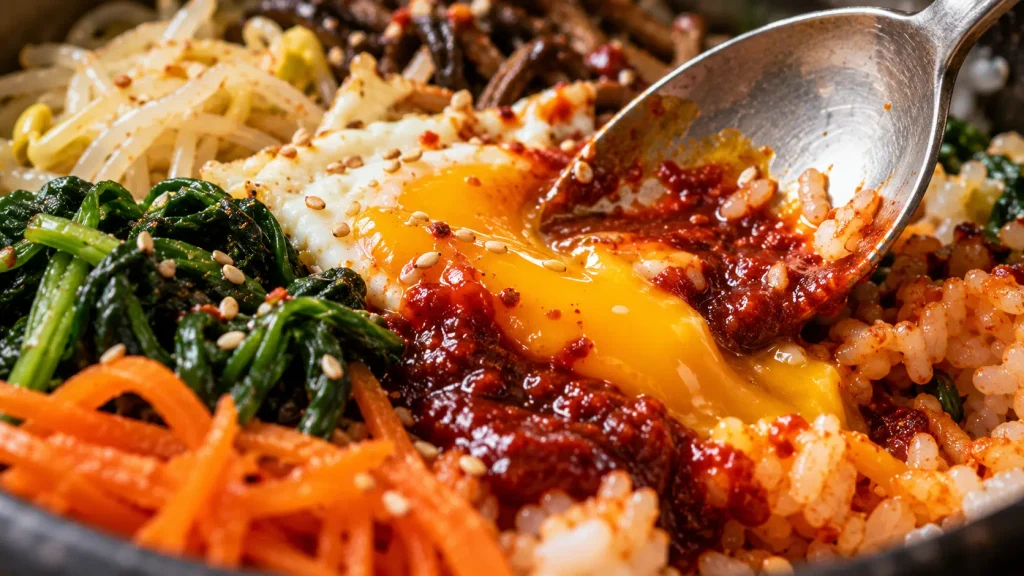
The transformation happens quickly. A bowl that looked almost architectural becomes a loose mixture of rice, vegetables and egg, while individual traces remain: a strand of fernbrake, a piece of carrot, sesame seeds across the surface.
The diner controls the final texture as much as the flavour. One person can mix aggressively while another leaves parts relatively intact, and the bowl accommodates both.
The Rice Holds the Bowl Together
Rice sits underneath everything. Across Korean meals, it provides the familiar centre around which vegetables, fermented foods, soups, meat and sauces gather. Bibimbap builds the entire dish around that relationship.
Vegetables add bitterness, sweetness, freshness and texture. Gochujang brings heat and fermented depth, sesame oil adds fragrance, the egg softens the mixture and meat, when included, contributes savouriness.
Rice absorbs those elements without erasing them. Too much sauce overwhelms the vegetables; too little leaves the rice disconnected. The balance can make the bowl feel hearty and composed at once.
Why Are There So Many Colours?
Before the spoon touches the rice, bibimbap can look almost like a colour study: green spinach, orange carrot, pale bean sprouts, dark mushrooms, brown fernbrake, red gochujang and a yellow egg.
Korean culinary tradition has long paid attention to the appearance of food, and bibimbap makes that especially visible. The dish is sometimes discussed alongside obangsaek, the five colours associated with directions and elements in traditional thought, although actual bibimbap varies widely and does not always follow a strict five-colour formula.
BEFORE THE SPOON
Bibimbap is often photographed before it is mixed, when each ingredient still occupies its own place. The visual order is part of the experience, even though the dish is ultimately meant to be stirred together.
The colours also serve a practical purpose. Different vegetables bring different textures and flavours, and many are prepared and seasoned separately before they meet in the bowl. The eye notices the separation first; the palate discovers the combination afterward.
The Vegetables Were Never an Afterthought
Bibimbap looks simple until the preparation behind it comes into view. Vegetables may be blanched, sautéed or seasoned individually: spinach takes sesame oil and seasoning, bean sprouts retain their crunch, mushrooms develop a deeper savoury character and fernbrake contributes an earthy texture.
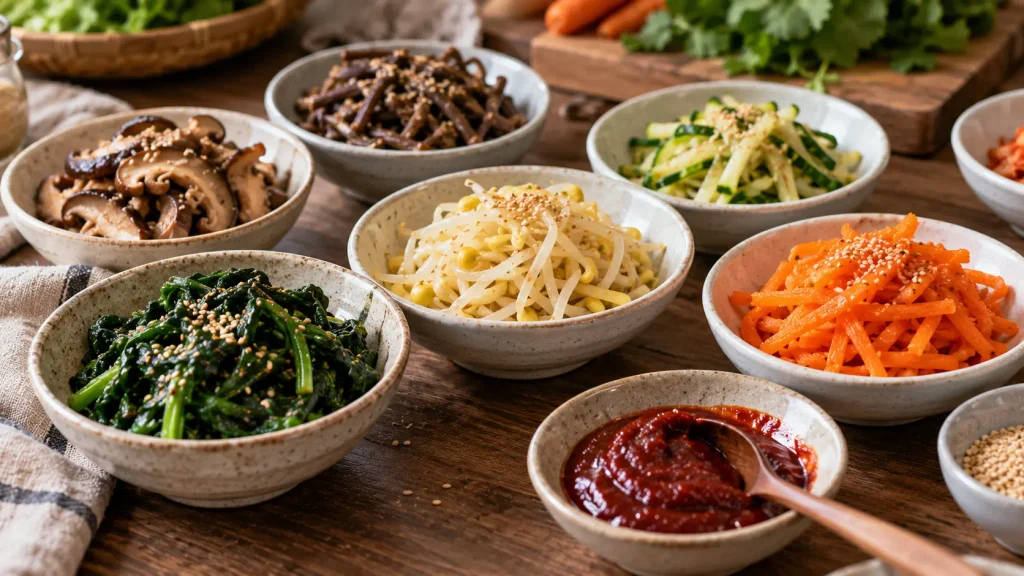
The ingredients meet only at the end. That gives bibimbap its particular tension, allowing each component to retain some character while becoming part of the same mouthful.
It also reflects the practical role of namul on Korean tables. A bowl of rice provides a natural place for several seasoned vegetables to gather, turning ingredients prepared for a broader meal into something complete in its own right.
Bibimbap Changes When the Place Changes
Bibimbap has never settled into one fixed recipe. Jeonju is particularly associated with the dish and has developed its own reputation around carefully prepared ingredients and local food culture. Jinju has its own variation, while Andong is associated with heotjesatbap, a related local dish inspired by foods served during ancestral rituals.
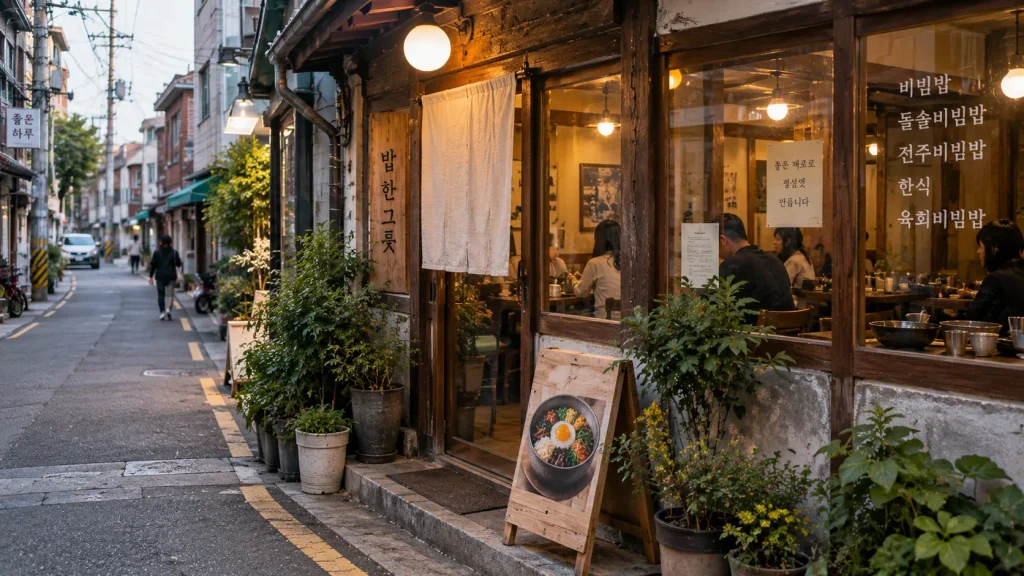
One bowl may feature beef; another may rely heavily on vegetables. A restaurant might add mushrooms, seafood or seasonal ingredients, while a home cook may simply work with whatever remains in the refrigerator.
The substitutions change the bowl without changing its basic structure: rice, ingredients, seasoning, mixing.
Then the Stone Bowl Changed the Experience
Dolsot bibimbap changes the relationship between the bowl and the food. The heavy stone vessel remains hot after leaving the kitchen, pressing rice against the bottom until a crisp layer of nurungji forms.
The sound changes too. Oil meets hot stone, rice crackles at the edges and the diner has to resist stirring immediately.
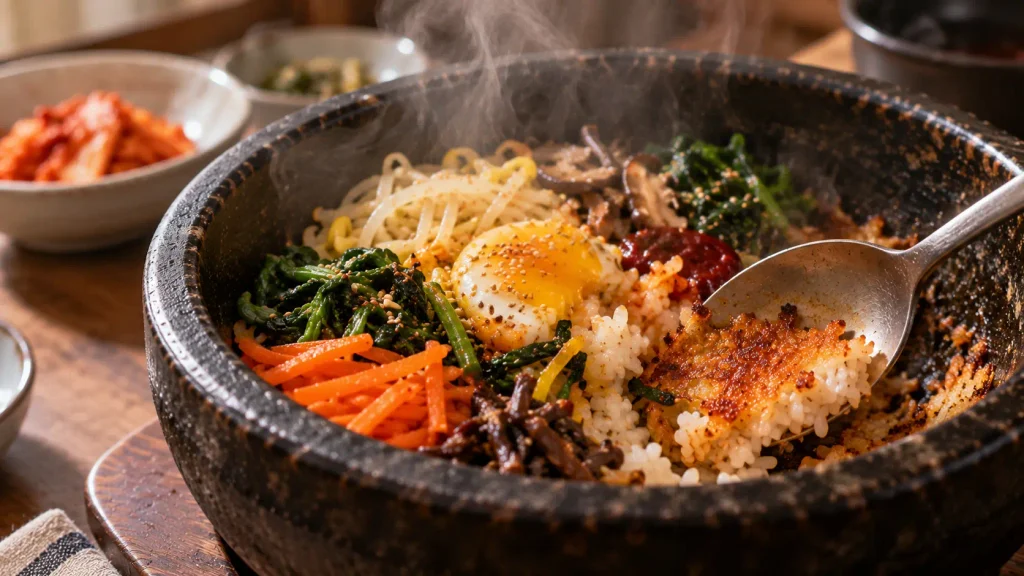
When the spoon finally reaches the bottom, it scrapes against the crust. Soft rice, vegetables and egg give way to something toasted and chewy, making the last few bites feel almost like another dish hiding underneath the first.
Bibimbap Was Ready for a Global Menu
Few Korean dishes travel as neatly as bibimbap. The name has become familiar outside Korea, while the visual format explains much of the dish before anyone describes it: rice, colourful vegetables, egg and red sauce.
That visibility helps first-time diners. They can see what they are ordering, choose meat or vegetables, decide how much sauce they want and mix the bowl themselves.
International Korean restaurants have adapted toppings, portions and presentation to local tastes. The structure survives because the dish never depended on every ingredient remaining in exactly the same place.
K-Pop Did Not Invent the Craving
Korean popular culture has given bibimbap a larger international audience. Korean dramas place food inside everyday scenes, K-pop sends visitors towards Korean restaurants and Seoul food districts, and travel videos turn ordinary meals into destinations.
Bibimbap also photographs unusually well. Before mixing, it offers colour and symmetry. After mixing, the entire bowl changes, giving short-form video an easy transformation to capture.
The screen may show the process.
The diner still has to take the next bite.
The Bowl Leaves Room for Preference
One person may add enough gochujang to turn the entire bowl deep red. Another may use only a little. Someone leaves the egg intact until the final few bites, while another breaks it immediately. A diner can push aside an unwanted vegetable, add extra sesame oil or ask for more meat.
Bibimbap rarely demands uniformity. It provides a framework.
That flexibility helps explain why the dish moves so easily between home kitchens, traditional restaurants, food courts and contemporary cafés.
Everyone starts with the same ingredients. Nobody has to finish them in exactly the same way.
The Spoon Does the Cultural Work
The defining action of bibimbap happens between the untouched bowl and the first bite.
Mixing distributes sauce, breaks the egg, moves vegetables through the rice and changes the texture. The diner decides when the ingredients have crossed the line from separate parts into one meal.
Korean dining contains many dishes intended to be shared from the centre of a table. Bibimbap takes another route: several ingredients occupy one bowl, and the person eating determines how they finally meet.
The sharing happens inside the bowl.
Why Does Bibimbap Still Feel So Korean?
Rice alone cannot explain it. Neither can gochujang, sesame oil, vegetables or the colourful arrangement. Other cuisines combine grains, vegetables and sauces in bowls.
Bibimbap feels distinctly Korean through the way it gathers familiar elements of the Korean table and makes them interact. Namul brings seasoned vegetables, rice provides the centre, gochujang brings fermentation and heat, sesame oil carries aroma and the egg adds richness.
Even the apparent simplicity depends on preparation. Each ingredient reaches the bowl after its own process, then gives up some individuality once the diner begins to mix.
One bite can contain traces of several separately prepared foods.
The Bowl Loses Its Shape
By the end, the careful arrangement has disappeared. Green vegetables run through the rice, red sauce stains the egg white and sesame seeds cling to the spoon. A few pieces of carrot sit against the side of the bowl while the last spoonfuls gather at the bottom.
There is little left to photograph.
The diner leans forward, scraping along the bowl for one last mushroom or a patch of rice carrying just enough sauce. In a stone bowl, the spoon reaches the crisp rice underneath and breaks it loose with a dry scrape.
A moment earlier, every ingredient had its place.
Now there is only the next bite.