Around eleven on a summer night, Myeongdong starts to empty itself.
Shop shutters slide down. Tour groups vanish through hotel doors. The neon remains, but its glare begins to give way to the softer, steadier light of convenience stores.
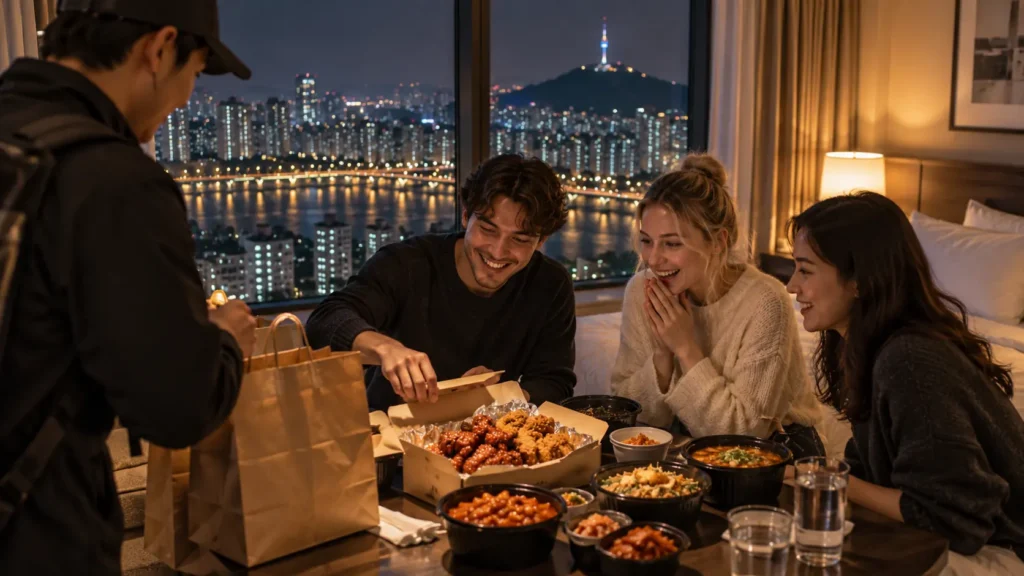
Upstairs, a different Seoul is still awake. On a phone screen, a visitor orders fried chicken, café desserts or something hot enough to require another drink. The map shows a rider moving through the city. A few minutes later, dinner arrives at the hotel.
For years, this was one of Korea’s great invisible conveniences for anyone who lived there and a frustratingly closed system for almost everyone else. Korean-language interfaces, domestic payment requirements and phone-number verification could turn a five-minute food order into a small technical project for a short-term visitor. During the first half of 2026, orders on Baemin made through overseas-issued cards and global payment services surged 331 per cent from a year earlier, while their value rose 308 per cent.
Korea welcomed more than 10 million foreign visitors in the same six-month period. Baemin’s foreign-user orders grew far faster than tourism itself, pulling a habit that once belonged almost entirely to domestic life into the tourist economy. Food delivery has begun to appear on the itinerary.
The Hotel Room Became Part of the Restaurant Map
A familiar Seoul evening follows a simple rhythm: leave the hotel, find somewhere to eat, queue, sit down, continue walking.
Delivery redraws that route.
A hotel room in Jongno can become a late-night chicken shop. An apartment-style stay in Mapo can turn into a table for tteokbokki and beer. Beside the Han River, a patch of grass or a park bench can serve as an open-air dining room, with the meal arriving after the order rather than being carried there beforehand.
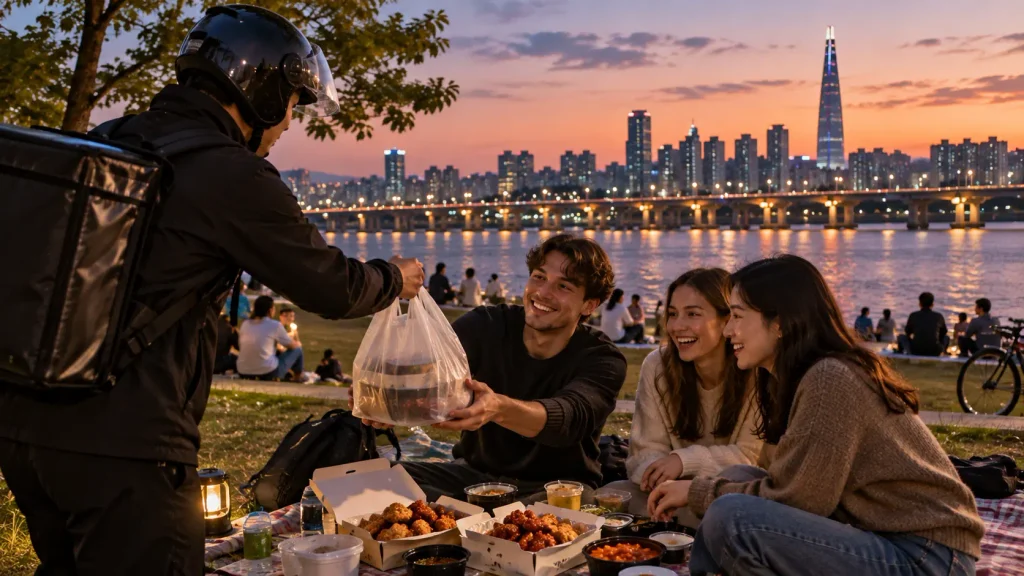
Seoul has started making room for that possibility. In July, the Seoul Metropolitan Government announced a partnership with Baemin aimed at helping international visitors use delivery services, including guidance for orders placed at accommodations and Han River parks. Multilingual information and designated delivery guidance were part of the plan.
It is a curious task for a city famous for teaching visitors how to use its palaces, subways and markets: explaining where to stand while waiting for a scooter.
The Language Barrier Finally Started to Crack
For a short-term visitor, Korean delivery had always carried an awkward contradiction. The service itself was famously efficient. Getting through the front door could be anything but.
Menus were designed for domestic users. Payment systems often expected Korean-issued cards. Addresses and building entrances introduced another layer of friction, especially when the customer and rider did not share a language.
Baemin began dismantling some of those obstacles in 2026. English, Chinese and Japanese interfaces arrived in February. Support for overseas cards and international payment services expanded, and from June 2, eligible overseas cards could be used through Apple Pay.
None of these changes looks dramatic in isolation. Together, they alter the moment at which a visitor decides whether ordering is worth the trouble.
The customer does not need to understand the machinery behind Korean delivery. They need to recognise the menu, enter a location, pay with a familiar method and know where the food will appear.
The system was already there. The interface finally began speaking to outsiders.
Then the Orders Started Coming Late at Night
The categories tell a more revealing story than the total alone.
Chicken led foreign-user orders during the first half of 2026, rising 281 per cent year on year. Café and dessert orders climbed 298 per cent; fast food, 292 per cent. The sharpest jump came after dark, when late-night food orders increased 520 per cent.
That timing changes the meaning of delivery.
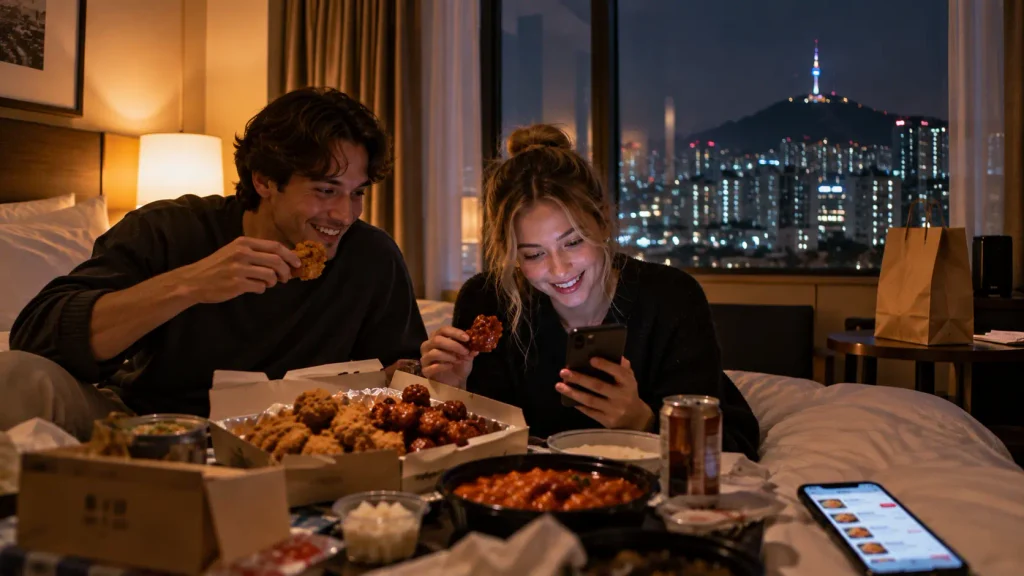
A restaurant usually occupies a deliberate slot in a traveller’s day. You decide where to eat, go there and build the evening around it. Delivery begins after the schedule has already run out.
The palace has closed. The shopping bags are on the hotel floor. Twenty thousand steps have passed beneath your feet.
Someone opens the app.
Korea has long had a food culture built around that hour: fried chicken, ramyeon, tteokbokki, beer and meals that arrive after everything else has wound down. A visitor ordering at midnight is stepping into a part of Korean life that tourism rarely packages.
Chicken Was Always Going to Get There First
Fried chicken travels well. It arrives intact, works for a group and requires almost no ceremony. More importantly, it lands somewhere between familiar and distinctly Korean.
Double-frying transformed the texture. Yangnyeom sauces gave the dish its own vocabulary. Chicken and beer became inseparable in popular culture, while Korea’s vast delivery network turned an occasional meal into an everyday option.
A visitor does not need a cultural briefing before taking the first bite.
The numbers follow the intuition. Chicken remained the largest foreign-user category on Baemin during the first half of 2026, even as desserts, fast food and other cuisines accelerated.
There is a subtle difference between eating Korean food in a restaurant and receiving it in a plastic bag at your hotel door.
The second experience puts the visitor inside a domestic routine almost immediately.
The box opens.
The sauce gets poured.
Someone reaches for a beer.
For a moment, the traveller is no longer watching Korean life from the other side of a restaurant table.
K-Delivery Does Not Ask Tourists to Change Their Evening
Travel usually comes with friction. You walk farther because a street looks interesting. You queue because a restaurant has a reputation. You cross town because the place you want sits on the other side of the river.
Delivery removes one particular inconvenience: having to go back outside.
That matters to the independent traveller. Someone returning late from Nami Island, a couple exhausted after a full day of shopping, a family travelling with children — none of them needs to locate another restaurant before the night ends.
Seoul can come to the room.
The shift fits a broader change in how international visitors are moving through the city. Seoul has been expanding the tourism map beyond palaces and major shopping districts into neighbourhood cafés, markets, pop-ups and ordinary urban routines. Delivery pushes that logic one step further.
The visitor no longer needs to be where the food is.
They can eat Seoul from somewhere else in Seoul.
The App Became Part of the Cultural Experience
Food photographs rarely capture the strange choreography of Korean delivery.
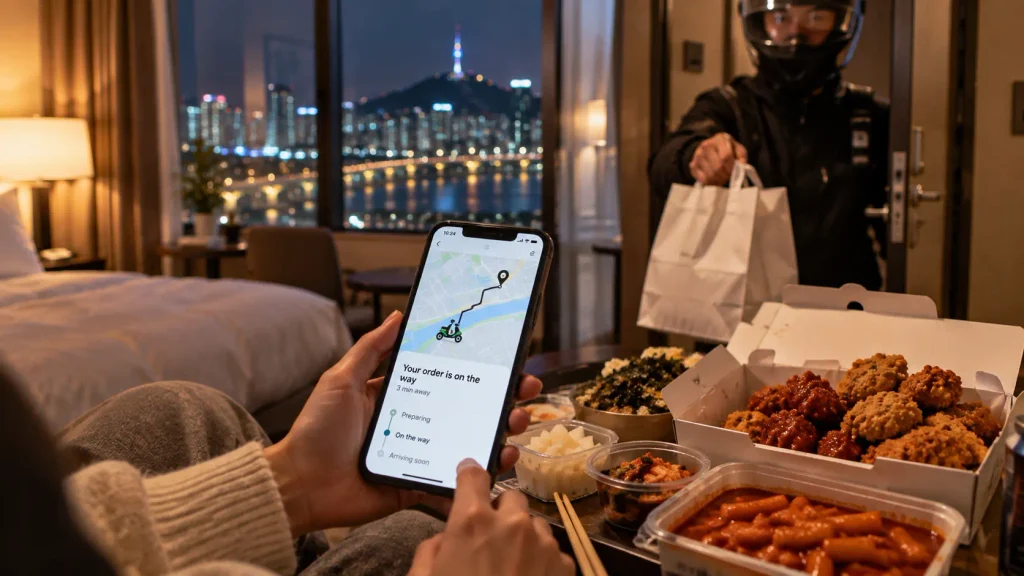
There is the moving marker on the map. The notification. The elevator ride. The knock, call or message. The plastic bag suspended from a hand. Side dishes packed into separate containers. An empty desk suddenly becoming a dinner table.
For residents, most of the machinery disappears through familiarity.
Visitors see it precisely because they do not yet know how ordinary it is.
A restaurant hands an order to a rider. The rider crosses neighbourhoods without the customer ever speaking to the restaurant. Payment, mapping, kitchen preparation and logistics pass through several invisible layers before dinner reaches the door. The system only becomes visible when the screen starts tracking it.
That invisibility has its own fascination.
Korea built its delivery culture around dense cities, enormous restaurant variety and customers accustomed to speed. International visitors are beginning to experience the finished infrastructure firsthand.
Seoul Started Making Room for the Delivery Rider
A resident ordering to an apartment already knows the building entrance, the security desk and the usual meeting point.
A visitor standing beside the Han River might know only that they are somewhere around Yeouido.
That gap has become part of the tourism problem. Seoul’s 2026 partnership with Baemin addresses it through multilingual guidance and information for designated delivery areas, including major Han River parks, while also supporting orders from visitors without Korean mobile phone numbers.
The change is small enough to miss.
It also changes who counts as part of the city’s logistics.
Delivery used to happen mostly behind the tourism map, inside apartments and residential neighbourhoods. Now the rider, the hotel lobby and even a riverside park can occupy the same visitor infrastructure.
A bench by the Han River can sit on the same map as a restaurant kitchen.
The Numbers Look Bigger After Midnight
The 331 per cent increase in foreign-user orders becomes more revealing beside the 520 per cent rise in late-night food. Chicken, café and dessert, and fast food all approached roughly three times their previous-year volumes.
331%
Foreign-user Baemin orders rose 331% in the first half of 2026.
Orders made through overseas-issued cards and global payment services, compared with the same period in 2025.
Korea had just crossed the 10-million mark for foreign visitors in the first half of 2026.
The figures should not be treated as a complete count of international tourists. Baemin’s numbers cover orders made through overseas-issued cards and global payment services, not every foreign visitor using the platform.
They point to something narrower.
People who once struggled to enter Korea’s delivery ecosystem are now using it, and they are doing so after the hour when most conventional tourism has gone quiet.
The daytime tourist map begins to fade after midnight.
The delivery map does not.
K-Delivery Fits the New Independent Traveller
Package tours compress a country into destinations.
Independent travel leaves more room for habits.
The traveller decides when to wake, how long to stay in a neighbourhood, whether coffee deserves an hour or ten minutes, whether dinner should happen at a famous restaurant or somewhere closer to the hotel. Younger visitors increasingly assemble trips through maps, apps, social platforms and recommendations rather than following a fixed sequence.
Delivery fits neatly into that behaviour.
No reservation. No dress code. No need to identify the restaurant worth crossing the city for.
Once language and payment stop getting in the way, the decision can take half a minute.
It also stretches the definition of a Korean food experience.
A visitor can spend the afternoon at a barbecue restaurant, queue at a market stall or photograph a café in Seongsu, then return to the hotel and order fried chicken. The two experiences occupy different parts of the same evening.
They no longer need to compete.
Korea’s Most Ordinary Habit Became Something Visitors Wanted to Try
Korean tourism has spent years exporting the spectacular version of the country: palaces, skincare, K-pop, restaurants, cafés, fashion districts.

Delivery sits at the other end of the scale.
There is no landmark. No ticket. No queue worth photographing. A rider simply arrives carrying dinner.
That is precisely what makes it interesting.
A visitor who first encountered Korea through polished images of Korean culture can, through delivery, glimpse something less curated: chicken ordered after midnight, a convenience-store drink added to the meal, dinner eaten in socks because there is no reason to go back outside.
Seoul is now actively helping visitors reach that ordinary experience, while Baemin continues reshaping parts of the service around customers who have never used a Korean delivery platform before.
Tourism has long been about getting people to places.
K-delivery lets the place come upstairs.
The Doorbell Is Part of the Journey
By the time the order arrives, the traveller may no longer think about where it began.
The restaurant could be three streets away or three kilometres. The app handled the address, the payment and the route. Somewhere below, a rider waits for the elevator.
Inside the room, someone clears a corner of the desk.
A box opens. Steam rises. The sauce looks redder in person than it did on the screen. Someone reaches for a piece before finding the napkins.
Outside, Seoul keeps moving.
Another order appears on the map. Another rider turns onto the next street. Another hotel room lights up.
The visitor never leaves the building.
The bell rings again.