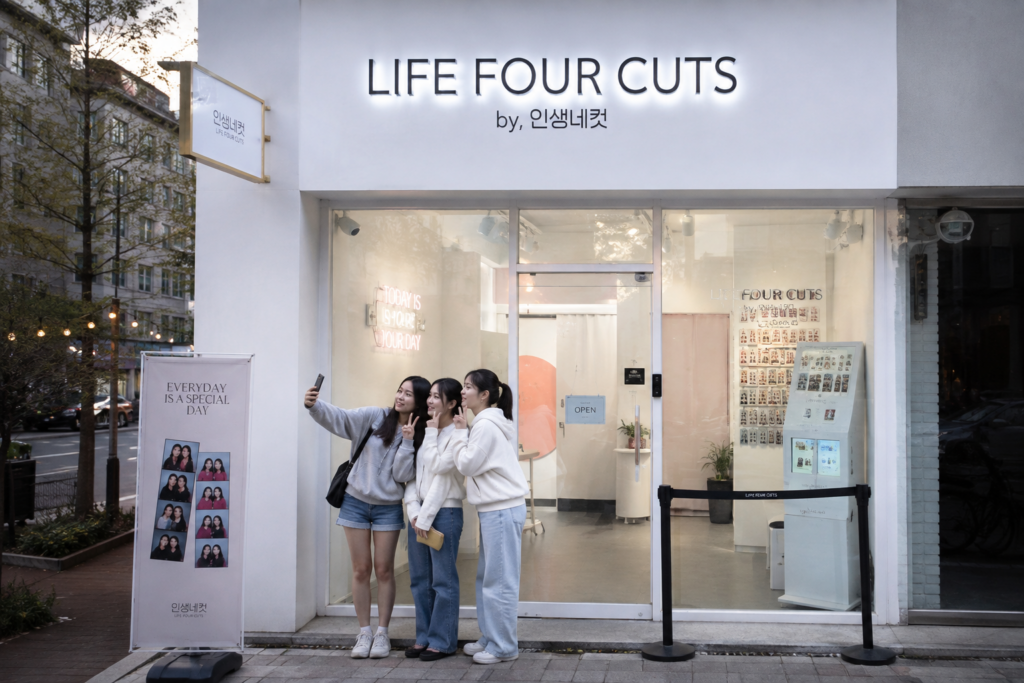
Walk through a busy shopping district in Seoul and you will notice something that is easy to miss until you start looking for it: small photo booths tucked between cafés, beauty shops and clothing stores, their entrances marked by bright signs and sample portraits. Inside, groups of friends squeeze into narrow spaces, adjust their hair, choose a frame and pose through a quick sequence of photographs before the machine prints a strip a few minutes later.
The format has travelled well beyond Korea. Korean-style self-photo studios are now appearing in shopping centres, university neighbourhoods and areas with strong Asian and K-pop communities across the US and UK. The visual language is instantly recognisable: four frames, carefully arranged poses, playful props, colourful or understated backgrounds and, usually, a physical print that feels more like a keepsake than an ordinary photograph.
It would be easy to explain the trend as another export of the Korean Wave. K-pop fans encounter photo booths through idols and fan culture, then try them for themselves. But that only explains part of the appeal. The Korean photo booth sits at the intersection of several things that have become unusually important in contemporary Korean life: documenting friendship, managing appearance, creating small rituals around ordinary outings and turning a photograph into something you actually keep.
The Photo Booth Was Never Really About the Photograph
Korea has had photo booths for decades, but the contemporary version belongs to a different cultural moment.
Traditional photo booths were largely functional. You went inside because you needed an identification photograph, a commemorative picture or a quick record of yourself. The newer generation of Korean photo studios shifted the purpose of the space. The photograph became an activity in its own right, something friends could do together rather than simply a document of where they had been.

That distinction matters. In Korea, taking photos can become part of an afternoon spent shopping, having coffee or meeting a friend. The booth is not necessarily the destination; it is one of the small rituals that gives an outing its shape. You might buy clothes, eat something, take photographs and continue walking, with the printed strip eventually ending up inside a phone case, wallet or bedroom mirror.
The physical print is part of the charm, too. At a time when most photographs disappear into camera rolls containing thousands of nearly identical images, a small strip of four frames has a certain permanence. It is inexpensive, immediate and imperfect in a way that a carefully edited social-media post often is not.
Then Came the Four-Cut Photo
The format most closely associated with Korea is the four-cut photo, usually presented as a narrow vertical strip containing several photographs taken in quick succession.
Its popularity grew alongside the rise of Korean self-photo brands and studios, particularly among younger consumers. Instead of standing passively in front of a camera operated by someone else, customers control the process themselves. They can preview the image, adjust their pose, experiment with props and repeat the experience whenever they want.
3,000+ Photo Booths
South Korea had more than 3,000 unmanned four-cut photo booths in 2024.
The result is a peculiar combination of spontaneity and preparation. People often arrive knowing roughly what they want to do. There is time to fix your hair, decide where to stand and think about the next pose, but not enough time to make every frame completely polished. Some of the most appealing photographs are the ones in which everyone is laughing, looking in different directions or simply failing to coordinate.
That controlled imperfection is important. The image is designed to be shared, but it does not have to resemble a professional portrait. It records the people who were there, the mood of the afternoon and, often, the slightly ridiculous moment that happened inside the booth.
Why Do Koreans Take So Many Photos Together?
Part of the answer lies in the role photographs play in Korean social life.
South Korea has one of the world’s most thoroughly photographed everyday cultures. Phones are used constantly to record meals, trips, cafés, purchases, outfits and gatherings with friends. Social media has amplified the behaviour, but the habit is not entirely new. Taking photographs together has long been a way of marking relationships and occasions, particularly among younger generations.
The photo booth adds a physical ritual to something that might otherwise remain entirely digital. A group of friends can leave with identical copies, each person carrying a small reminder of the same afternoon. Couples do the same. So do students after graduation, colleagues celebrating a milestone and tourists who want something more personal than another photograph of a landmark.
There is also a useful social pressure built into the format. You are not expected to look perfect in every frame. Everyone has only a few seconds before the next photograph is taken, which makes the experience less formal than a portrait session and less performative than a carefully staged Instagram post. The awkwardness becomes part of the memory.
The Rise of Korean Photo Booth Brands
The modern Korean photo-booth industry was shaped by companies such as Photoism, Life Four Cuts and Haru Film, which helped turn the four-frame format into a recognisable part of youth culture.

Their studios are deliberately designed to be easy to enter and difficult to overthink. The machines are relatively simple, sessions are short and the results are immediate. What looks from the street like a tiny retail unit is really a compact piece of entertainment infrastructure.
The branding matters, too. Frames and backgrounds can change according to seasons, collaborations, characters or cultural moments. Some studios work with entertainment companies and celebrities, allowing fans to create images that place them visually alongside an idol or fictional character. Others keep the design restrained, leaving the people in the frame as the main attraction.
That flexibility has helped the format move between subcultures without losing its basic identity. The same machine can serve a couple on a date in Seoul, a group of university friends in Busan or a K-pop fan visiting London.
K-Pop Helped Take the Format Abroad
The international spread of Korean photo booths cannot be separated from K-pop.
Fans are already accustomed to collecting physical objects connected to artists: albums, photocards, posters, concert merchandise and limited-edition goods. A photo booth fits naturally into that ecosystem because it offers something different. Instead of buying an image of an idol, fans can create an image of themselves participating in the culture.
Entertainment companies have recognised the potential. Special photo frames and collaborations can turn a familiar booth into a temporary fan destination, particularly around album releases, concerts and anniversaries. The appeal is not simply that the image contains a famous face. It allows the customer to leave with something that feels personal.
That distinction helps explain why the format has travelled beyond communities that already know Korea well. Someone might first encounter a Korean photo booth through K-pop, but the experience itself requires no knowledge of Korean music. Once inside, the activity is immediately understandable: choose a frame, pose with your friends and take home the pictures.
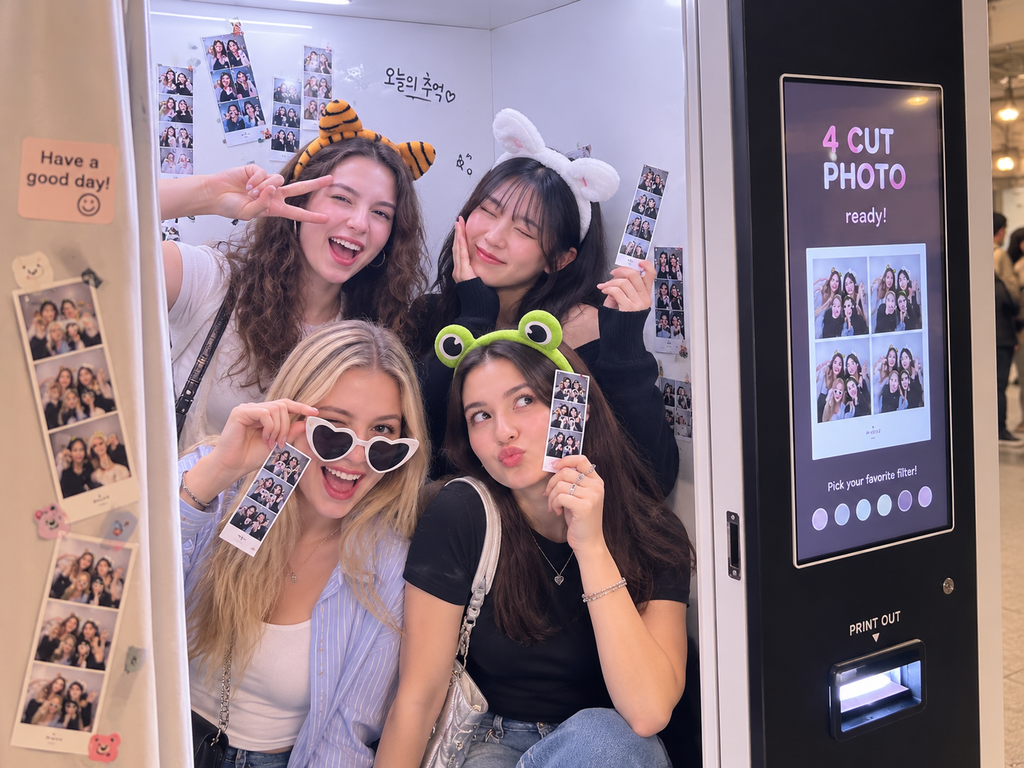
The cultural reference is Korean.
The activity itself is universal.
Why Does It Work So Well in the US and UK?
The timing is particularly interesting.
In Britain and the United States, younger consumers have become increasingly comfortable with Asian beauty, food, fashion and entertainment as ordinary parts of consumer culture. K-pop and Korean dramas have made Korean visual aesthetics familiar, while social media has shortened the distance between a trend in Seoul and one in Los Angeles or London.
Photo booths benefit from this environment because they do not require a major commitment. A customer does not have to understand Korean history or know the latest K-pop release. They simply need a friend and a few minutes.
There is something else at work, too: the format fits contemporary social-media behaviour unusually well. The printed photographs can be scanned or photographed and posted online, while the physical strip remains as a souvenir. One object serves both the digital and analogue versions of social life.
That combination is difficult to reproduce with an ordinary selfie.
The Korean Photo Booth Is a Small Social Space
Perhaps the most revealing part of the trend is how little the booth actually has to do with photography.
It is a temporary social space. Four or five people enter together, close the curtain and spend a few minutes performing a version of themselves for one another. The outside world disappears, phones are put aside for a moment and everyone has the same objective.
The physical limitations of the booth help. There is nowhere to stand except next to the people you came with. The frame is fixed. The timer keeps moving. You have to improvise.

In a culture where many forms of social interaction are increasingly mediated by screens, that small amount of shared physical awkwardness can feel surprisingly valuable. The photograph is evidence that the moment happened, but the moment itself is the product.
Why the Imperfect Photo Matters
There is a subtle contradiction at the centre of the Korean photo-booth phenomenon.
A four-cut photo is more than a picture in Korea. It is a small record of time spent together.
Modern beauty technology is extraordinarily good at altering photographs. Korean photo booths often offer filters, lighting adjustments and digital effects that can make the final image considerably more flattering than what the camera originally captured. Yet the most popular photographs rarely look completely formal.
Hair is slightly messy. Someone is laughing. Two friends lean too far into the frame. One person closes their eyes. Another has clearly forgotten what pose they were supposed to make.
The photograph works because it looks lived in.
That quality has particular resonance in an era dominated by highly curated images. A four-cut strip is still an edited representation of a person, but its conventions leave room for mistakes. The point is not to produce four perfect portraits. It is to create four fragments of a shared moment.
From Korean Youth Culture to Global Souvenir
The overseas popularity of Korean photo booths also says something about how the Korean Wave is changing.
Earlier generations of Hallyu exports were largely things people consumed from a distance. You watched a drama, listened to an album or followed an actor. Increasingly, Korean culture is becoming something people want to physically participate in.
From Screens to Real Life
That can mean eating Korean food, visiting a convenience store, attending a pop-up, buying skincare or taking photographs in a Korean-style studio. The cultural export is no longer just the product. It is the experience built around it.
Photo booths are particularly effective because they allow participation without demanding much cultural knowledge. They are perhaps one of the clearest examples of how Korean popular culture can turn an ordinary piece of everyday infrastructure into something recognisably Korean, then send it back out into the world.
There Is a Reason the Format Feels So Korean
None of this means that Korea invented the idea of taking photographs with friends. Photo booths, instant photography and studio portraits have existed in many countries for generations.
What Korea did particularly well was combine them with the habits of contemporary urban life: dense commercial neighbourhoods, youth-oriented retail, social media, celebrity culture, strong visual branding and a willingness to turn even a few minutes of leisure into a small experience.
That is why the overseas booth can feel familiar and foreign at the same time.
You do not need to know anything about Korea to understand why you would want to step inside with your friends. But once you do, the format carries traces of the culture that made it popular: the emphasis on shared outings, appearance, fandom, collecting and the habit of turning everyday moments into something worth remembering.
The photograph is only the thing you take home.
The real export is the ritual.