For years, the most visible exports of Korean culture were easy to recognise: polished pop stars, glossy dramas, elaborate skincare routines and food that travelled well.
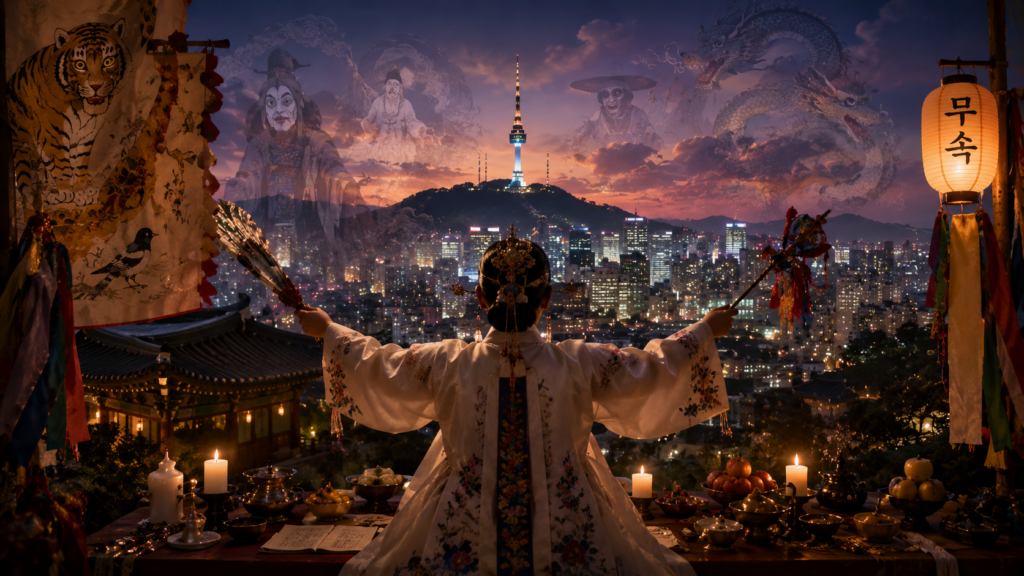
Then something stranger began appearing in the frame. Tigers with human expressions, shamans in vivid ceremonial dress, spirits of the dead, household gods and supernatural creatures rooted in centuries-old stories started turning up in films, television and design—and Western audiences were paying attention.
The shift has become especially visible after KPop Demon Hunters, the Netflix animated film that pulled Korean shamanism and folklore into the centre of a global pop-culture conversation. By August 2026, the film had accumulated nearly 650 million views and was being treated not simply as a successful streaming title, but as a cultural phenomenon in its own right.
Yet the interesting part is not that Western audiences have suddenly discovered that Korea has myths. Every culture has them. What feels new is the way Korean folklore is being encountered: not as a museum piece or a tidy explanation of the past, but as something visually striking, emotionally familiar and remarkably useful for contemporary storytelling.
Korea’s Supernatural World Was Never Really Gone
Korean folklore has never existed neatly behind glass. Traditional beliefs, stories and rituals survived alongside Confucianism, Buddhism, Christianity and modern secular life, sometimes openly and sometimes in forms that were easy to overlook. A person might visit a shaman, consult a fortune-teller, observe a household custom or grow up hearing a ghost story without considering any of it particularly unusual.
One of the most distinctive traditions is musok, often translated as Korean shamanism. Its practitioners, commonly known as mudang, have traditionally acted as intermediaries between the human and spiritual worlds. Rituals known as gut can involve music, dance, costume, offerings and the mediation of spirits, making them as much a performance tradition as a system of belief.
Korean folklore also has an unusually rich cast of supernatural figures. The jeoseung saja, for example, is often compared with the Western Grim Reaper, but the comparison only goes so far: traditionally, the figure is a messenger who guides the dead towards the afterlife rather than simply an embodiment of death. The dokkaebi, meanwhile, are mischievous supernatural beings whose stories bear little resemblance to the horned European demon the word is sometimes translated as.

For Koreans, these figures have long moved in and out of popular entertainment. Ghost stories, folk paintings, horror films and television dramas have repeatedly borrowed from them. What has changed is not necessarily the folklore itself.
It is the audience.
CULTURE NOTE
The Korean Grim Reaper is not quite the same figure as his Western counterpart. The jeoseung saja is traditionally a messenger between this world and the afterlife, a distinction that has become newly visible through contemporary Korean films and animation.
Then K-Content Found a Way to Make the Old Feel New
The global success of Korean entertainment created an unusual opening for traditions that had previously travelled much less easily.
K-dramas had already been experimenting with Korean supernatural material. Guardian: The Lonely and Great God, Along with the Gods and more recent works such as Exhuma placed ghosts, spirits, shamanism and the afterlife inside stories that otherwise looked unmistakably contemporary. The supernatural was not presented as a separate historical world. It could sit beside Seoul apartments, smartphones, family arguments and modern relationships.
That combination matters.
For a Western viewer, a story can feel recognisably Korean without requiring prior knowledge of Korean history. A shaman’s ritual, a masked spirit or a tiger from a folk painting provides an immediate visual vocabulary, while the underlying story can still revolve around grief, love, family, ambition or fear.
Perhaps that is one reason folklore has travelled so effectively through K-content. It does not have to be understood in full before it can be felt.
A 2026 analysis of global Hallyu trends by Korea’s Ministry of Culture, Sports and Tourism and the Korea Culture Information Service Agency found that K-pop remained the largest source of international media attention, but the broader Korean Wave continued expanding into film, tourism, consumer culture and other forms of cultural content. The study analysed roughly 1.5 million foreign media articles and social-media posts from 30 countries.
Folklore benefits from that expansion because it offers something K-pop alone cannot: a sense of historical depth.
KPop Demon Hunters Made the Connection Impossible to Miss
KPop Demon Hunters did not invent Western interest in Korean folklore. What it did was package several relatively unfamiliar elements inside one of the most globally accessible forms of contemporary entertainment: a big, funny, visually extravagant pop film.
Its world combines K-pop idol culture with demons, shamanic ideas, Korean folk imagery and traditional supernatural figures. Even the film’s approach to music carries an older cultural echo. Korean shamanic rituals have historically used song and dance as part of ceremonies, meaning the idea that music can possess protective or supernatural power is not simply a fantasy invention.
The film’s treatment of folklore also gives audiences something to investigate after the story ends. Viewers who become curious about a tiger or magpie, a jeoseung saja, Korean shamanism or a particular visual motif can search for its real-world origins within seconds. The fictional world becomes a doorway into a much larger cultural archive.

That effect has been measurable beyond streaming numbers. Sales of Korea’s official K-Heritage cultural products reached an estimated 16.1 billion won in 2025, a record and a 35.5 per cent increase from the previous year. The Korea Heritage Agency attributed part of that momentum to the global popularity of KPop Demon Hunters.
The film did not merely make Korean folklore visible.
It made people curious about what existed behind the screen.
The Tiger and the Magpie Are More Than a Pretty Image
One of the most interesting things about Korean folklore is how ordinary some of its symbols can look once they are removed from their original context.
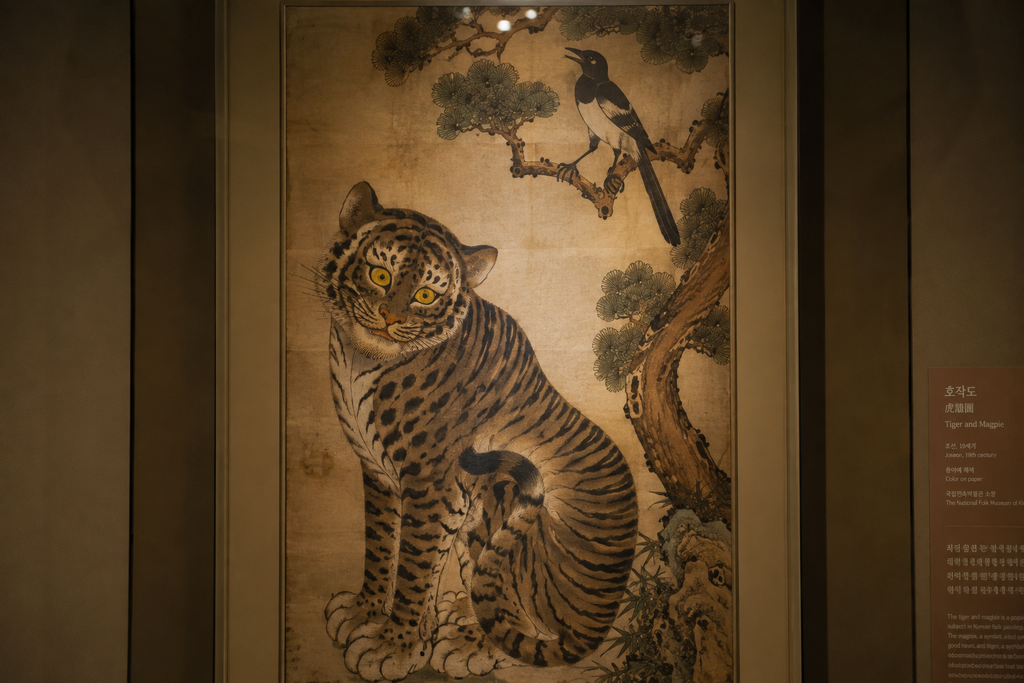
The tiger is a good example. In Korean traditional imagery, tigers could be powerful, frightening and protective, but they were also frequently portrayed with an almost comic quality. The famous hojakdo, or tiger-and-magpie paintings, became a familiar form of folk art, combining the imposing tiger with the much smaller bird in a relationship that could carry humour, protection and social commentary.
To a Western audience encountering the image for the first time, it simply looks unusual.
That unfamiliarity has become an asset.
The same applies to supernatural beings that do not map neatly onto Western categories. Korean folklore contains ghosts, spirits and creatures that occupy spaces between the human and supernatural worlds. Their motivations are often messy rather than neatly divided between good and evil, and their stories can carry humour alongside fear.
That ambiguity works particularly well in contemporary visual culture.
A creature does not have to be translated into a perfect Western equivalent to be compelling. In fact, its refusal to fit may be precisely what makes it memorable.
Western Audiences Are Also Getting Better at Reading Korean References
There is another change taking place, and it has less to do with folklore itself than with the audience consuming it.
The first wave of global Korean entertainment often required explanation. Viewers encountered unfamiliar food, honorifics, social customs or historical references and relied on subtitles, fan communities and explainers to fill in the gaps. Over time, those audiences became more culturally literate.
Someone who has watched several Korean dramas may already recognise the sound of a traditional ritual, understand what a hanbok looks like or know that Korean stories have their own versions of ghosts and spirits. Someone who has listened to Korean music, visited a Korean restaurant or travelled to Seoul has another layer of reference.
The result is a different kind of cultural exchange. Korean references no longer have to be stripped of their specificity to become popular abroad.
That matters because folklore tends to lose some of its character when it is reduced to a universal template. A dokkaebi does not need to become “the Korean goblin” in order to be understood. A mudang does not need to become simply “a witch” or “a fortune teller”. The more familiar audiences become with Korean culture, the more room there is for the original concepts to remain slightly strange.
And strange, in this case, is useful.
The West Has Always Been Fascinated by Other People’s Ghosts
There is nothing uniquely Korean about the Western appetite for folklore.
Japan has exported yokai. Nordic countries have turned trolls and folklore into a global visual language. Greek mythology has been repeatedly reinvented for Hollywood, publishing and fashion. British and Irish folklore has travelled through fantasy fiction for generations.
What makes Korea particularly interesting now is the speed with which its folklore is arriving through an already established cultural pipeline.
K-pop brought the audience. Korean film and television widened the doorway. Food, beauty and travel made the country more familiar. Once that foundation existed, older cultural material no longer appeared completely out of nowhere.
This helps explain why a story about Korean spirits can now reach an audience that might never have deliberately searched for Korean folklore.
The audience did not necessarily go looking for the mythology.
The mythology arrived with something they already wanted to watch.
Folklore Offers Something Modern Korea Cannot Always Show
There is also a deeper reason these traditions are resonating.
Modern South Korea is one of the world’s most technologically advanced and densely connected societies. Seoul is full of glass towers, apartment complexes, convenience stores, delivery riders and high-speed networks. Much of the country’s global image has been built around precisely this modernity.
Folklore complicates that picture.
It suggests that Korea is not only a country of futuristic cities and hyper-efficient services, but a place whose cultural memory contains its own ideas about death, spirits, luck, nature and the relationship between visible and invisible worlds.
That contrast is visually powerful. A neon-lit Seoul street can coexist with a centuries-old ritual tradition. A K-pop performance can borrow the energy of a shamanic ceremony. A supernatural character can wear contemporary clothes and still carry an old cultural idea beneath them.
For international audiences, that combination offers a version of Korea that feels less polished and more layered.
A country becomes more interesting when its present does not completely erase its past.
The Museum Became Part of the Story
The renewed attention is not confined to entertainment.
The National Folk Museum of Korea saw the number of foreign visitors rise dramatically, from around 5,000 in 2021 to approximately 1.35 million in 2025, according to reporting on the country’s recent cultural tourism boom. The shift reflects a broader interest in everyday Korean life and folk culture rather than only major historical monuments.
That distinction matters.
For a long time, international cultural promotion often relied on the most recognisable symbols of Korea: palaces, traditional clothing, major historical figures and famous foods. Folklore belongs to a different category. It is closer to the texture of ordinary life—the stories people tell, the objects they keep, the superstitions they half-believe, the creatures that appear in paintings and the rituals that survived despite modernisation.
In other words, folklore can make Korea feel lived-in rather than simply presented.
That may be one reason it fits the current moment so well. International audiences already know that Korea has become a major cultural exporter. They are now becoming curious about what sits underneath the export.
CULTURE NOTE
Korean folklore does not form a single, tidy mythology. It developed through layers of indigenous beliefs, shamanic traditions, Buddhism, Confucianism and later religious influences, which is part of why its supernatural world can feel less neatly organised than familiar Western fantasy systems.
There Is a Difference Between Discovering Folklore and Consuming an Aesthetic
The sudden popularity also comes with a risk.
Once a culture becomes fashionable, its most visually distinctive elements can be detached from their meaning. A shamanic object can become a design motif. A traditional mask can become decoration. A dokkaebi can be reduced to a generic monster. The more successful the aesthetic becomes, the easier it is to forget that these images belonged to real systems of belief and storytelling.
That tension is already visible in academic and cultural discussions surrounding recent K-content. Researchers have pointed out that Korean shamanism works particularly well in contemporary fantasy because it can combine culturally specific material with universal themes, while also giving international audiences unfamiliar visual and narrative elements.
The strongest works do more than borrow the surface.
They let the unfamiliarity remain.
That is what gives folklore its weight. It is not simply another collection of costumes, monsters and mysterious symbols waiting to be turned into content. It carries memories of how people understood illness, death, luck, nature and the unknown long before Korea became associated with smartphones and global pop music.
Korea’s Old Stories Have Found a New Audience
The renewed Western fascination with Korean folklore is therefore less of a sudden revival than it first appears.
The stories were already there. Korean filmmakers, television writers, artists and designers had been using them for years. What changed was the scale of the audience, followed by a generation of international viewers who had become familiar enough with Korean culture to recognise that there was something deeper behind the images.
KPop Demon Hunters accelerated that process dramatically. Its success showed that Korean folklore could sit comfortably beside K-pop, animation and global pop storytelling without losing all of its cultural specificity. The subsequent interest in museums, heritage products, shamanism and traditional imagery suggests that some viewers are willing to follow the thread further.
That may ultimately be the more important story.
Korea’s cultural influence is no longer travelling only through what is new. Increasingly, it is travelling backwards, too—from today’s pop culture into the older stories, symbols and beliefs that helped shape it.
The West did not suddenly discover that Korea had ghosts.
It discovered that those ghosts had stories of their own.