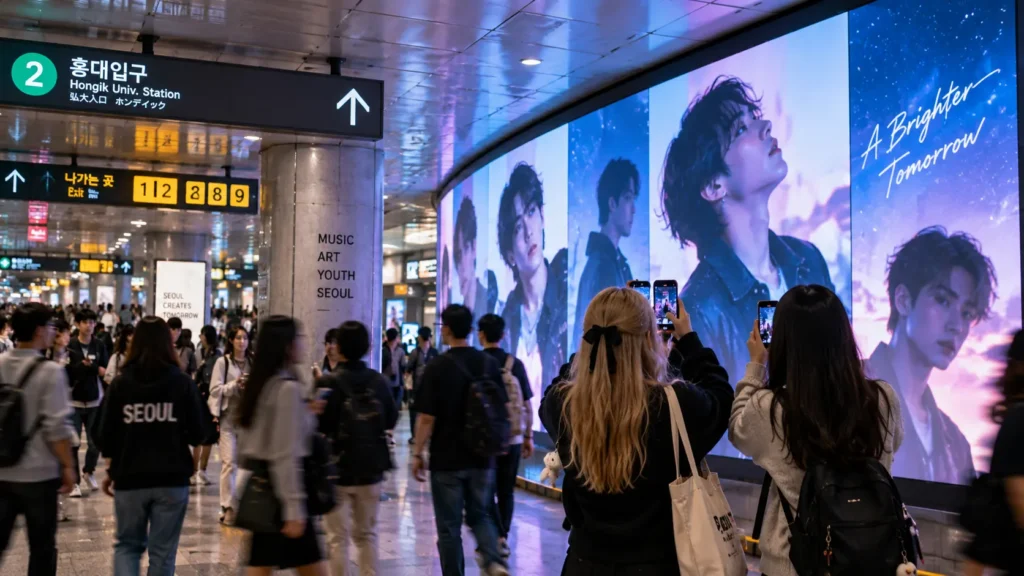
At Hongik University Station, the crowd keeps moving even when the screen changes.
A train arrives underground. Commuters climb the stairs. Someone stops beneath the LED wall, lifts a phone and waits for a familiar face to appear. For a few seconds, the station fills with an idol’s birthday message, a fan-made video or a congratulatory graphic. Then the screen turns to an ordinary commercial, and the people who had gathered begin walking again.
The interruption looks commercial until you notice who paid for it.
Across Seoul, fans pool money to rent advertising space for an idol’s birthday, debut anniversary, comeback or other milestone. The screens appear in subway stations, shopping districts and large digital billboards, temporarily turning pieces of the city into stages for fandom. What resembles an advertisement from a distance can, up close, function more like a public message sent by one group of fans to one particular artist.
The practice has expanded alongside K-pop’s international audience, giving fans who may live thousands of kilometres away a way to leave something physical behind in Seoul. In late 2025, Bunjang Global’s New Year Billboard Award in Seoul pushed the format into a voting competition, allowing supporters to compete for billboard exposure for winning idols at the beginning of 2026. The campaign was commercial rather than an official Billboard Music Awards event, belonging to the fan-advertising ecosystem that has grown around K-pop.
Seoul’s Screens Have Become Part of the Fandom
The geography comes first.
Seoul does not conceal its advertising underground. Screens fill station corridors and exits, department-store facades and shopping streets. Hongdae, Gangnam and other districts dense with younger consumers generate the pedestrian traffic advertisers want. Those same crowds make the locations valuable to fans.
A birthday advertisement placed there can find an audience without selling a single ticket.
Fans photograph the screen. They upload the image. Other fans repost it. An advertisement that lasted only a few seconds in a station acquires a second life online, often reaching people who were thousands of kilometres away when it appeared.
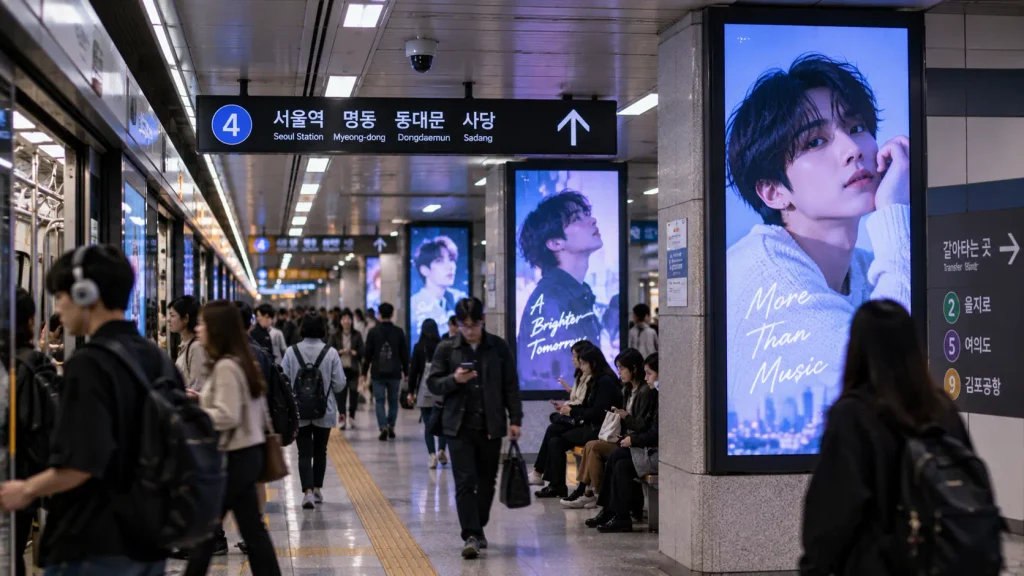
The physical screen does two jobs at once.. It reaches people passing through Seoul, and it gives distant fans proof that their community has claimed a small piece of the city.
The Birthday Ad Changed the Meaning of Advertising
Birthday advertisements became one of the most recognisable forms of the practice.
A fan community chooses an artist, sets a budget, selects a location and commissions the artwork. A campaign might run for several days or repeat at scheduled intervals. Fans then travel to the site, photograph the display and circulate the result online.
The gesture has little connection with selling a conventional product.
The idol becomes the subject being celebrated. The fans become, simultaneously, the advertiser, creative agency and audience.
The infrastructure already existed. Cosmetics companies, telecommunications brands and retailers had been buying the same advertising inventory for years. The new customers simply had different reasons for doing it.
For the passer-by, almost nothing distinguishes the two.
For the fandom, everything does.
When Fans Became the Advertisers
The money behind a billboard campaign comes from collective effort.
Individual fans may contribute modest amounts, while larger communities organise fundraising across hundreds or even thousands of supporters. International fandoms add another dimension, bringing people in different countries and time zones into the same campaign.
The finished display might carry dozens of names, a fan-account identity, a personal message or nothing more than the artist’s face.
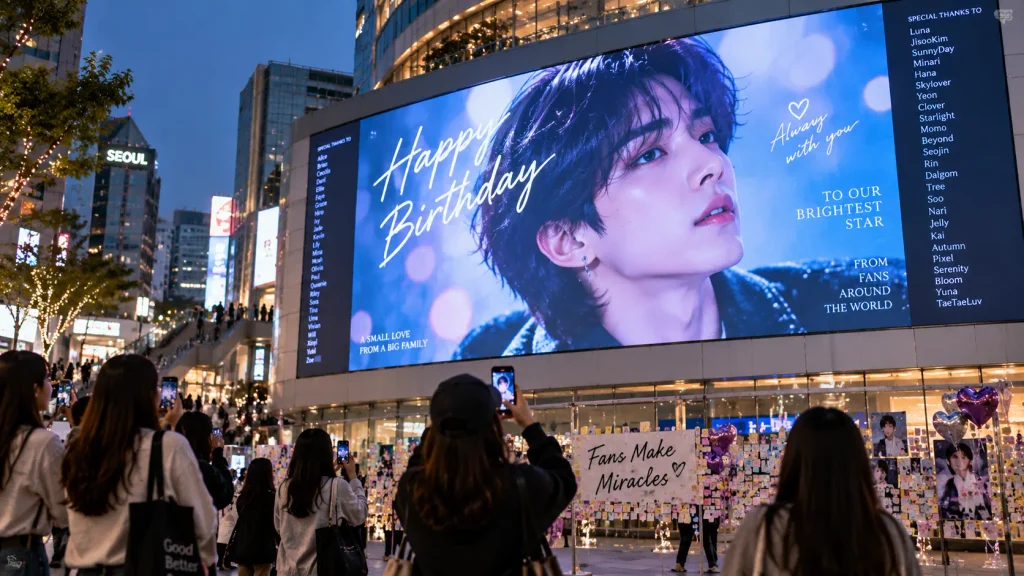
The arrangement changes the relationship between fan and idol. The fan has no control over the artist’s career, and the advertisement never reaches the artist privately. It operates in public, using money and physical space to turn support into something visible.
The mechanics resemble advertising. The gesture often resembles gift-giving.
A billboard usually asks strangers to notice something.
A birthday billboard asks the city to notice someone.
A Billboard Can Become a Trophy
The New Year Billboard Award in Seoul offered a particularly revealing variation.
Bunjang Global’s 2025 campaign invited fans to vote for idols in a New Year Billboard category, with the winning artist receiving advertising exposure in Seoul. A separate Rookie Billboard category extended the format to newer artists. The New Year Billboard was planned around Hongik University Station, while the Rookie Billboard was associated with Seoul Station, with winning advertisements scheduled to run for roughly 15 days.
Advertising space became the prize.
2,166 FAN BILLBOARDS
2,166 fan billboards were posted in Seoul in 2019, compared with just 76 in 2014.
Fans were no longer simply buying a display to celebrate an idol. They were competing to win one, voting through a commercial platform and treating the resulting screen as evidence of what their fandom had achieved.
Promotion and competition began to overlap.
The screen still sold nothing.
The victory belonged to the people who had put the artist there.
Why Hongdae Matters
Hongdae makes a natural setting for this culture.
The district has spent years absorbing youth culture, independent music, fashion, nightlife and the commercial infrastructure that follows large crowds. Subway exits release streams of pedestrians onto streets lined with cafés and shops, while digital advertising competes for attention overhead.
An idol advertisement does not need to manufacture its own audience here.
The audience is already underneath it.
For international fans, the location adds another layer. Visiting a birthday billboard can become a small pilgrimage: find the station, locate the screen, take photographs, share them with friends, then continue to the next stop.
The city becomes a catalogue of fan destinations.
Someone might arrive in Seoul for a concert and leave with photographs from several stations, a birthday café, a pop-up store and a bag of merchandise. None needs to be an official tourist attraction to become part of the journey.
The Advertisement Became a Gathering Place
A billboard campaign can create its own appointment.
Fans know when the advertisement will appear and where to find it. Some travel specifically for it. Others coordinate through social media and meet near the station before photographing the display together.
The screen turns into a backdrop.
People stand in front of it with banners or photocards. Phones rise when the idol appears. One photograph becomes several because the first angle is rarely the last. The resulting posts then travel to fans who may never see the billboard in person.
The physical location gives the fandom something that a digital post cannot quite provide: coordinates.
For several days, one station exit or shopping street becomes the place where the birthday advertisement is.
That sounds minor until you consider how little geography contemporary fandom usually requires.
K-pop can reach Los Angeles, London or Jakarta almost instantly. The billboard gives that distant relationship a physical address.
The Billboard Does Not Need to Sell Anything
Traditional advertising measures attention in commercial terms.
Fan advertising follows another logic. The idol’s face does not need to convince a commuter to buy something. The appearance itself carries the value. Photographs, social posts and the feeling of having created something visible can matter more than a conventional conversion rate.
That changes how fans read public space.
A screen most commuters barely register becomes important when it displays the artist they follow. A station that ordinarily functions as infrastructure becomes a temporary landmark. Advertising inventory turns into a set of possible messages.
Seoul’s commercial landscape makes this possible because advertising space can be bought in relatively small, targeted packages. Fans do not need to own the building above the screen. They need a budget, artwork, a campaign and a location.
The city supplies the rest.
K-Pop Turned Public Space Into Fan Space
The practice also reflects the organised structure of K-pop fandom.
Fan communities do far more than consume releases. They maintain accounts, translate announcements, organise streaming campaigns, coordinate voting and raise money for collective projects. Some operate across countries and time zones, allowing a campaign conceived on one side of the world to materialise on another.
A billboard fits neatly into that machinery.
There is a beginning: choose the artist and location. There is the fundraising. Then the artwork, the booking and the launch.
And finally, the photograph.
The finished billboard becomes proof that the campaign happened. It can circulate as quickly as a concert clip or comeback teaser, while the original object remains somewhere in Seoul.
The physical advertisement becomes digital content again.
From Fan Culture to K-Pop Tourism
For international fans, the screen is only one stop.
Seoul has accumulated a geography of K-pop-related experiences: entertainment-company buildings, concert venues, pop-up stores, cafés, merchandise shops and advertising displays. A fan who comes for one event can build an entire itinerary around the others.
The billboard has one practical advantage. There is no admission fee.
A visitor can walk into a subway station, spot an idol’s face ten metres above the crowd and take a photograph before continuing with the day.
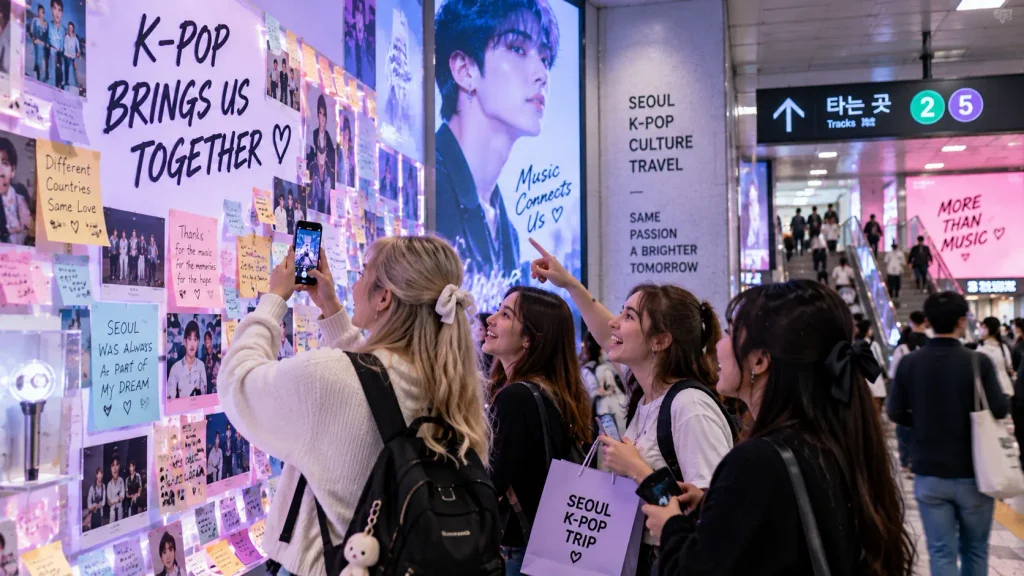
The emotional distance can be much greater than the physical one. Someone who has followed an artist almost entirely through a screen suddenly finds that face occupying a real place in the city.
The irony is almost too neat.
A global digital culture brings people to Seoul to photograph another screen.
The City Keeps Moving Around It
The temporary nature of the campaigns gives them much of their character.
A birthday display ends. The screen changes. Another commercial takes its place. A different idol appears somewhere else, and the fans move there.
Seoul never pauses for the fandom.
The subway keeps arriving. Office workers continue checking their phones. Shops keep flashing their signs. Someone carrying groceries can walk past a twenty-metre portrait without looking up.
For the fans who arranged the campaign, those few seconds are enough.
They paid for the space, filled it with an image and watched other people notice.
A Few Seconds Above the Crowd
Back at Hongik University Station, the crowd has swallowed the space beneath the screen.
The idol appears again.
A young woman recognises the face before the people around her do. She steps sideways, raises her phone and waits for the display to cycle back.
The screen gives her perhaps fifteen seconds.
She takes three photographs.
Then the image disappears, the station keeps moving, and another train pulls in.