

Walk into a Korean convenience store around lunchtime and the first thing you may notice is not the wall of drinks or the shelves of snacks. It is the smell of something being heated.
Near the entrance, a microwave seems to be running almost constantly. Someone peels back the lid of a cup of ramyeon beside the hot-water dispenser. At a narrow counter, a student unwraps a triangle-shaped samgak-gimbap, while another customer stands in front of the refrigerators comparing boxed lunches. People come and go, but the rhythm is closer to a small neighborhood eatery than the convenience stores many foreign visitors know.
In Korea, that overlap has become almost unremarkable.
Convenience stores still sell groceries, household supplies, drinks and snacks, but food occupies a far more important place in the business than the name might suggest. Gimbap, lunch boxes, sandwiches, fried chicken, instant noodles, desserts and other ready-to-eat meals fill the shelves, while some branches provide seating, ramen cookers, coffee machines and equipment for preparing hot food on site.
The result is a retail format that has quietly taken on some of the functions of a restaurant.
A Convenience Store That Sells Dinner
The word convenience can sound slightly misleading if you are accustomed to the format elsewhere.
In Korea, the major chains have spent years building stores around the idea that several everyday needs should be solved in a single, short visit. GS25, for instance, describes convenience in four ways: opening hours, proximity, a compact selection of useful products, and everyday services such as parcel collection and bill payment. Its own business materials also place fresh food and ready-to-eat products at the center of the format.
Food fits naturally into that system because it answers one of the most immediate questions a convenience store can solve: what are you going to eat right now?
There is no restaurant to book, no table to wait for and no reason to buy a meal large enough for a group. A boxed meal can be picked up on the way home. Gimbap works as breakfast before work. A cup of noodles can become dinner when the neighborhood around you has already gone quiet for the night.
And the store is usually close enough that going there barely counts as a detour.
The Rise of the One-Person Meal
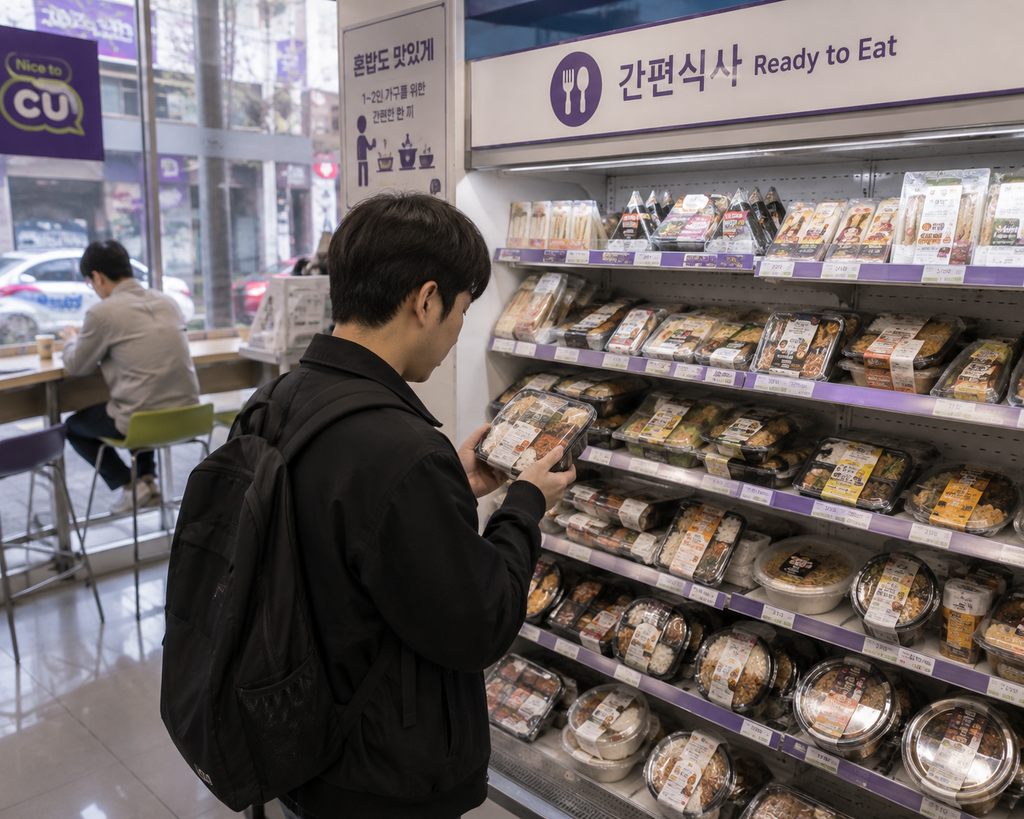
There is a demographic reason the model works so well.
For someone living alone, buying ingredients for a full meal, storing whatever is left and cooking after a long day is not always the most appealing option. A convenience store offers something simpler: a meal-sized portion, already prepared, that can be bought and eaten with very little effort.
The retailers have adjusted to that reality. GS25, for example, explicitly promotes smaller packaged portions for one- and two-person households alongside its fresh-food range.
The result is that convenience stores now occupy moments that once belonged more naturally to home cooking or restaurants. Breakfast is a particularly good example. In March 2026, Korea JoongAng Daily reported that the proportion of CU’s ready-to-eat meal sales taking place between 5 a.m. and 9 a.m. had risen from 12 percent in 2023 to 17.2 percent in 2025. Morning ready-meal sales at GS25 increased 15.8 percent over the same period.
The people buying breakfast are not necessarily looking for something memorable.
They just need something that works.
The Meal Is Already Designed for the Microwave
Part of the appeal lies in how little preparation is involved.
A Korean convenience-store lunch is rarely an assembly project. The portion has already been decided, the packaging tells you what to heat and the meal is designed to go from refrigerator to microwave with minimal fuss. A few minutes later, you have something that looks and feels recognizably like lunch.
The ordinariness is the point.
A typical refrigerator may hold several versions of gimbap, rice bowls, pork cutlets, fried chicken, sandwiches, noodles and side dishes. The selection changes frequently, and the chains compete heavily on new products, limited editions and collaborations.
That matters when eating out becomes more expensive. In 2025, CU reported a 23.8 percent increase in ready-made meal sales on the day Korea’s new consumer coupons began being used. Gimbap sales rose 35.8 percent and sandwiches 29.7 percent, while GS Retail also recorded substantial increases across meat and ready-to-eat categories. Retailers attributed part of the demand to consumers becoming more conscious of the cost of eating out.
The convenience-store meal has therefore moved beyond the emergency snack.
For many people, it is simply another way to have dinner.
Then There Is Ramyeon
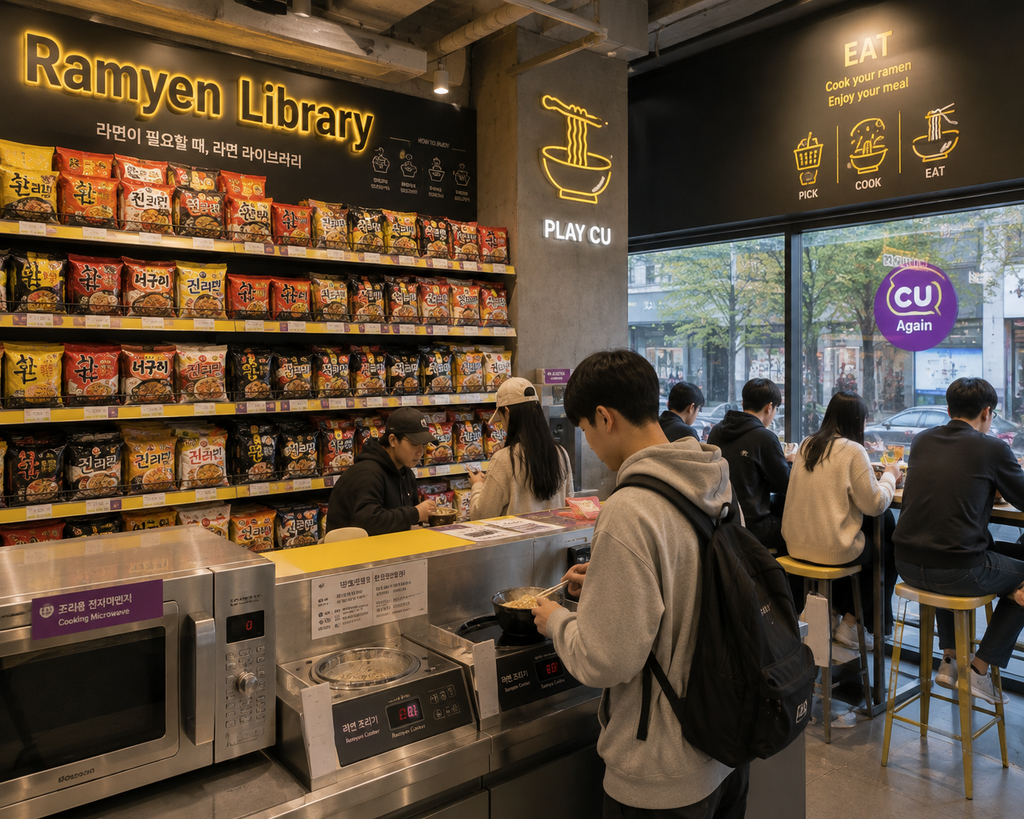
Instant noodles deserve a category of their own.
A Korean convenience store often supplies more than the packet itself: hot water, microwaves, disposable utensils and, in some locations, dedicated cooking machines and seating. What starts as a shelf product can become a meal without ever leaving the store.
CU has pushed the concept particularly far with its so-called Ramyeon Libraries, stores or sections built around instant noodles where customers choose a product and prepare it on site. Some locations have become attractions in their own right, particularly among tourists who want to experience a habit they may already have seen online.
At that point, the distinction between buying food and eating it becomes difficult to maintain.
You choose a packet, cook it a few steps away and sit down. The same store provides the ingredients, equipment and place to eat.
For a traveler, that can feel novel. For a local customer, it is simply another Tuesday.
The Store Has Become Part of the Neighborhood
There is something else that helps explain the Korean convenience store: where it sits.
These stores are woven into residential streets, office districts, university neighborhoods and transport hubs rather than being confined to dedicated shopping zones. Their value depends in part on being close enough that stopping by requires almost no thought.
That makes them unusually visible in everyday life.
A student might buy breakfast before class. An office worker can pick up lunch without leaving the immediate area. Someone heading home late can grab dinner and a few household supplies in the same stop. On a warm evening, people may gather outside with drinks and food, turning the small patch of pavement beside the store into an informal meeting place.
The store does not need a proper dining room to become part of neighborhood life.
Sometimes a plastic chair and a narrow table are enough.
Convenience Stores Keep Expanding What “Convenience” Means
The major chains have responded to these habits by pushing well beyond the traditional convenience-store model.
GS25 operates coffee, fried chicken and pizza concepts within selected stores, while its specialized formats include locations built around fresh groceries and smaller portions for one- and two-person households.
Delivery has entered the same territory. In 2026, CU and GS25 began expanding 24-hour delivery through Coupang Eats, with CU making deliveries available during the previously uncovered 3 a.m. to 6 a.m. period at around 2,000 stores across several major cities. The range includes desserts, drinks, fried chicken and boxed meals.
The interesting part is not that a convenience store can deliver.
It is how much the definition of convenience has expanded.
A store that once existed primarily for nearby essentials now competes on prepared meals, coffee, freshly cooked food, delivery, private-label products and everyday household purchases. Its advantage remains remarkably simple: it is close, it stays open for long hours and its shelves can change quickly when customers’ habits change.
The 24-Hour Habit
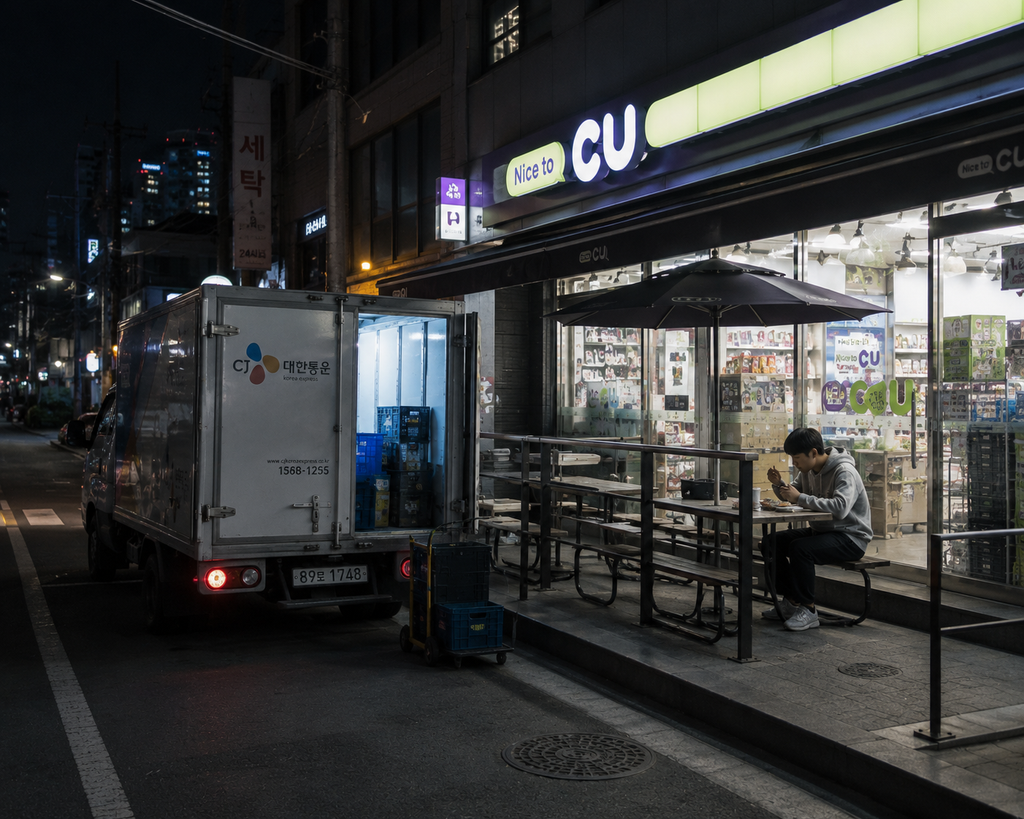
The image of a Korean convenience store glowing late at night has become almost inseparable from the country’s urban landscape.
Many stores operate around the clock, although not every branch does. GS25’s own description of the format emphasizes 24-hour, year-round availability as one of its defining conveniences.
That flexibility matters in a country where the day often stretches well beyond conventional shopping hours.
The person buying breakfast at 7 a.m. and the person buying ramyeon at 1 a.m. may have almost nothing else in common, yet the same store accommodates both. Neither has to organize their day around a supermarket’s closing time or a restaurant’s last order.
This helps explain why convenience stores are so closely associated with the spaces between other parts of the day: before work, after school, between trains, after drinks, on the way home.
They are there when the rest of the day does not quite fit together.
Why Are There So Many of Them?
Eventually, the density of convenience stores becomes difficult to ignore.
According to 2025 government data reported by The Korea Times, South Korea had 54,835 stores operated by its four major convenience-store chains at the end of 2024. It was the first decline in the total number of stores since the industry began expanding in 1988, yet the figure still worked out to roughly one store for every 1,000 people.
That density has created intense competition.
Two branches can sit only a few minutes apart, especially around busy intersections, universities and residential neighborhoods. They compete through discounts, private-label products, collaborations, fresh meals and increasingly specialized store formats.
It is one reason the food selection is always moving.
A convenience store cannot keep selling the same sandwich indefinitely and expect customers to remain interested. The result is an unusual combination of familiarity and novelty. You know there will probably be gimbap somewhere in the refrigerator, but the flavor, collaboration or limited-edition product may be entirely different from what you bought last week.
From Gimbap to K-Pop Collaborations
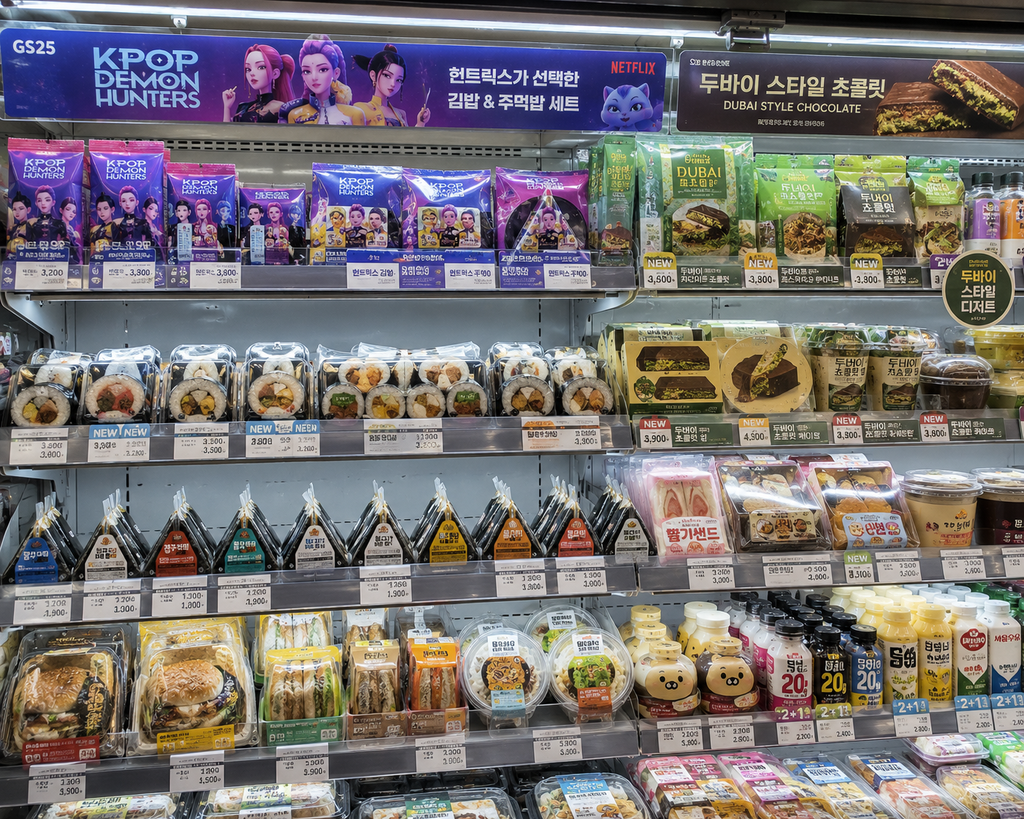
The chains have become remarkably quick at translating cultural trends into food.
A popular character, television series or online phenomenon can appear on a rice ball, dessert, snack or boxed meal with surprising speed. In 2025, GS25 announced a collaboration with Netflix’s KPop Demon Hunters, producing ready-to-eat items inspired by the film’s Korean food imagery, including gimbap and rice-ball sets.
The same mechanism works with food trends.
When dujjonku, the chewy Dubai-style chocolate dessert, gained popularity in Korea, CU quickly introduced its own private-label versions. The chain reported that one kataifi chocolate chewy rice cake sold more than 1.8 million units in three months, while cumulative sales of its Dubai-themed products surpassed 8.3 million units.
The refrigerator case has therefore become something of a cultural monitor.
Look closely enough and you can often see what Korean consumers have suddenly decided they want.
The Tourist Version of the Convenience Store
Foreign visitors have noticed that, too.
Some arrive looking for products they have already encountered online: banana milk, instant noodles, gimbap, Korean snacks, beauty products and seasonal desserts. For someone visiting Korea for the first time, the convenience store can function as a compact introduction to everyday Korean consumption.
There is no ticket, reservation or carefully planned itinerary.
You simply walk in.
That accessibility has helped convenience stores become part of the travel experience itself. CU’s Ramyeon Libraries, for example, have attracted international visitors precisely because they offer an easy way to experience the Korean instant-noodle ritual. At one flagship location, foreign customers accounted for 68 percent of sales, according to the company.
The appeal is practical, but it is also cultural. A visitor can eat something inexpensive, discover products that may be difficult to find at home and watch ordinary Korean customers use the same space.
There is no clear line between the tourist attraction and everyday life.
The attraction is everyday life.
It Still Has to Make Economic Sense
The expansion has not continued without limits.
South Korea’s four major chains saw their combined store count fall for the first time in 2024, while sales declined in the first quarter of 2025 as the market became saturated and consumer spending weakened. The Korea Times reported that convenience-store sales fell 0.4 percent year over year during the quarter, the first quarterly decline since the government began tracking the sector in 2013.
Online shopping adds another layer of pressure.
When groceries, snacks and household products can arrive at the front door the next morning, the physical convenience store loses some of its advantage for planned purchases. What it retains is immediacy. Breakfast on the way to work, a cold drink on a summer evening or a quick meal when there is nothing in the refrigerator are needs that are difficult to postpone.
Food is especially resistant to being moved to tomorrow.
That is one reason ready-to-eat meals have become such an important battleground between the chains.
So, Why Does a Convenience Store Feel Like a Restaurant?
Because in Korea, the boundary between the two has become unusually thin.
A convenience store can provide the meal, the microwave, the hot water, the coffee, the table, the delivery service and, increasingly, something worth photographing. Its shelves react quickly to changes in price, taste and popular culture, while its locations place all of that within a short walk of homes, schools, offices and stations.
The country’s large one-person household population has created a strong market for small, ready-to-eat portions. Higher restaurant prices have made those meals more attractive, while fierce competition between convenience-store chains has pushed them to keep refining what goes into the refrigerator.
That is why a Korean convenience store can occupy so many roles without feeling as though it is doing anything unusual.
At seven in the morning, it might be breakfast. At noon, lunch. At midnight, ramyeon.
For a traveler, it can also be one of the easiest places to glimpse how Koreans actually eat outside the dishes and restaurants that dominate guidebooks. You walk in for a drink and notice the food. A few minutes later, you are sitting with a hot bowl of noodles, watching people come and go through the automatic doors.
For a convenience store, that is a surprisingly complete definition of convenience.