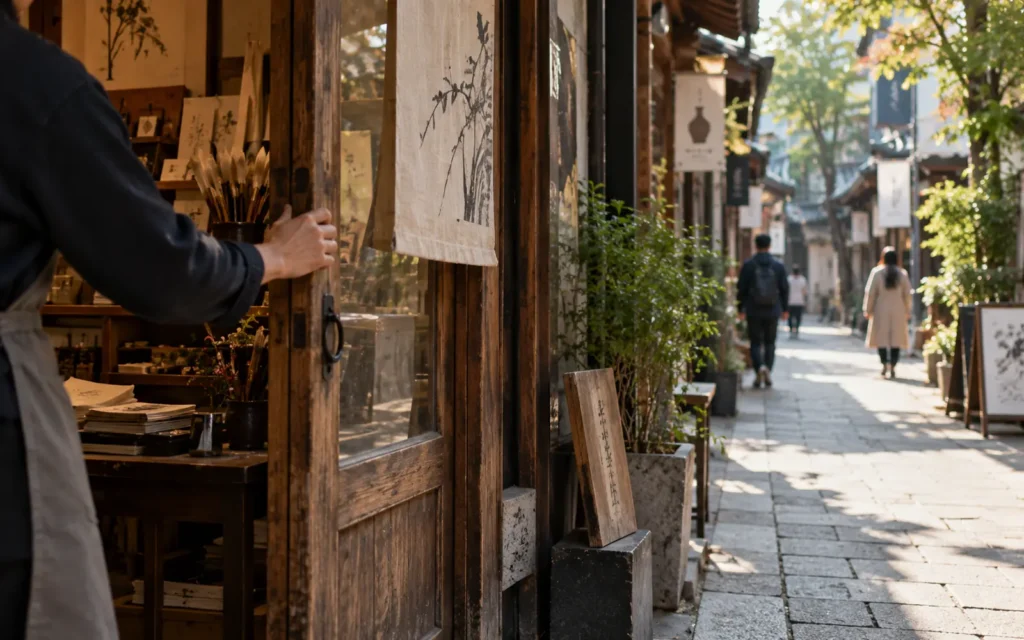
A shopkeeper pulls a wooden door open just after the morning deliveries arrive.
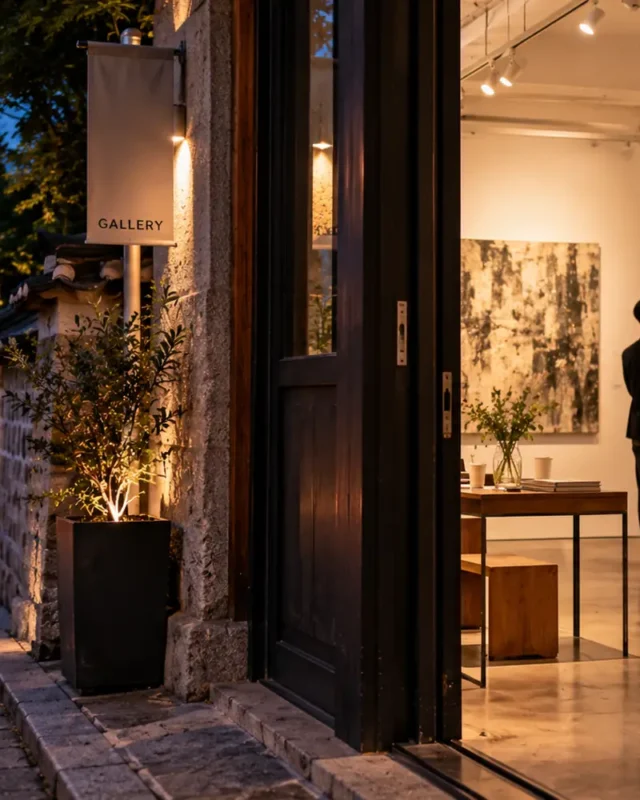
Bundles of paper lean against one wall, brushes sit in narrow jars, and a handful of tourists drift past before the street has fully warmed up. A few doors down, a gallery is preparing for the day; around the corner, tea steams behind a window framed by dark timber.
Walk through Insadong long enough and the contradictions stop looking unusual. Antique shops sit beside polished retail spaces. Traditional tea houses share lanes with cafés. Calligraphy supplies, ceramics and contemporary souvenirs compete for attention in a district that has spent decades negotiating what Korean culture should look like in public. Seoul formally designated Insadong as a traditional culture street in 1988 and as its first cultural district in 2002, preserving the area while allowing it to keep changing.
That tension gives Insadong its staying power. Other parts of Seoul have reinvented themselves around fashion, nightlife, food or design. Insadong keeps returning to art, craft, memory and the physical habits of an older city — then folds new businesses and new audiences into the same narrow streets.
Before It Became a Destination
Insadong’s cultural identity predates the tourism industry built around it. The neighbourhood developed a long association with artists, writers, calligraphy and traditional arts, and its lanes accumulated businesses dealing in paintings, antiques, stationery and craft. Seoul’s own guide traces the district’s character through galleries, antique shops, tea houses and traditional restaurants rather than through a single landmark.
That history still sits close to the surface. A visitor can move from a shop selling brushes and ink to a room displaying ceramics, then emerge onto a main street crowded with people taking photographs. The sequence feels less like entering a museum than walking through a working neighbourhood whose older trades never entirely disappeared.
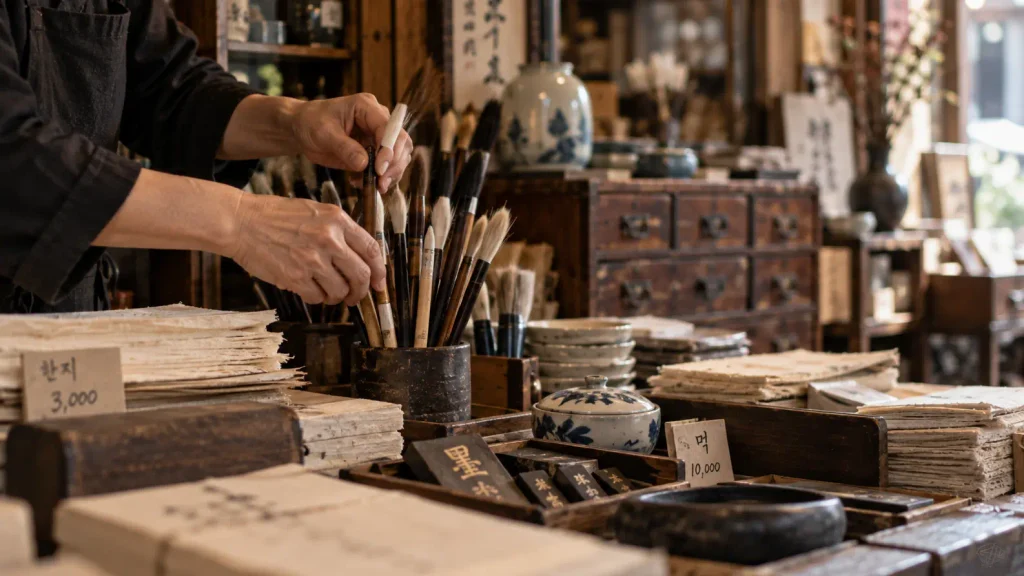
Modern Seoul grew upward and outward. Insadong stayed unusually low, threaded with alleys and small storefronts. The physical scale creates a different kind of encounter: shop windows sit close enough to inspect, doors open directly onto the street, and the distance between one business and the next can be measured in a few steps.
The Street Turned Culture Into a Business
Insadong learned early that tradition could circulate commercially without becoming entirely theatrical.
Calligraphy tools, paintings, folk art, pottery, porcelain, antiques and handicrafts remain central to the district’s commercial identity. The Seoul Metropolitan Government still describes the area through that mixture of galleries, traditional craft shops, antique art shops, tea houses, restaurants and cafés.
That commercial layer matters because culture survives differently when people can make a living from it. A craft object sitting behind glass remains connected to a seller, a customer and a transaction. A tea house needs regular visitors. A gallery needs buyers. A stationery shop needs someone who still wants to write.
Insadong’s appeal therefore does not depend entirely on preserving old buildings or staging old customs. It keeps pieces of Korean material culture in circulation.
Seoul Gave Insadong a Special Role
The city eventually formalised what the neighbourhood had already been doing.

Insadong became a designated traditional culture street in 1988, then Seoul’s first cultural district in 2002. The policy aimed to protect the area’s historical and cultural value while supporting its distinctive commercial and cultural activity. Weekend traffic restrictions later turned parts of the district into a more pedestrian-friendly public space.
SEOUL’S FIRST CULTURAL DISTRICT
Insadong became Seoul’s first designated cultural district in 2002, following its designation as a traditional culture street in 1988.
The designation changed the stakes. Once a neighbourhood becomes an official cultural district, every new shop enters a conversation with what came before it. A café can open, a gallery can modernise its interiors, a souvenir store can target overseas visitors — and the street still carries an expectation that something recognisably Korean should remain visible.
That expectation can feel conservative. It can also function as a shield against total commercial turnover.
Seoul has seen fashionable districts rise quickly and then move on. Insadong has absorbed change at a slower pace.
The Tourists Arrive, and the Locals Stay
Insadong attracts international visitors looking for an immediately legible version of Korean culture. Its streets offer visual cues that require little explanation: hanok-style architecture, ceramics, calligraphy, tea, traditional snacks and craft shops. Seoul’s official tourism guide describes it as one of the city’s most visited areas for visitors seeking traditional Korean culture.
The district would be easier to dismiss as a tourist quarter if tourists were its only audience. They are not.
On weekends, Seoul residents also use Insadong as a place to walk, browse exhibitions, meet friends or wander between cafés and shops. The city’s tourism material notes that the district’s pedestrian streets draw people of different ages, while newer walking programmes continue to frame its alleys as living cultural spaces rather than a single historic attraction.
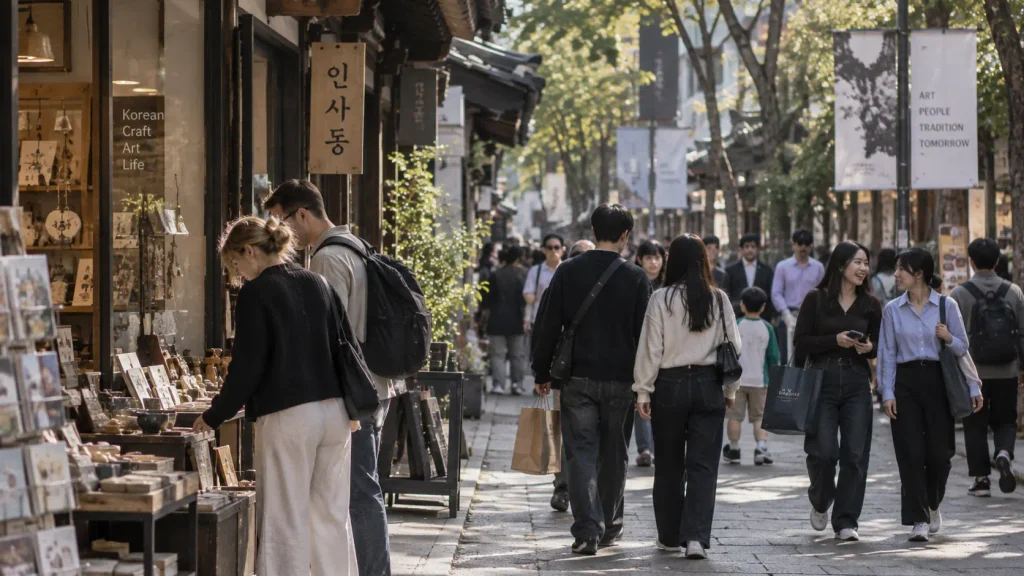
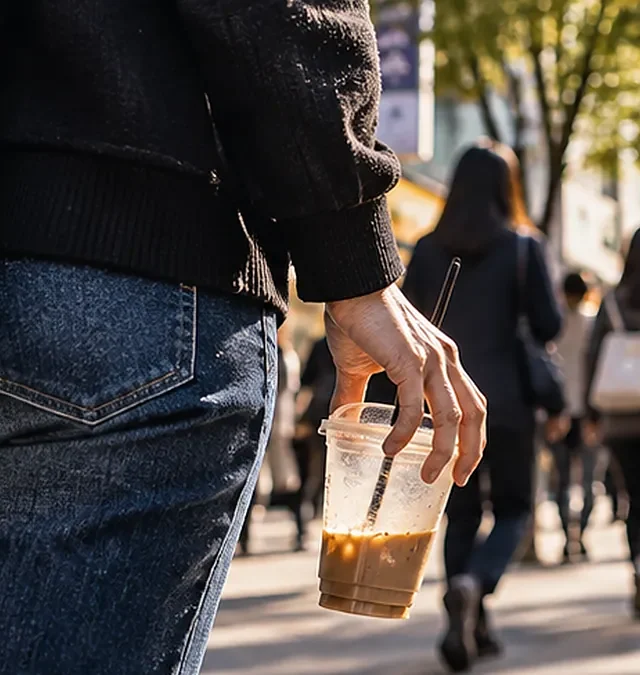
That dual audience gives the neighbourhood an unusual rhythm. One person arrives searching for a souvenir; another is looking for art; someone else simply turns into an alley because the weather is pleasant.
The same street accommodates all three.
Tradition Has Learned to Share the Address
Walk far enough into the side streets and Insadong starts revealing its less obvious layers.
The neighbourhood’s cultural routes connect places associated with Joseon-era art, traditional scholarship, crafts, temples and Korea’s modern history. Seoul’s current guided walking course, for example, links Insa-dong Culture Street with the former site of Dohwaseo, antique and craft shops, Jogyesa and other historically significant sites.
That density changes the experience of the district. Culture does not appear as one large attraction with a ticket counter and an exit. It accumulates in storefronts, alleys, plaques, objects and buildings encountered almost by accident.
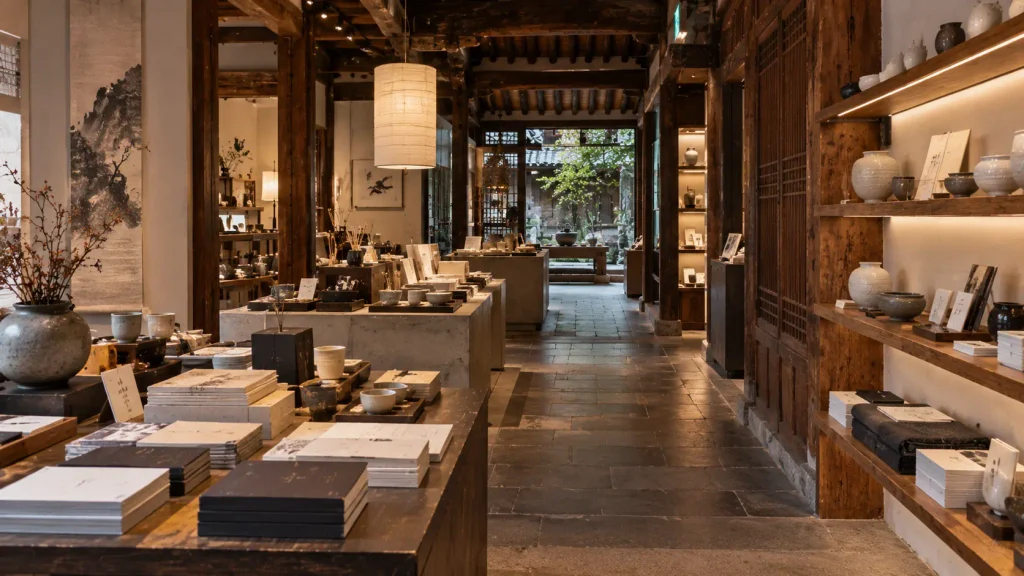
Even commercial spaces participate. Ssamzie-gil and other developments have given traditional goods a more contemporary retail environment, while newer cultural venues continue to operate inside the same neighbourhood. The old vocabulary remains. The typography, packaging and interiors around it keep moving.
The Problem With Preserving a Place
Insadong’s greatest challenge comes from the same quality that made it valuable: everyone understands what the neighbourhood represents.
Too much change can drain its identity. Too little can turn it into scenery.
The district has spent decades balancing that pressure. Seoul’s own descriptions acknowledge both its preserved cultural character and its mixture of traditional and contemporary businesses. Its shops sell old forms through new retail formats; its streets serve tourists while remaining part of everyday urban life.
There is no permanent solution. A culture district that never changes becomes a display. One that changes without restraint becomes interchangeable with everywhere else.
Insadong survives in the narrow space between those outcomes.
The Street After the Souvenir
Late in the afternoon, the foot traffic thickens. A visitor stops at a shop window, turning a small ceramic cup in both hands. Across the lane, someone carries a paper bag from a stationery store. A café door opens and closes as people disappear into the warm light inside.
The street has spent generations being asked to prove that Korean culture still exists here.
It rarely answers in one grand gesture.
Instead, a calligraphy brush remains in a shop window. A tea house keeps pouring. An old alley carries people toward a new exhibition, and the same pavement takes them past a store that was not there a decade ago.
By evening, the doors begin to close.
The brush stays where it was.