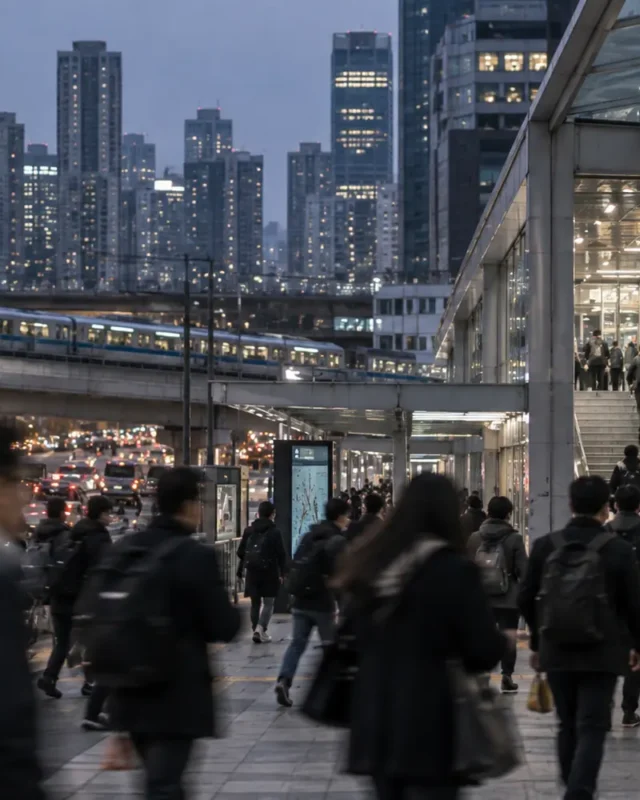
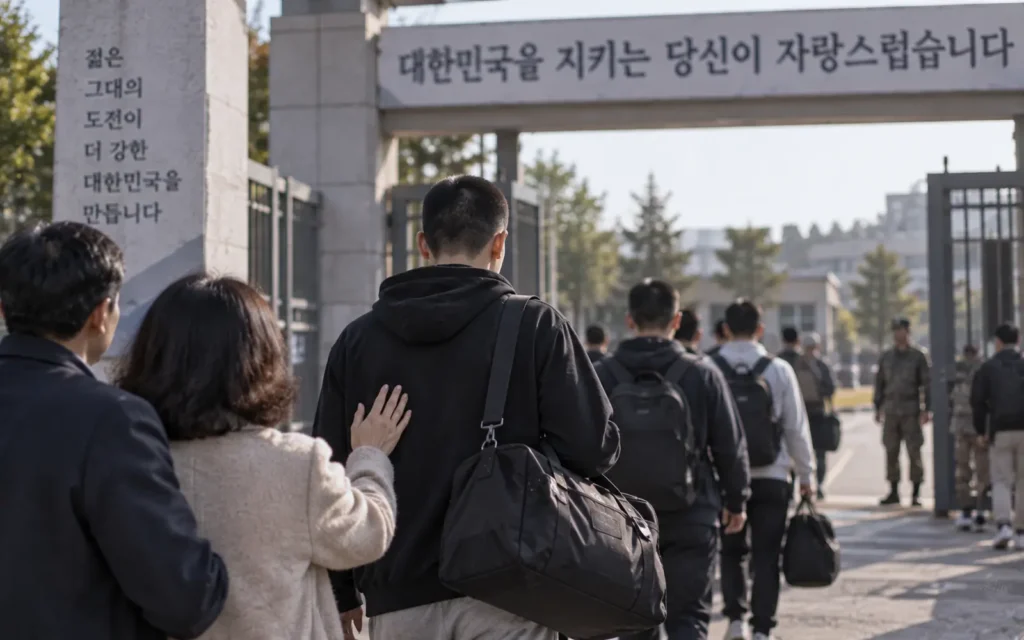
At a train station in Seoul, a young man in civilian clothes waits with a duffel bag between his feet.
His hair is cropped short. Family members stand nearby, speaking more quietly than usual, while trains continue arriving and leaving behind them.
In a few hours, the clothes will change. Phone calls will become less frequent. Ordinary life will continue without him for a while.
For many Korean men, military service arrives somewhere between school and adulthood. South Korea’s Constitution places a national-defense duty on citizens, while the Military Service Act requires male citizens to fulfil military service; women may serve through voluntary enlistment.
The system grew from a specific security reality, but its effects reach well beyond barracks and guard posts. It interrupts university plans, reshapes early careers and gives generations of Korean men a shared reference point that can surface years after the uniform has disappeared.
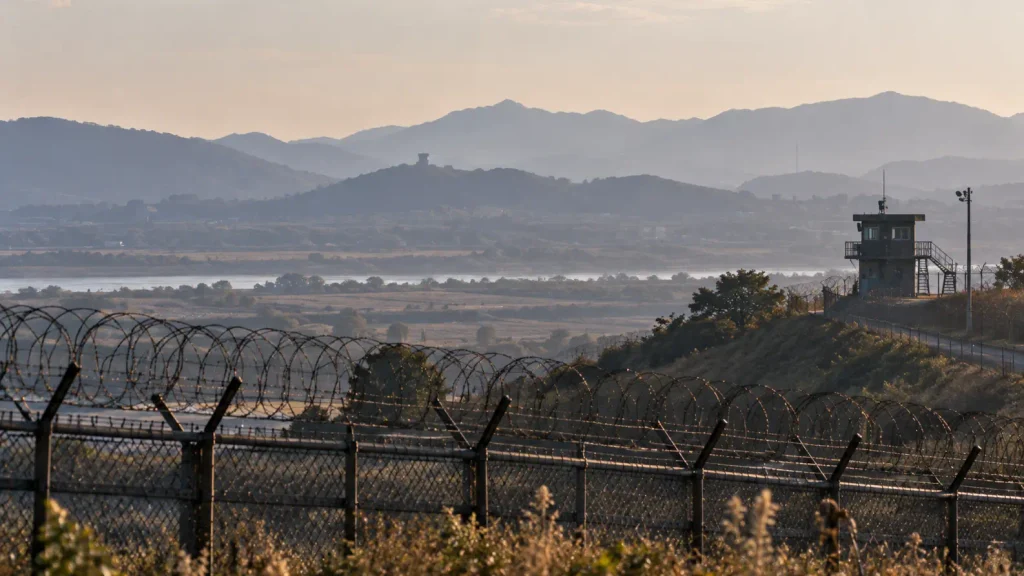
The Border Is Never Very Far Away
South Korea has lived for generations with the unresolved legacy of the Korean War. The peninsula remains divided, and the country has built its defence system around the possibility that a military crisis could return with little warning.
Universal conscription developed within that environment. The Military Manpower Administration describes mandatory service as part of the country’s national-defence structure, followed by a reserve obligation that extends the relationship with the military beyond active duty.
The political arguments have changed over time. The security calculation has proved harder to remove.
South Korea maintains a large standing military while requiring a broad share of young men to spend part of early adulthood in uniform. For a country that has become one of the world’s most connected economies, that arrangement can appear distant from modern civilian life.
The border keeps it close.
A Date Arrives on the Calendar
Military service begins before the first day in uniform.
There are medical examinations, paperwork, postponements and decisions about when to leave school or work. The Military Manpower Administration operates a draft physical examination system and allows postponements in cases such as university study. Once enlisted, conscripts undergo basic training before moving to their assigned units.
For the Army, active service currently lasts 18 months, including five weeks of basic training. Navy service lasts 20 months, while Air Force service lasts 21 months.
CURRENT ACTIVE-DUTY PERIODS
Army / Marine Corps — 18 months
Navy — 20 months
Air Force — 21 months
For a university student, eighteen months can land directly in the middle of a degree. For someone beginning a career, it can interrupt a first job or delay entry into the workforce.
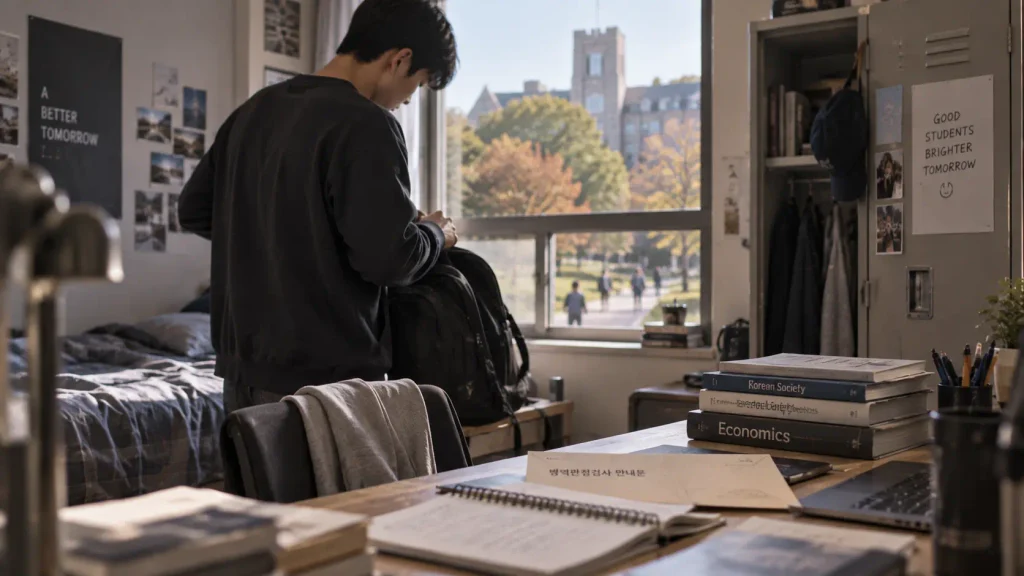
The date eventually reaches the calendar.
Then the calendar starts rearranging everything around it.
Eighteen Months, Then Another Life
Inside the military, ordinary time becomes highly structured.
Wake-up calls, formations, meals, training and duty divide the day into fixed blocks. Personal schedules give way to a collective timetable. Someone accustomed to deciding where to go, when to eat and when to sleep suddenly has very little control over any of those things.
The experience varies by branch, unit and assignment. Some serve near the front line. Others work in technical, administrative or support roles.
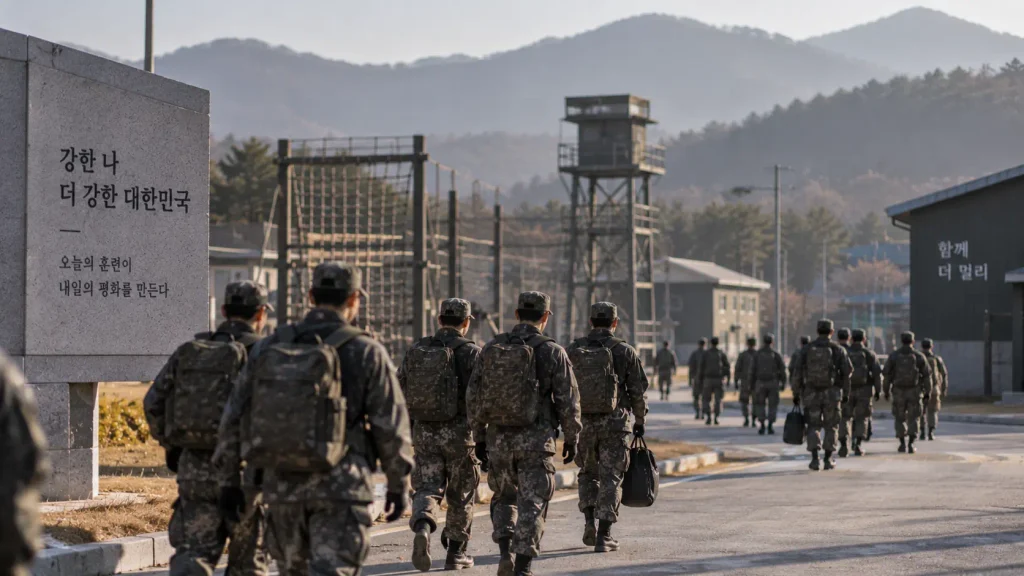
The shared element is the interruption of civilian autonomy.
And active duty is not the end. Under the current framework, discharged personnel remain in the reserve system for eight years. A young man can therefore leave the barracks without entirely leaving the military structure.
The Uniform Follows You Home
Ask two Korean men about military service and the conversation can become unexpectedly specific.
Where did you serve? Which branch? What year did you enlist?
The questions can establish an immediate point of reference. Someone who served on an island, worked in communications or spent long nights on guard duty carries experiences another former conscript may recognise without much explanation.
That vocabulary follows people into civilian life. Stories, expressions and habits survive the transition back to university, offices and restaurants. For some generations, military seniority also became another way of reading age and hierarchy.
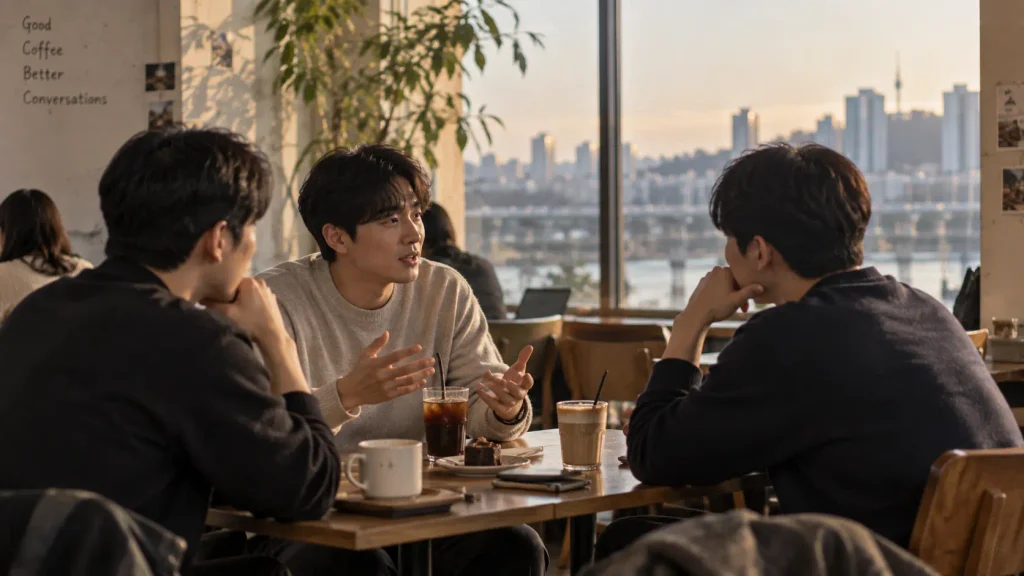
The memories themselves differ. Some remember friendships. Others remember exhaustion, boredom or conflict.
For many, it simply becomes one of the dividing lines of their twenties: before service and after it.
The Cost of the Missing Year and a Half
Military service takes something more tangible than time on a calendar.
A student may return to campus after classmates have moved ahead. A job seeker may re-enter a labour market that has changed during the absence. A relationship may spend part of its early years divided between a military base and civilian life.
Korean institutions have built procedures around that interruption because it affects so many people. Universities provide military leave and return arrangements. Employers regularly encounter applicants whose résumés contain an expected gap.
The eighteen months do not disappear from a biography.
They occupy a place inside it.
Not Everyone Serves in the Same Way
“Korean military service” describes a system with several different routes.
The Military Service Act requires male Korean citizens to fulfil military service, while women can serve voluntarily in active or reserve roles. Physical classification, individual circumstances and legal provisions can place people into different forms of service or exemption.
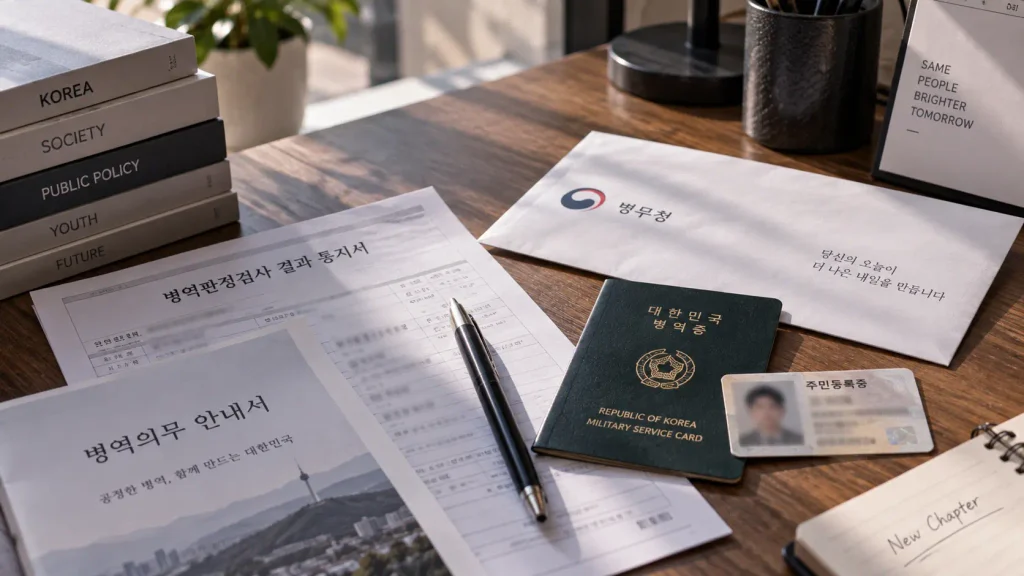
Alternative service also exists for recognised conscientious objectors. Under the current system, it lasts 36 months and takes place in correctional facilities rather than military units.
Those distinctions matter because military obligation sits close to questions of fairness. Who serves, how long they serve and what qualifies as an equivalent contribution have remained subjects of public debate.
For anyone looking at Korea from outside, the simple question “Does Korea have conscription?” quickly becomes several different questions.
When the Uniform Becomes a Memory
Eventually, the haircut grows out.
The boots disappear into a closet. Civilian clothes replace the issued uniform. The alarm no longer needs to ring before dawn.
The experience survives in smaller places.
A former soldier recognises a unit patch in an old photograph. Friends laugh about a story that makes little sense outside the barracks. Someone mentions an enlistment year at dinner, and another person immediately calculates how old they must have been.
Army active duty lasts about eighteen months, but the institution reaches further because military service has become woven into the transition from youth to adulthood.
At a Seoul café, two men in their twenties can talk about work, university, dating and rent.
Then one asks the other where he served.
The answer usually comes quickly.