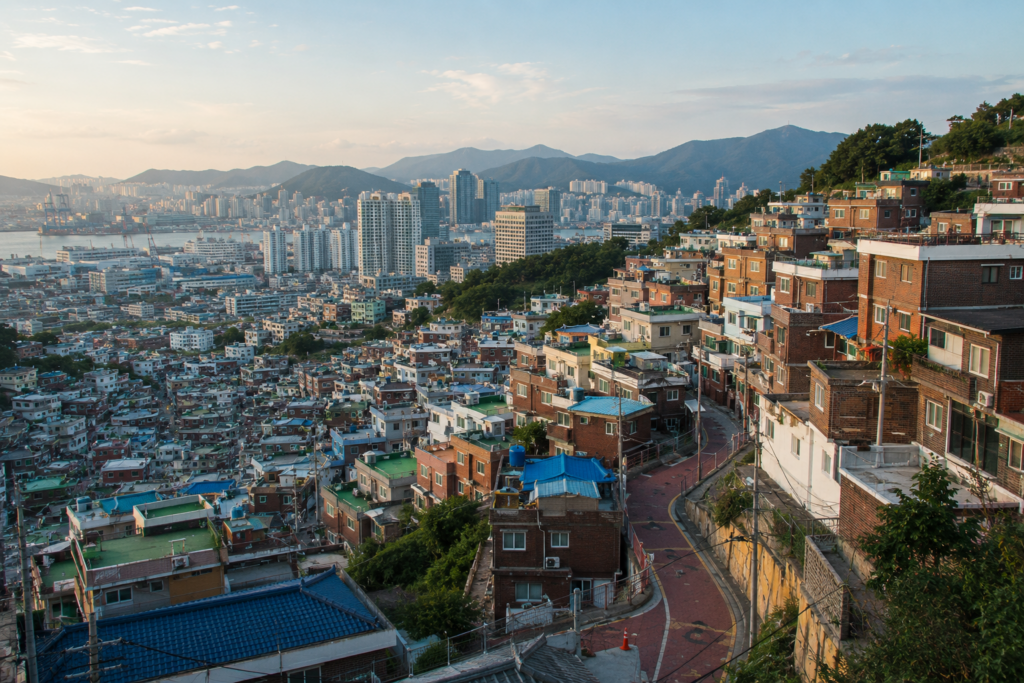
In Seoul or Busan, walking through a residential neighborhood can sometimes feel less like moving through a city and more like climbing one.
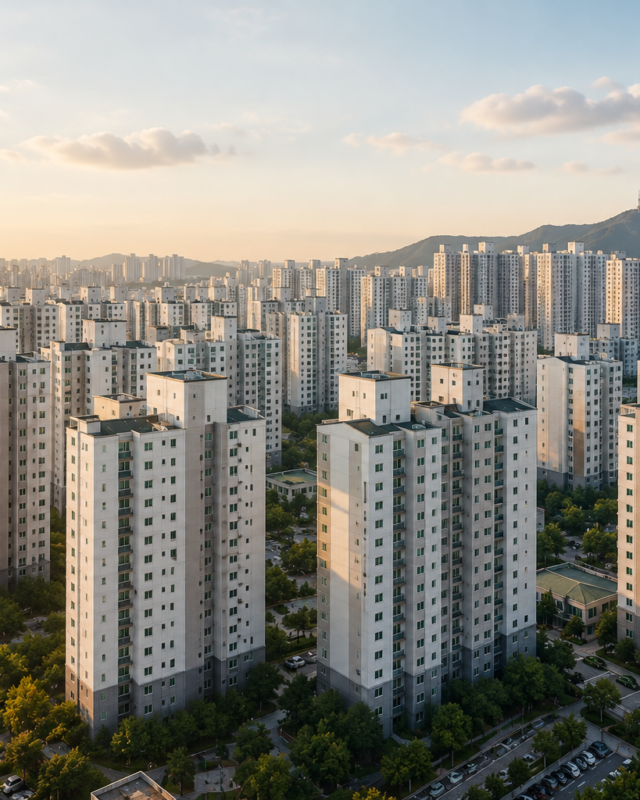
Streets rise sharply between houses, stairways cut through blocks, and buildings seem to settle into slopes that would have been easier to leave undeveloped. From higher ground, the pattern becomes even clearer: dense neighborhoods spread across hillsides while flatter land below is occupied by roads, offices, stations and larger apartment complexes.
It can look accidental. Much of it was anything but.
Korea’s hillside neighborhoods grew out of a combination of geography, rapid urbanisation, housing shortages and the particular way Korean cities expanded during the second half of the twentieth century. The mountains were already there, of course, but the decision to live on them was often made under pressure. People needed to stay close to jobs and transport, cities needed somewhere to put a rapidly growing population, and relatively inexpensive land on the urban fringe was not always flat.
The result is one of the more distinctive features of Korean urban life: neighborhoods that climb.
Korea Was Never Short of Mountains
Start with the geography. Seoul is surrounded by mountains, with the city’s historic centre enclosed by a series of peaks and ridges. Roughly 40 per cent of Seoul’s terrain is hilly, according to the Seoul Metropolitan Government. The city’s older neighborhoods therefore developed within a landscape that was never a blank, level surface waiting to be filled with buildings.
Around 40% of Seoul’s area consists of hilly terrain more than 40 metres above sea level.
This matters because modern Seoul did not simply replace that landscape with a new city. It expanded around it.
The historic capital was shaped by mountains long before high-rise apartments appeared. Seoul’s old city wall itself follows the contours of the terrain, while neighborhoods formed along the lower slopes of Naksan, Bugaksan and other mountains. Some of today’s low-rise residential districts still preserve street patterns and lot shapes that reflect this earlier relationship with the land.
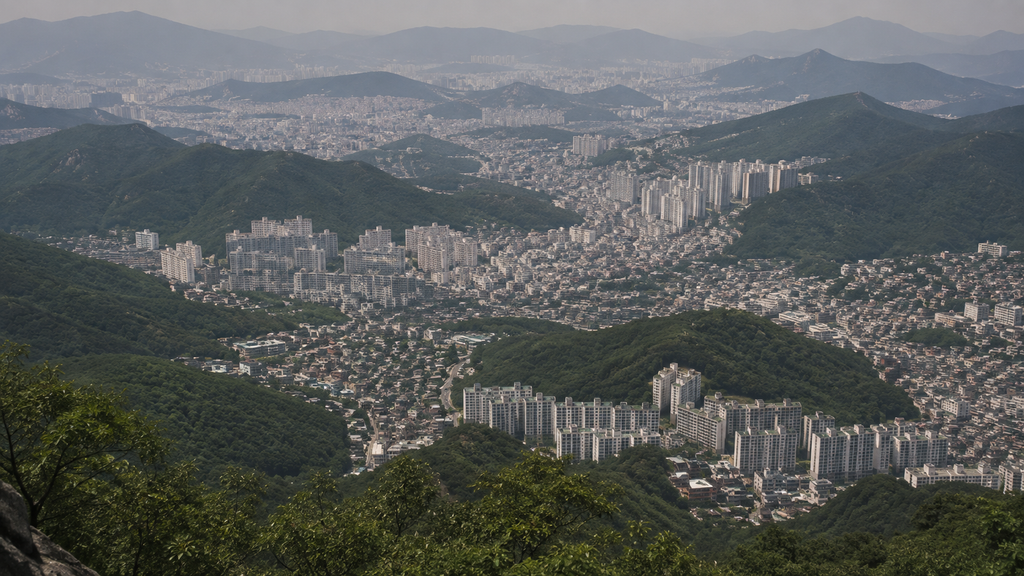
The mountains were not an obstacle outside the city.
They were part of the city.
As Seoul grew after liberation, however, the relationship became much more complicated.
Then the City Started Growing Much Faster Than the Land Could
South Korea’s postwar transformation was extraordinarily rapid. Seoul’s population surged as people moved to the capital in search of work, while industrialisation pulled millions of people from rural areas towards expanding cities.
Housing could not keep up.
People arriving in Seoul still needed somewhere to live, and the most desirable land was not necessarily available to them. Areas close to employment and transport were valuable, while large expanses of flat land were limited. For lower-income households, living farther up a slope could be one of the few ways to remain within reach of the city.
Some of these communities were informal settlements. Others gradually became established neighborhoods as houses were improved, roads extended and services arrived.
Around Naksan, for example, poor residents gathered in hillside settlements after the colonial period and the Korean War. Public housing was later built in some areas, while redevelopment during the 1970s changed others. Yet parts of the original alleyways and urban form remain visible today.
The hillside was not necessarily where people wanted to live. It was often where they could.
In Busan, the Story Is Even More Visible
If Seoul demonstrates how hills became woven into a growing metropolis, Busan makes the story almost impossible to miss.
The city has relatively little flat land and is surrounded by mountains. During the colonial period, workers moving to Busan settled on slopes above the old urban core. The Korean War brought a huge influx of refugees, many of whom established makeshift settlements on higher ground. Later, rural-to-urban migration during industrialisation added another wave of residents.
These neighborhoods became known as sandongne—literally, mountain villages.
They were not remote mountain settlements. They were remarkably close to the economic heart of the city. Residents could walk downhill towards ports, markets and workplaces, then climb back home.
That relationship between elevation and employment shaped the physical form of Busan for decades.
The famous sanbokdoro, or hillside roads, emerged partly in response. Construction began in the early 1960s, connecting settlements that had spread across the slopes. The first section of Choryang Sanbokdoro opened in 1964, and the network expanded through the surrounding districts.
The roads did more than make the hills accessible. They helped turn scattered hillside settlements into functioning pieces of the city.
A Hill Could Be Cheaper Than Waiting for Flat Land
There is an important distinction between saying that Koreans chose to build on hills and saying that hills became part of the available housing supply.
During periods of intense urban growth, the second explanation is closer to reality.
Flat land was valuable. So were locations near established employment centres. When population growth outpaced formal housing construction, steep and previously marginal land could be occupied incrementally, sometimes through informal construction and sometimes through later government or municipal intervention.
This produced a very different urban landscape from the planned apartment districts that would later dominate much of Korea.
Instead of one large development being designed at once, houses could appear one by one. Alleys followed the slope because the slope was already there. Staircases connected streets at different elevations. Small plots produced irregular buildings, retaining walls and narrow passages.
The physical awkwardness is part of the history.
A perfectly straight road was not always possible. A generous driveway was a luxury. Even today, walking through some hillside neighborhoods means moving between roads, stairs and narrow lanes that seem to have been assembled over decades rather than designed on a single drawing board.
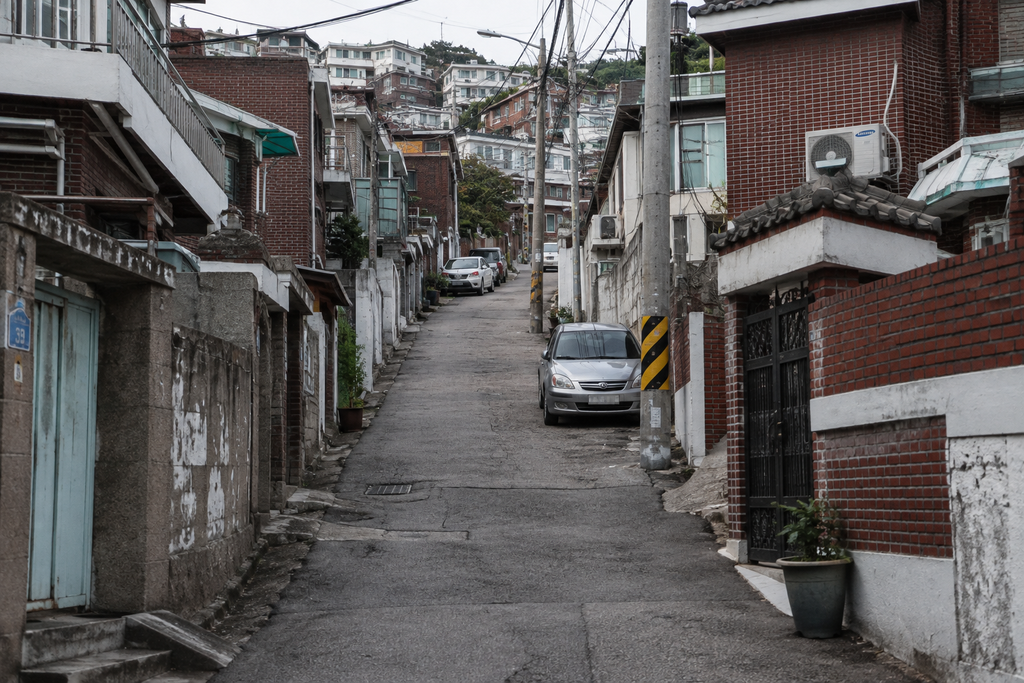
The Staircase Is Part of the Infrastructure
That is why stairs are such a conspicuous feature of Korean hillside neighborhoods.
In a flat city, a staircase is usually an architectural detail. On a steep Korean residential slope, it can function more like a street.
This is particularly apparent in older parts of Seoul, where narrow stairways connect roads at different heights and lead directly into residential alleys. In some neighborhoods around the Seoul City Wall, steep paths and low-rise housing remain closely tied to the contours of the hills.
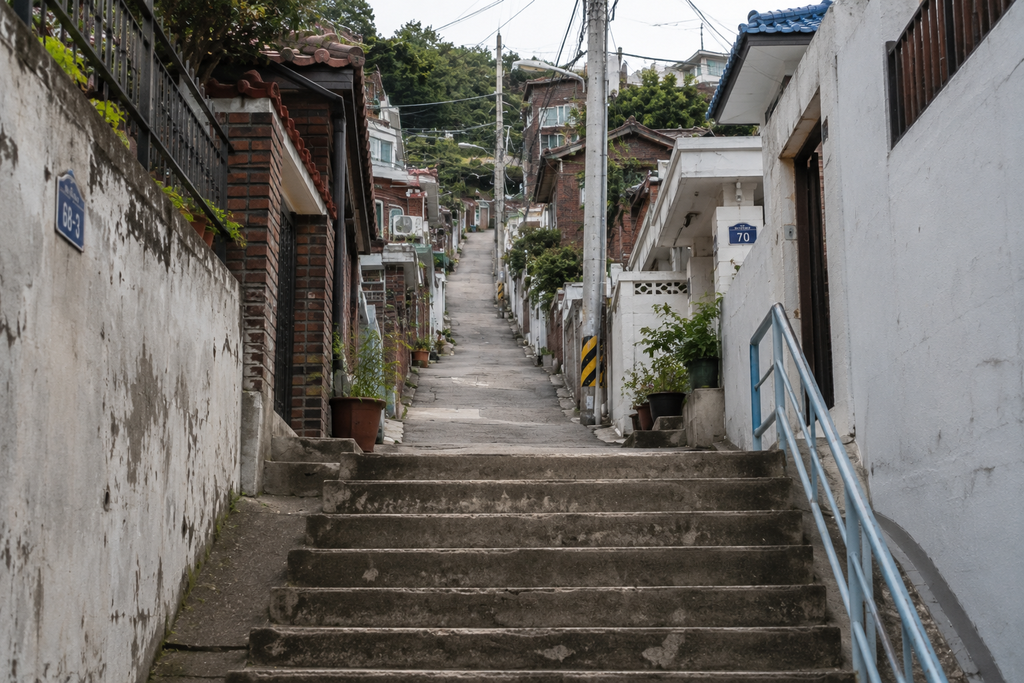
The arrangement can be inconvenient. It can also create a remarkably intimate scale.
Cars become less dominant when streets are too narrow or steep for easy access. Front doors open directly onto alleys. Neighbours encounter one another while walking up and down. Small shops and local services can occupy awkward corners that would disappear in a larger planned development.
The same terrain that made construction difficult helped produce neighborhoods with a very different rhythm from the high-rise districts below.
Then Korea Learned to Build Over the Hills
Korea’s rapid development did not mean that every hillside remained a low-rise settlement.
Over time, roads improved, engineering techniques advanced and redevelopment became increasingly systematic. Hills were cut, retaining structures were built and new roads were pushed through difficult terrain. In some areas, older houses disappeared and were replaced by larger residential developments.
But the hills themselves did not disappear.
This is one reason Seoul can feel visually contradictory. A dense apartment district may sit only a short distance from a maze of small houses climbing a slope. One neighborhood looks as though it belongs to a highly planned twentieth-century metropolis; another still follows the terrain in ways that reveal much older patterns of settlement.
The city’s current planning still has to negotiate this geography. Seoul’s own planning documents emphasise development that responds to natural topography, while the city has recently been reconsidering rigid height and floor restrictions in low-rise hillside residential areas.
The hills remain an active urban-planning problem, not merely a historical curiosity.
Why Didn’t Everyone Just Move to the Flat Parts?
Because the flat parts became the most valuable parts of the city.
As Seoul developed, major roads, commercial districts, transport infrastructure and employment centres concentrated in areas that were easier to build on and easier to connect. New towns and large apartment developments could then be planned on a much larger scale, often combining housing with schools, roads, parks and commercial facilities.
That made the contrast sharper.
The flatter parts of the city could accommodate large-scale redevelopment. Older hillside neighborhoods were more difficult to assemble because land ownership was fragmented, streets were narrow and the terrain made construction expensive.
Some were demolished and rebuilt. Others survived for decades.
In places such as Buam-dong and the neighborhoods around Seoul’s old city wall, development restrictions and historical or environmental considerations have helped preserve areas where the relationship between houses and mountains remains unusually visible.
The hills therefore became not just places where poorer neighborhoods survived, but in some cases places where older forms of urban life survived as well.
The View Changed the Meaning of the Hill
Something else happened as Korean cities became wealthier.
The hillside stopped being associated exclusively with necessity.
A difficult location could also offer something the flat city could not: a view.
From higher neighborhoods, the city opens up below you. In Busan, the relationship between steep settlements and the sea creates some of the city’s most recognisable views. In Seoul, homes on the slopes around the old centre can look across dense neighborhoods towards mountains, towers and the changing skyline.
Some older hillside areas have consequently been rediscovered through urban regeneration, cafés, galleries, walking routes and tourism.
That does not erase their difficult history. In fact, it can make the contrast more visible. A neighborhood that once existed because residents had few alternatives can later become desirable precisely because it retained something the newly built city had lost.
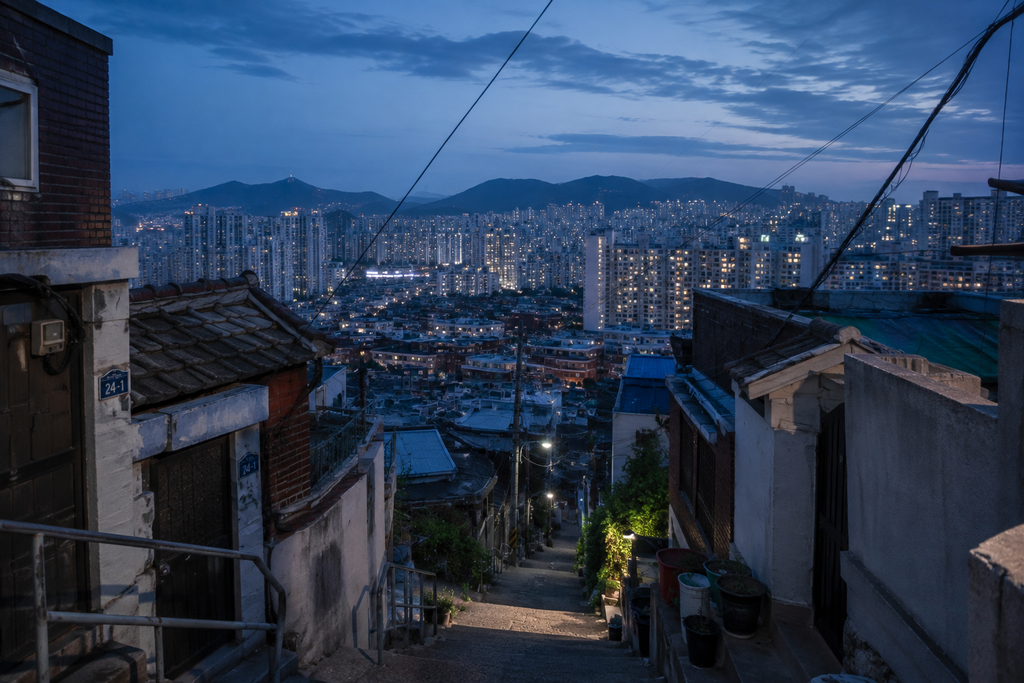
The view was always there.
The value placed on it changed.
Hillside Korea Is Not One Story
It would be easy to reduce all of this to a single explanation: Korea is mountainous, so Koreans built on hills.
That misses most of what makes these neighborhoods interesting.
Geography created the constraint, but history determined who moved into the available spaces and when. Industrialisation accelerated population growth. Housing shortages pushed people towards marginal land. War and migration reshaped cities. Infrastructure gradually connected settlements that had begun informally. Later redevelopment replaced some neighborhoods while leaving others intact.
Seoul and Busan also followed different paths. Seoul’s hillside neighborhoods grew within a capital surrounded by mountains and constrained by a long-established urban core. Busan’s mountain settlements developed alongside a port city where flat land was particularly scarce and successive waves of workers and refugees moved uphill.
The same basic landscape can therefore produce very different urban histories.
The Hills Are Still Part of Korean City Life
Today, Korea’s hillside neighborhoods sit somewhere between past and present.
Some are ageing residential areas where residents have lived for decades. Others are being rebuilt. Some have become fashionable precisely because their irregular streets and elevated views feel different from the increasingly standardised apartment districts around them. Seoul’s current planning debates also reflect the practical difficulty of improving ageing low-rise areas without treating every hillside as a blank development site.
There is no single future for these places.
Some slopes will become apartment complexes. Others will remain low-rise. Some will be preserved because of their history or landscape, while others will change simply because maintaining old infrastructure is difficult.
What is unlikely to disappear is the basic fact that Korean cities grew around their terrain rather than waiting for the terrain to become convenient.
A City That Learned to Climb
The next time a Korean street suddenly turns upward, the slope is worth noticing.
It may be tempting to see the stairs, retaining walls and houses stacked above one another as an odd feature of the city—an inconvenience left behind by imperfect planning. But the hillside neighborhood is also a record of how modern Korea was built: rapidly, unevenly and under enormous pressure to house people close to the places where opportunity was accumulating.
The mountains did not move.
The cities grew around them.
And in the spaces where flat land ran out, Korean urban life simply kept going uphill.