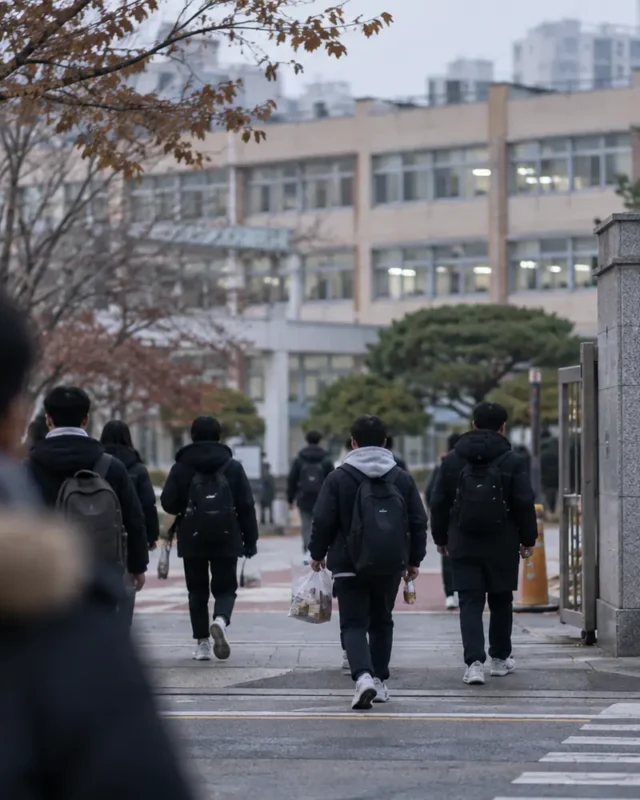
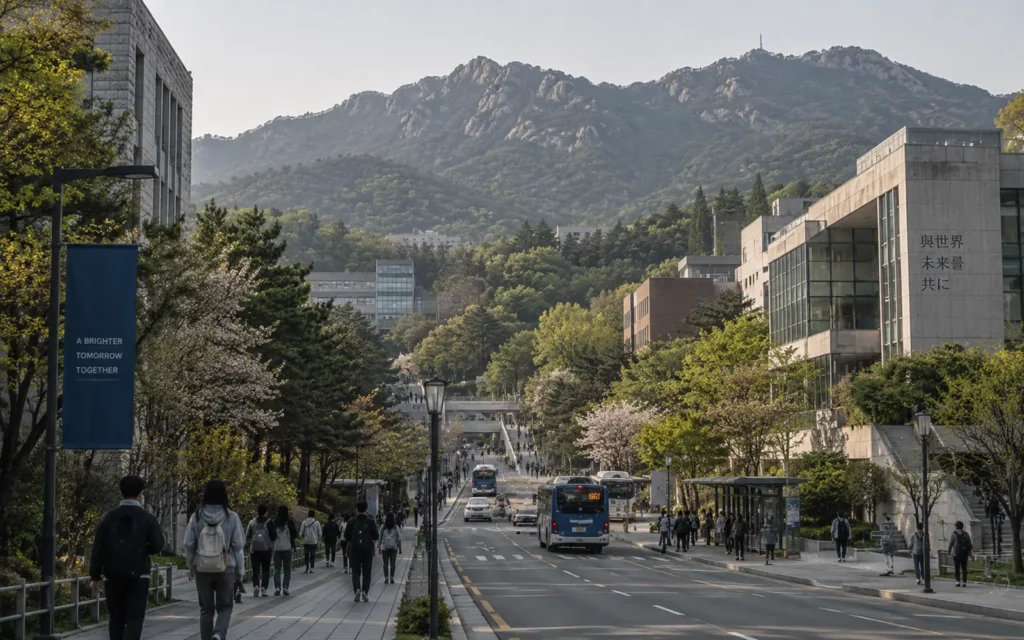
On a spring afternoon in Gwanak
students move between lectures, libraries and laboratories while buses climb the roads towards Seoul National University’s sprawling campus. Behind the buildings, the mountain rises close enough to make the university feel slightly removed from the city, even as nearly every road around it points back into Seoul.
The name on the entrance gate carries weight far beyond the campus. In conversations about university entrance, recruitment and professional careers, “Seoul National University” can function almost like a credential before anyone has seen a transcript.
SNU opened in 1946 as Korea’s first comprehensive national university, bringing together institutions from the country’s early modern education system. Its founders envisioned a university capable of producing intellectual leaders for a newly liberated nation. Over the decades, the institution expanded its research base and sent graduates into government, academia, law, medicine, business and other parts of public life.
Prestige accumulated through repetition. Strong applicants kept choosing the same university. Employers kept recognising the name. Alumni built networks that made the next generation want to enter.
A University Built for a New Country
The timing of SNU’s foundation matters. South Korea emerged from Japanese colonial rule in 1945 with institutions to rebuild, political structures to establish and an economy with enormous gaps to close.
When Seoul National University opened on October 15, 1946, it began with nine colleges and a graduate school spanning law, medicine, engineering, education, agriculture and other fields. The scale matched a country trying to construct modern national institutions almost from the ground up.

Then came decades of industrialisation. Education became closely linked with upward mobility as professional qualifications opened paths into the expanding state, corporations and specialised professions.
SNU occupied a prominent position because it trained across so many of those fields while maintaining deep historical connections to Korea’s public and professional leadership. Its graduates moved through ministries, courts, universities, hospitals, corporations and politics.
A university can acquire prestige through reputation.
A national institution can acquire something closer to memory.
The Three Letters That Sort a Crowd
By the time university entrance became one of the defining competitions in Korean education, SNU no longer stood alone.
It formed the first letter of SKY, the shorthand for Seoul National University, Korea University and Yonsei University. Three names became a compact way of describing the highest tier of Korea’s university hierarchy.

The cycle reinforces itself. Strong students apply because the university carries prestige. Those students strengthen its academic reputation. Employers continue to recognise the name. Younger students grow up seeing the same pattern.
SNU’s selectivity adds another layer. Admission itself can function as evidence of academic performance before a graduate has entered the workplace.
Prestige feeds on precedent.
The Gate Opens Onto a Labour Market
A university name can follow a Korean graduate well beyond campus.
SNU currently lists more than 407,000 alumni and international partnerships across 85 countries, alongside 82 research institutes and 42 government-funded research centres. Those networks do not guarantee employment, but they create connections that can remain useful long after graduation.
SNU currently lists more than 407,000 alumni and international partnerships across 85 countries, alongside 82 research institutes and 42 government-funded research centres.
The labour market has changed. Technology companies and newer industries increasingly evaluate skills, internships, portfolios and practical experience. Still, when recruiters face large applicant pools, a familiar university name can serve as an early signal.
The effect does not need to be dramatic. An employer does not have to assume an SNU graduate will always outperform another candidate. The university can simply reduce uncertainty at the first stage of selection.
Then the rest of the competition begins.
The Campus Grew Into a Research Powerhouse
SNU’s reputation would look very different if it rested entirely on history.
The university reports more than 6,500 faculty members, 16 colleges, 108 graduate departments and more than 92,000 SCI-level papers published between 2013 and 2023. It also lists 23 researchers among the world’s highly cited researchers and more than 10,000 annual research papers in 2024.

Its international position has risen alongside that research capacity. SNU places itself at No. 38 in the 2026 QS World University Rankings and No. 58 in the 2026 Times Higher Education World University Rankings, with employer reputation and research among its stronger areas.
Global rankings measure research, reputation, internationalisation and other defined indicators.
Korean prestige carries another layer.
A university can rank well internationally and still occupy a uniquely powerful place inside its own society. SNU manages to do both.
The Name Carries a Social History
Ask why SNU remains so powerful and the answer eventually leaves the campus.
Many Korean parents who came of age during the country’s rapid transformation saw education reshape family circumstances within a single generation. Professional employment, higher incomes and social mobility became tangible outcomes attached to educational attainment.
SNU became one of the clearest symbols of exceptional academic achievement within that history. The university also developed deep connections to national institutions and public service, later expanding professional programmes across law, education, business, public administration and health.
That history accumulates quietly.
No billboard needs to explain why the name matters. Parents know. Teachers know. Employers know. Alumni know.

A student can hear the name for years before ever reaching the gate.
A Prestige That Survived Its Own Success
There is a paradox in elite education: the more valuable a credential becomes, the harder people compete for it.
South Korea eventually pushed university attendance to very high levels, making the degree itself less scarce. Distinctions between institutions became more important.
SNU’s current profile lists 36,231 students, 6,569 faculty members and more than 407,000 alumni. Its reputation now sits alongside modern measures of research strength, employer recognition and graduate outcomes.
The hierarchy has never represented ability perfectly. Graduates of regional universities build exceptional careers, while SNU graduates can struggle. Many industries increasingly hire through technical tests, portfolios and specialised experience.
Still, the signal survives.
A name built over eight decades can outlast several changes in the economy because each generation encounters it before deciding what the name should mean.
The View From Outside Korea
To an international student, SNU may initially look like another highly ranked Asian university.
To a Korean applicant, the name carries a much longer archive.
Global rankings measure a university through specific indicators such as research, citations, reputation, internationalisation and employment outcomes. Domestic prestige also carries history, social networks, national institutions and the accumulated expectations of families who have spent generations watching the university hierarchy.
SNU’s international standing has grown alongside that domestic reputation. Its research footprint continues expanding while employer reputation and graduate outcomes remain important parts of its global profile.
A ranking can tell you where a university sits.
It cannot quite tell you what its name sounds like in a room.
The Gate at Gwanak
Late in the afternoon, students begin moving down the roads from Gwanak campus. Someone checks a message before boarding a bus. Another walks past the library with a laptop tucked under one arm, already thinking about the next assignment.
Behind them, the university looks almost ordinary from the road: concrete, glass, trees and hills.
The name on the gate has travelled much farther.
A student keeps walking. The buses keep climbing.
The mountain stays where it is.