Step out of Seongsu Station at one of the busier exits and you may find yourself in a queue before you have even decided where you are going.
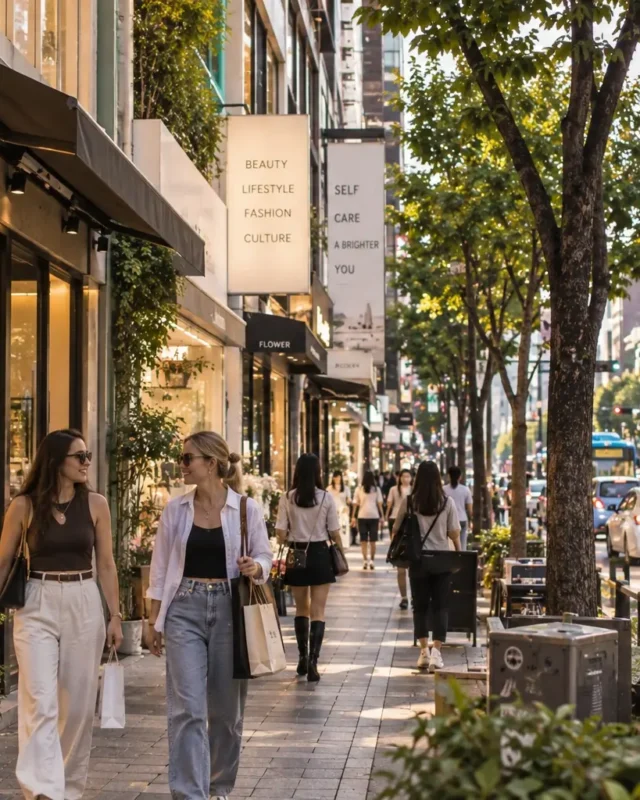
Someone is waiting outside a pop-up store. A passerby carries a shopping bag from a beauty brand. A group of friends pauses in front of a storefront, checks a map on their phones, then disappears down a narrow side street.
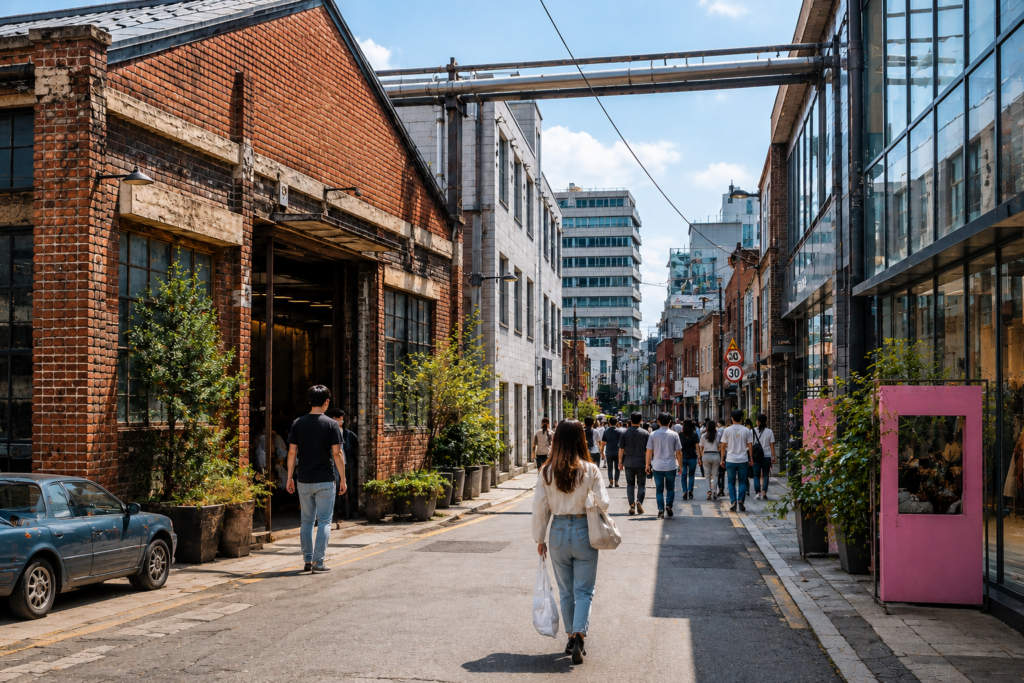
For all the activity, Seongsu still looks unmistakably industrial. Red brick, old workshops, loading doors and concrete walls remain woven into the streetscape, many of them built for work rather than aesthetics. Then you turn a corner and the logic of the neighborhood shifts: a former factory is now a café, another building houses a fashion label, and a warehouse has become a gallery or temporary exhibition space. Further down Yeonmujang-gil, another queue has formed for something that may not even be there next month.
Seongsu has become one of those places in Seoul where people come partly to see what has changed since their last visit. It is an unusual way for a neighborhood to become famous, but it explains much of its appeal.
Seongsu Was Built for Work
Long before cafés and fashion labels arrived, the streets around Seongsu were shaped by manufacturing. The area developed as an industrial district filled with shoe factories, printing businesses and manufacturers producing everything from metal goods to automotive parts. Seoul’s official tourism guide describes a neighborhood that once contained around 3,000 manufacturers, with small factories and workshops packed closely into its streets.
Shoemaking became particularly associated with Seongsu. Workshops clustered throughout the area, supplying shoes to businesses across Seoul and creating an ecosystem of manufacturers, suppliers and skilled workers. For decades, the neighborhood’s identity was tied less to where people went to spend their free time than to what was being produced behind its doors.
Then manufacturing changed. Some workshops disappeared, others moved elsewhere, and buildings designed for production became increasingly difficult to fill with businesses doing the same work.
The buildings, however, remained.
That mattered more than it first appeared. High ceilings, generous interiors, exposed brick and wide entrances gave these old industrial properties qualities that newer commercial developments often struggle to reproduce. When cafés, creative studios and independent businesses began looking for affordable spaces with character, Seongsu already had them.
The neighborhood had been built for making things. The next generation simply wanted to make something different.
Yeonmujang-gil Changed the Way People Saw the Area
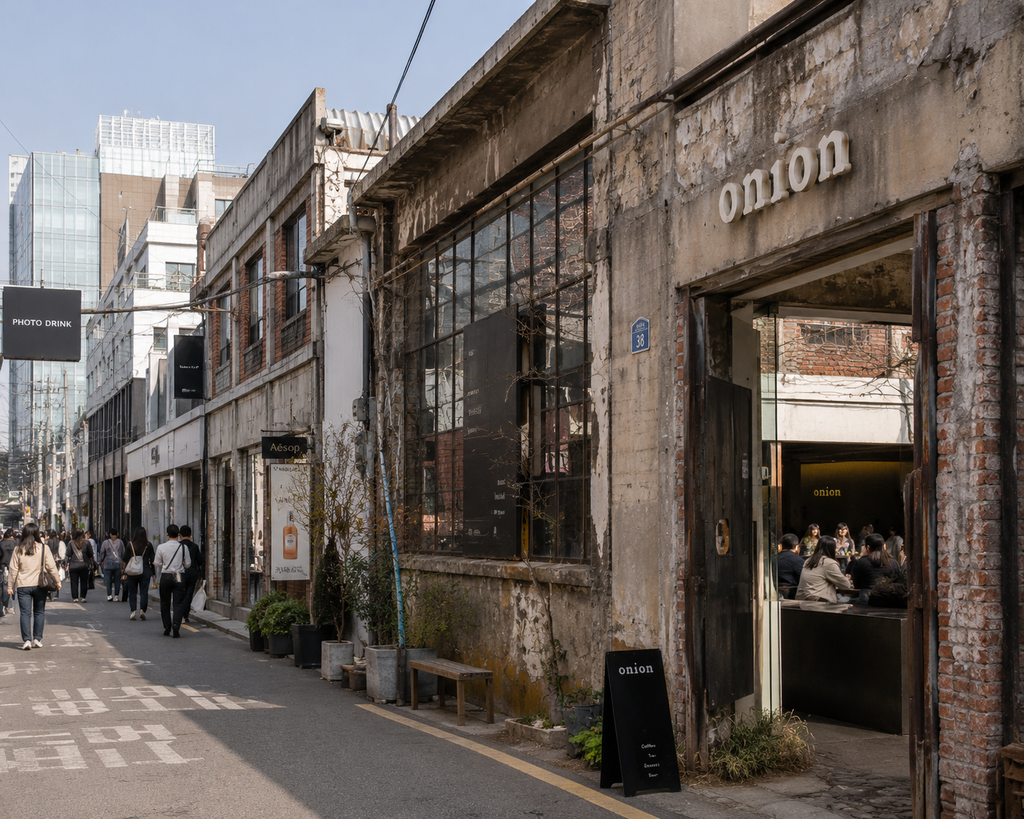
One of the clearest expressions of that transformation can be found along Yeonmujang-gil. The street still carries traces of the shoe factories that once defined the area, but those buildings now sit beside cafés, galleries, clothing stores and brand pop-ups. Seoul’s official travel guide describes the street as a place where former industrial architecture and contemporary retail have grown into the same streetscape.
The contrast is easy to photograph, but its value goes deeper than that.
A new business moving into a factory does not have to invent an identity from an empty shell. The building already has one. Peeling paint, steel frames, rough brick and oversized doors can remain visible while the interior becomes something entirely different, allowing the old structure to do part of the branding before a business has even put its sign up.
That combination has proved particularly useful for cafés and lifestyle businesses. Cafe Onion Seongsu is one of the better-known examples, occupying a converted industrial building while retaining much of its original character. Places like this helped turn Seongsu into somewhere people would visit deliberately, even when they had no practical reason to be there.
The industrial past never completely disappeared. You can still see it between the newer storefronts.
Then People Started Coming for Coffee
Once cafés and small creative businesses began attracting visitors, Seongsu developed a different kind of foot traffic. Someone might come for coffee and spend the afternoon walking. A shop discovered by accident might become the reason for another visit, while a side street that seemed unremarkable six months earlier could suddenly contain a place worth finding.
The neighborhood’s physical layout encourages this kind of wandering. There is no single shopping boulevard telling you where to go next. Interesting places are scattered through streets that still retain much of their industrial structure, so the experience often involves walking between them, noticing something through a doorway, checking the name on your phone and deciding whether to go inside.
It feels less like moving through a conventional retail district than exploring a neighborhood that keeps changing beneath your feet. Seoul’s current tourism guide makes much the same observation, describing Seongsu as a place where new concept stores, cafés, creative spaces and pop-ups continue to appear around former industrial buildings.
Eventually, the turnover itself became part of the attraction.
The Pop-Ups Changed the Rhythm
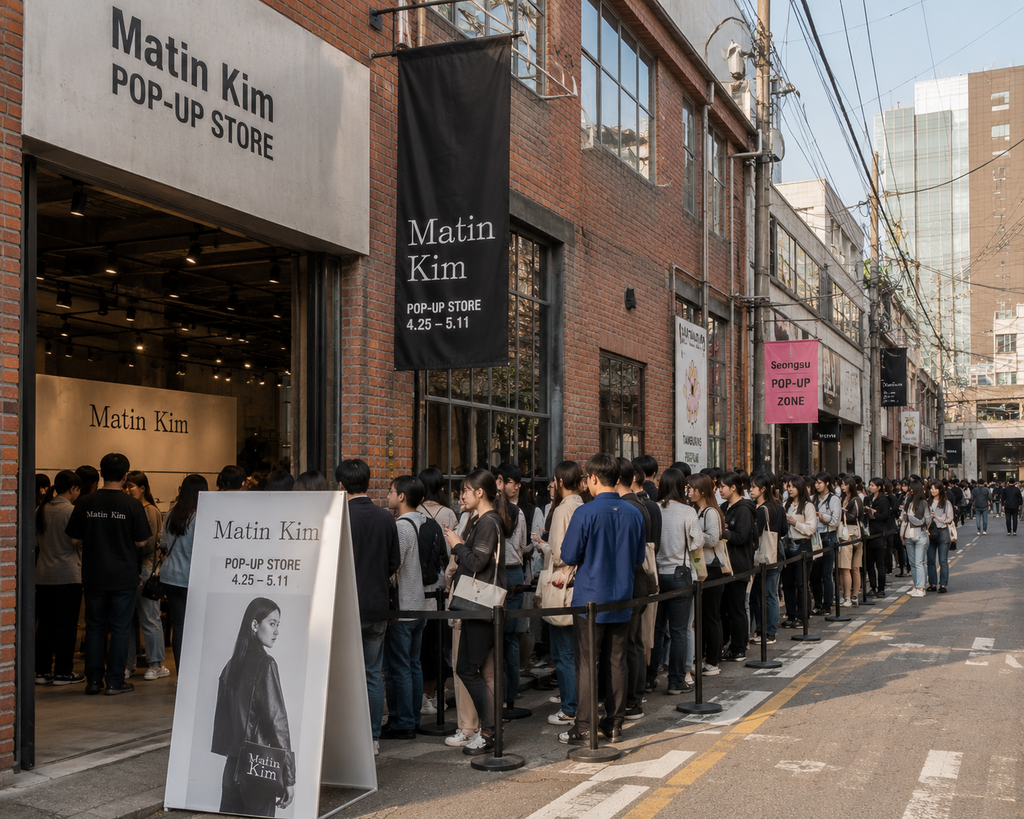
Permanent businesses gave people a reason to visit. Pop-ups introduced something more urgent: a reason to go now.
By 2025, queues outside temporary stores and restaurants had become such a familiar sight that Seoul’s official trend report used them as one of the defining scenes of the neighborhood. New pop-ups, flagship stores and independent shops were appearing frequently enough that even regular visitors could reasonably expect something different on their next trip.
The appeal of a temporary space is straightforward. You can visit a permanent store later. A pop-up has an ending.
A limited collaboration, an event tied to a new product or an installation that will disappear in a few weeks gives people a concrete reason to make the trip today rather than someday. For brands, Seongsu offers another advantage: visitors are already accustomed to moving from one new experience to the next.
The infrastructure for discovery was already there. Brands learned how to use it.
A Few Weeks Can Be Worth Millions of Won
The price of that attention has risen sharply.
In April 2026, Seoul Economic Daily reported that a roughly 660-square-meter pop-up property on Yeonmujang-gil was charging 20 million won per day and had been booked months in advance. Another location near Seongsu Station was reportedly commanding as much as 30 million won a day.
Those figures would be difficult to justify if the space were valued simply as somewhere to display products. What brands are paying for is the foot traffic, and just as importantly, the audience.
A successful pop-up can generate photographs, social posts, press coverage and word of mouth while the event is still running. The physical store becomes content as well as retail space, while the neighborhood supplies a steady stream of people willing to photograph what they have just seen.
That has made Seongsu particularly attractive to fashion, beauty and lifestyle brands. The district has become a place where companies can test how much attention a physical experience can generate before deciding whether they want a permanent presence.
The Internet Starts the Trip Before the Train Does
A visitor does not necessarily discover Seongsu after arriving in Seoul. Increasingly, the discovery happens weeks earlier.
A pop-up appears on Instagram. A Korean beauty brand turns up in a TikTok video. Someone photographs an unusual storefront and, almost incidentally, creates a new destination for thousands of people planning a trip to Seoul.
Recent analysis by Lotte Members found that foreign visitors were increasingly encountering Korean brands through social media before traveling, with Seongsu functioning as an important place where those online discoveries became physical experiences.
The effect is especially pronounced in a neighborhood that refuses to stand still. A photograph can introduce a place to thousands of people without guaranteeing that the same place will still exist when they arrive. By then, another brand may have taken over the building.
For Seongsu, that does not necessarily weaken the attraction. The neighborhood itself has become the destination. The individual shop may be temporary, but the habit of looking for something new is much harder to replace.
Foreign Visitors Have Started Following the Same Route
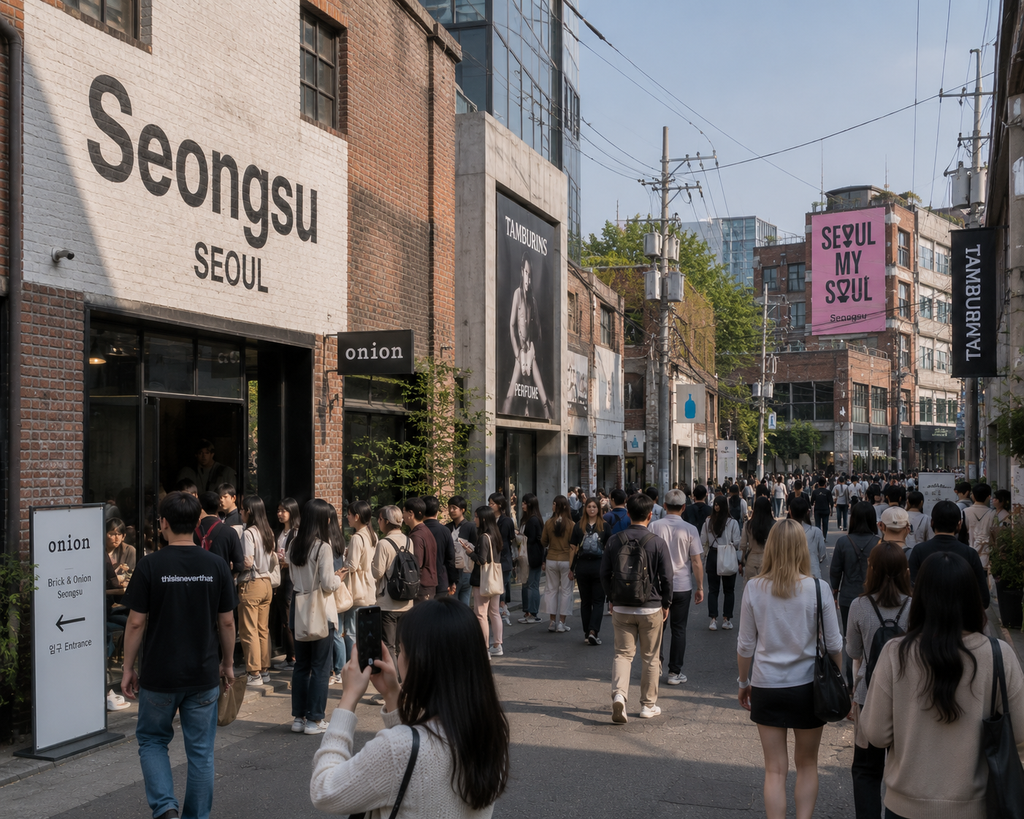
The change is visible in the numbers. Cushman & Wakefield Korea reported that foreign visitors to Seongsu increased by 82 percent in 2025 compared with the previous year. Its analysis also recorded a rise in social-media mentions, from around 134,000 in 2023 to 159,000 in 2025.
Seongsu has moved beyond being a neighborhood that happens to be popular with Seoul residents. It has become part of the city’s international image.
A first-time visitor looking for contemporary Korean fashion, beauty, cafés or design can encounter all of those things within a relatively small area. The experience also fits comfortably with the way many people now travel: save a place online, visit it in person, take photographs, then move on.
The palaces and traditional markets still tell important parts of Seoul’s story. Seongsu tells a newer one.
Pop-Up First, Flagship Later
Perhaps the most revealing change is happening inside the stores themselves.
Brands that once treated Seongsu as a place for temporary experiments are increasingly establishing permanent locations. Cushman & Wakefield describes the district as moving from a “testbed” for pop-ups toward a more established retail hub, with brands using temporary spaces to gauge demand before expanding into flagship stores.
The pattern is visible across fashion and beauty. Musinsa opened a large Seongsu complex in 2026 combining fashion, beauty and content across roughly 6,600 square meters. AMORE Seongsu has spent years offering product testing, personalized beauty services, exhibitions and rotating brand pop-ups.
These places are designed to be visited even when the customer has no immediate intention of buying anything. A flagship can become a meeting point, an exhibition, a photo stop or simply somewhere to browse before moving on.
Retail has taken on some of the qualities that originally made Seongsu’s cafés attractive. People have a reason to stay.
The Storefront Has Become Part of the Product
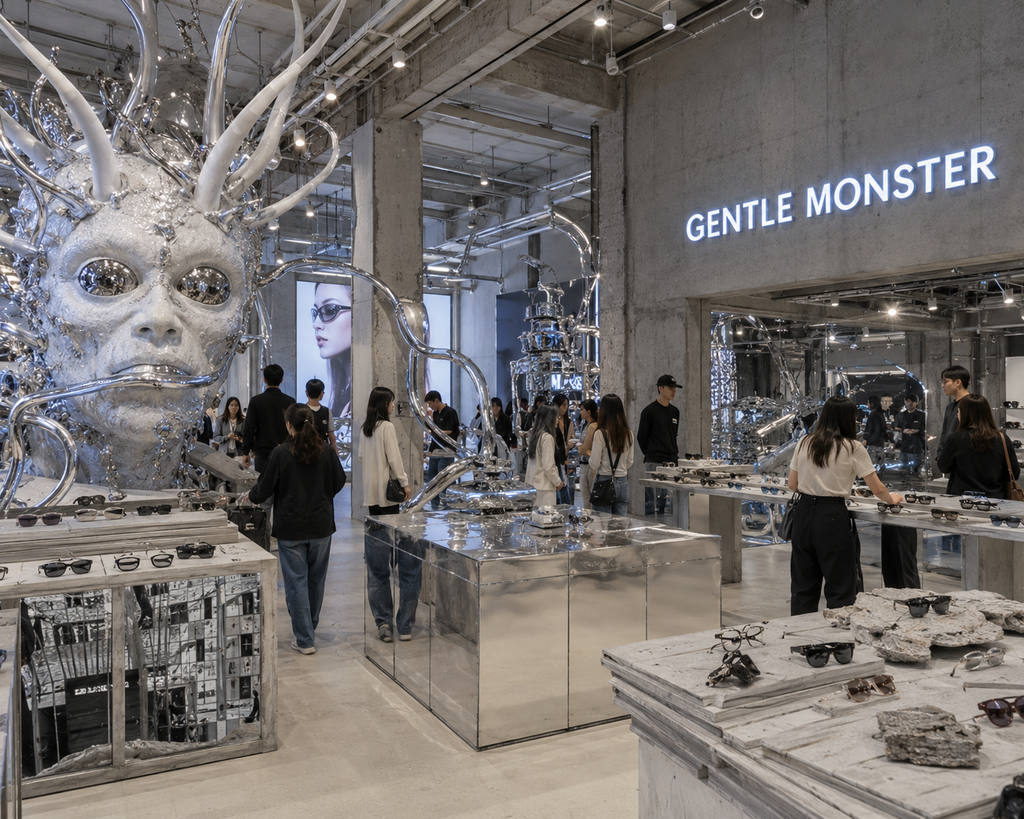
Gentle Monster offers an especially clear example. Its Seongsu flagship combines eyewear with large-scale installations and a deliberately theatrical interior. Seoul’s tourism guide lists it among the neighborhood’s major destinations, describing a space where retail, art and design overlap.
A visitor might walk in intending to look at sunglasses and spend most of the visit looking at the building instead. It sounds like a small distinction, but it reflects a much larger shift in Korean retail: the physical space can carry as much of a brand’s identity as the product sitting on the shelf.
Beauty brands are doing something similar. The recently opened Medicube Seongsu, for example, combines product displays with testing stations, photo experiences and other interactive elements.
Once enough businesses begin working this way, the neighborhood starts to feel less like a collection of shops and more like a collection of experiences. For brands trying to attract younger consumers and international visitors, that makes Seongsu an unusually useful environment.
The Success Has Made Seongsu More Expensive
Becoming desirable has a price.
Rents have risen, putting pressure on smaller businesses and older commercial uses. The extraordinary sums being paid for temporary spaces show how fierce the competition has become for the best locations, with Seoul Economic Daily reporting that major pop-up properties were already being booked months ahead despite daily rents reaching tens of millions of won.
That creates an uncomfortable question for a neighborhood whose appeal partly came from its industrial spaces and independent businesses. As the area becomes more valuable, the businesses that made it interesting may find it harder to afford.
The tension is familiar in cities around the world. Seongsu has simply reached that point remarkably quickly.
The same rough buildings that once offered an alternative to Seoul’s more expensive commercial districts have become some of the most sought-after spaces in the city. The neighborhood’s history became an asset. So did its image.
Both now carry a price.
What You See in Seongsu Keeps Moving
Perhaps the easiest way to understand the neighborhood is to watch what happens between destinations.
Someone leaves a pop-up and turns into a side street. Someone else photographs a café entrance. A delivery scooter passes an old workshop while a couple stops to check a map. A new sign has appeared where another one was photographed only a few months earlier.
No single building has to be remarkable. The accumulation does the work.
One place brings people into the neighborhood. Another gives them somewhere to sit. A third sells something they saw online. A temporary exhibition gives them a reason to come back the following month. The street between all of them becomes part of the experience without ever having been designed as one.
Seoul’s latest tourism coverage describes this continual change as one of Seongsu’s defining qualities: visitors return because a new concept store, pop-up or creative space may have appeared since their last visit.
That makes the neighborhood unusually difficult to finish.
There is always another corner.
Why Has Seongsu Become Seoul’s New Hotspot?
The answer is scattered across the neighborhood.
The factories left behind large, distinctive spaces. The decline of manufacturing made some of them available to new businesses. Cafés and independent shops gave people a reason to linger, while Yeonmujang-gil gradually became a dense cluster of places worth walking between.
Then the pop-ups arrived. They brought larger brands, shorter deadlines and a steady supply of new things to see. Social media carried those experiences beyond Seoul, and international visitors began adding Seongsu to trips that might once have focused almost entirely on the city’s traditional tourist districts.
The strongest brands eventually opened permanent stores, giving the neighborhood an even larger commercial presence.
None of that erased the old Seongsu. The factories and workshops are still visible, as are the narrow streets and industrial buildings that give the area its particular character.
What changed was the reason people walk through them.
A neighborhood once associated with manufacturing now attracts people who want to see fashion, beauty, food, design and whatever happens to be new that week. That is why Seongsu feels different from a conventional shopping district.
You can visit the same street twice and have two completely different afternoons.
In a city as fast-moving as Seoul, that may be the strongest reason to come back.